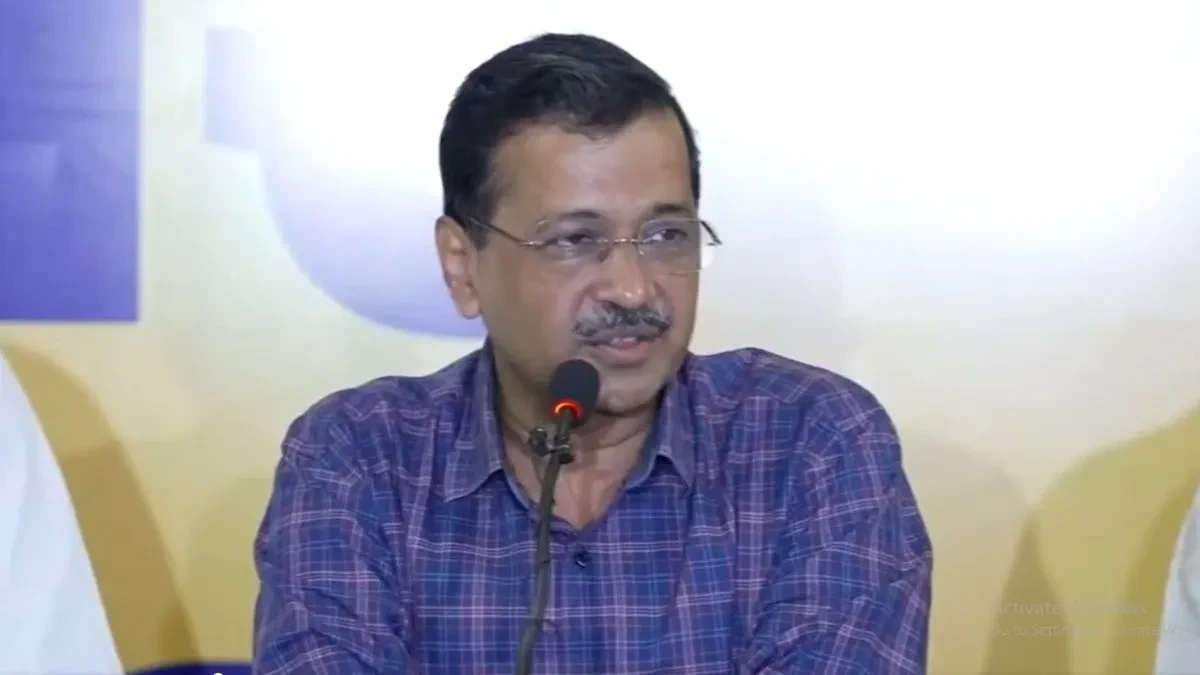
Arvind Kejriwal alleged that the Gujarat BJP government stopped a planned visit to farmers jailed in Rajkot, calling the move an example of authoritarian rule.
During a three-day tour of Gujarat, the Aam Aadmi Party leader claimed the administration feared any voice of dissent, and repeated that AAP aims to form a government in the state after two years and cancel all cases against farmers.
At a press conference held at the party office in Rajkot, Arvind Kejriwal said the incident showed how the state was being run. Kejriwal stated that a request had been filed to meet the farmers, yet permission was denied on 10 December. Kejriwal described the government as cruel and oppressive, and said the refusal proved that criticism was being suppressed.
Arvind Kejriwal Gujarat BJP farmers protest crackdown
Arvind Kejriwal explained that on Tuesday, at 11 am, the plan was to visit farmer leaders lodged in Rajkot jail, but officials did not allow entry. Kejriwal asked whether the government viewed Kejriwal as a terrorist or criminal. Kejriwal added that the people inside were farmers and citizens, not offenders, and questioned why such strict restrictions were used against them.
According to Arvind Kejriwal, the dispute goes back two months, when farmers assembled in Hadad against the karza pratha system while demanding rights peacefully. Kejriwal said police used lathis and tear gas shells on the gathering, then entered houses, detained unarmed family members and arrested 88 farmers. Kejriwal accused the authorities of filing false cases and keeping many of them in jail for around two months.
Arvind Kejriwal claimed that bail had been granted to 42 of those arrested, while the rest remained in custody. Kejriwal alleged that on bail hearing days, police often did not appear in court, which delayed proceedings. Kejriwal argued this pattern showed the BJP and the police wanted to mentally break the jailed farmers and weaken their resolve, instead of resolving issues through dialogue.
Arvind Kejriwal Gujarat BJP farmers crisis
Kejriwal said Gujarat is primarily an agricultural state, where around half the population depends on farming and many families feel neglected. Kejriwal pointed to shortages of seeds and long queues for fertiliser, along with low crop prices. Kejriwal added that some traders exploit farmers by fixing a price of 1500 rupees but paying only 1200 rupees for produce.
| Aspect | Detail |
|---|---|
| State profile | Agriculture-driven economy |
| Population in farming | About 50 percent |
| Farmer families | Nearly 54 lakh |
| Common issues | Seed shortage, fertiliser queues, low crop prices |
Arvind Kejriwal said nearly 54 lakh farmer families rely on agriculture in Gujarat, yet many are “बहुत दुखी” due to policy and market problems. Kejriwal linked the police action in Hadad to this wider distress, arguing that instead of listening to grievances about karza pratha, the administration answered with force, charges and long periods in custody.
Arvind Kejriwal Gujarat BJP youth jobs drugs
Arvind Kejriwal added that the crisis extended to farmers’ children, who often study using loans taken on interest. Kejriwal said youths appear for competitive exams hoping for jobs, but question papers keep getting leaked. Kejriwal said many aspirants, who spend thousands of rupees every month on preparation, were seen crying after another paper leak shattered their plans.
Kejriwal alleged that people linked to the BJP were behind the exam paper leaks, which left educated youths unemployed and anxious about when the next test would be held. Kejriwal argued that the government was failing to provide jobs to the young, and that repeated leaks deepened frustration among candidates from both rural and urban backgrounds.
Arvind Kejriwal further claimed that drugs were being sold across Gujarat, including in small neighbourhood lanes, while the BJP government looked away. Kejriwal said that unemployed youths were being pushed towards addiction, and alleged that this helped keep them silent about joblessness. According to Kejriwal, this pattern was ruining families and damaging the social fabric of the state.
Arvind Kejriwal Gujarat BJP AAP alternative
Kejriwal argued that BJP rule over nearly 30 years had left Gujarat with serious problems, mentioning drugs and pothole-filled roads as visible issues. Kejriwal said both drugs and roads with craters “are being sold openly” in the state. Kejriwal claimed that the last days of the BJP government in Gujarat had begun, as more residents were now coming together against it.
Arvind Kejriwal highlighted that in Hadad, when farmers were jailed, people from their villages collectively ploughed the farms and sowed crops on their behalf. Kejriwal said this solidarity showed how strongly villagers supported those arrested. Kejriwal suggested the BJP misread rural sentiment, because community support for jailed farmers only grew with each passing week.
Kejriwal claimed that, until recently, voters in Gujarat had no real alternative since BJP and Congress were “are back door partners” and running “joint ventures”. Kejriwal alleged that Congress did not actually want the BJP government removed from Gujarat. Kejriwal said that now the Aam Aadmi Party had emerged as the “the most prominant alternative” for people seeking change.
Arvind Kejriwal said that names like Gopal Italia, Isudan Gadhvi, Raju Karpada, Pravin Ram, Chaitar Vasava and Manoj Sorathiya were being discussed in homes across Gujarat. Kejriwal stated that many citizens were looking towards these AAP leaders with hope. Kejriwal contrasted this with BJP and Congress, claiming neither party had a single leader who inspired similar confidence.
Arvind Kejriwal Gujarat BJP elections promise
Kejriwal argued that people no longer expected solutions from either BJP or Congress, and that “today only Aam Aadmi Party is the hope for people.” Kejriwal appealed to citizens to take responsibility for saving Gujarat, saying that AAP leaders considered themselves small compared to the power of the people. Kejriwal stressed that the main responsibility lay with residents, not politicians alone.
Arvind Kejriwal urged voters to remove fear of the BJP from their minds, and to not be intimidated by threats of FIRs. Kejriwal said the party in power was playing an “FIR-FIR” to scare opponents. Kejriwal reminded people that Kejriwal had already been to jail, and suggested that others might also face imprisonment for speaking against the BJP.
Kejriwal pledged that if critics of the BJP were jailed, the Aam Aadmi Party would fight their legal battles. Kejriwal said elections in Gujarat were two years away, and repeated the promise that once an AAP government was formed, all “false FIR” would be cancelled within 24 hours. Kejriwal added that ministers who had harassed citizens would themselves be sent to jail.
Arvind Kejriwal also recalled how permission to visit Rajkot jail was denied. Kejriwal said an application to meet the farmers and leaders in jail had been submitted on Monday. On Tuesday morning, Kejriwal received a message informing that the visit would not be allowed. Kejriwal described this as further proof of a government unwilling to face questions.
Kejriwal compared the present situation with the freedom struggle, saying that when the British arrested Sardar Bhagat Singh, even then, Bhagat Singh’s colleagues were allowed to meet in jail. Kejriwal said, unlike the current administration, the British did not block meetings with Bhagat Singh. Kejriwal asked whether freedom fighters fought only to see a government “which is more cruel and tyrant than Britishers”.
Arvind Kejriwal said that stories from families of jailed and bailed-out farmers showed the scale of alleged mistreatment. Kejriwal claimed that children of farmers who came out on bail described how, for 24 hours after arrest, they were given neither drinking water nor food, and were beaten by police. Kejriwal asked if this was an attempt by the BJP to break their morale and warned that “i advice BJP people to be scared of god.”
Kejriwal alleged that the BJP had tried hard to stop farmers from meeting Kejriwal, yet the farmers still came. Kejriwal said this demonstrated that Gujarat’s public was now standing up against the ruling party, despite pressure. Kejriwal again drew a parallel with “Ravan and Kans”, saying both were consumed by arrogance, and similar pride was now visible in the BJP government, which wanted to crush every critical voice.
Across these allegations, Arvind Kejriwal presented Gujarat as a state where farmers faced police action, youths struggled with paper leaks and drugs, and voters were searching for an alternative to three decades of BJP rule. Kejriwal argued that people were uniting behind the Aam Aadmi Party, and that a change of government after the next election would also bring withdrawal of cases against farmers and action against officials accused of harassing citizens.