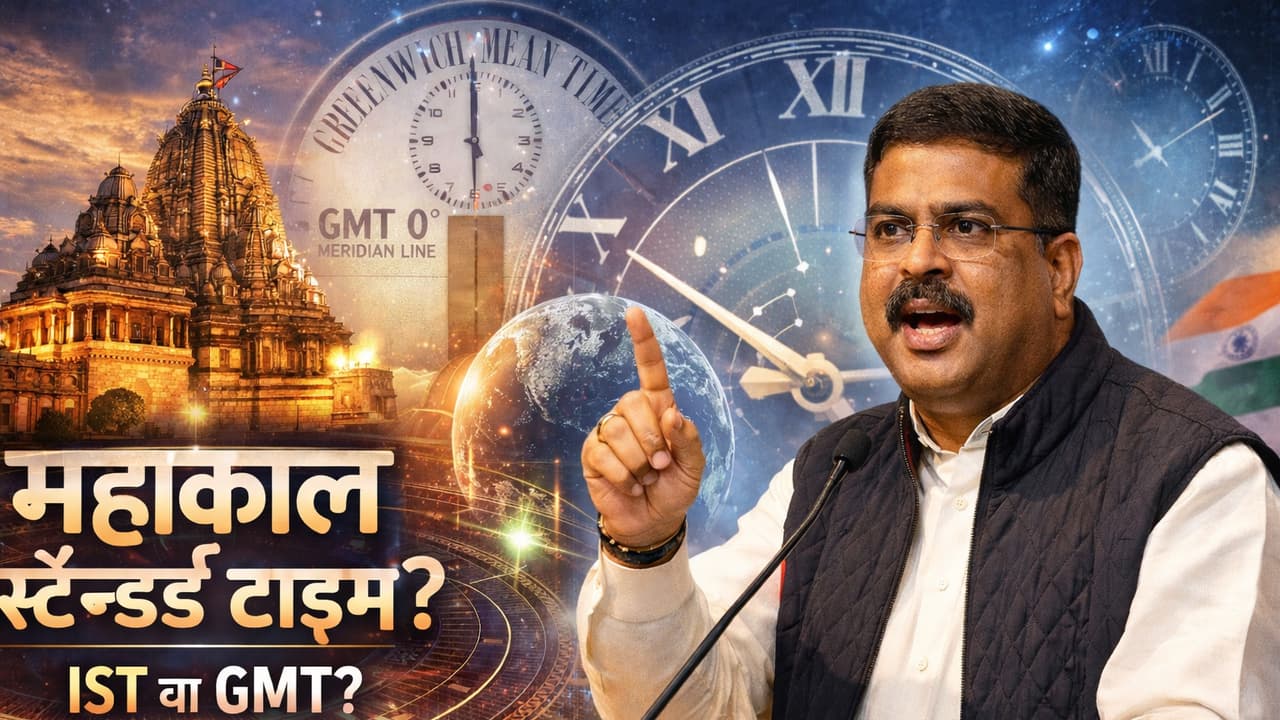
Breaking Insight: Is India now going to challenge IST and GMT? The proposal of ‘Mahakal Standard Time’ has raised a big question – will Ujjain again become the time center of the world? After Dharmendra Pradhan’s statement, in which direction will this debate between science, history and tradition go?
IST vs GMT Controversy: A new and interesting controversy has emerged regarding time system in India. Union Education Minister Dharmendra Pradhan has put forward an idea which has created a stir from social media to the scientific community. He raised the question: Should we consider “Mahakal Standard Time” instead of the existing Indian Standard Time (IST)?
Can India’s time system really change?
Speaking at an international conference held in Ujjain, the minister said that the name and method of calculating time can be reconsidered. He appealed to scientists and thinkers that this should be discussed openly. This was not just a religious or cultural idea, but a proposal for reconsideration on scientific grounds.
What is ‘Mahakal Standard Time’ after all?
“Mahakala” refers to a form of Lord Shiva, who is considered the lord of time. The Mahakaleshwar Temple in Ujjain has historically been associated with time and astronomy. Some historians claim that in ancient India, Ujjain was considered the “Prime Meridian”, i.e. the center of time calculation.
Scroll to load tweet…
What is the role of GMT and IST today?
Today, time around the world is calculated on the basis of Greenwich Mean Time (GMT). IST (Indian Standard Time) in India is determined by this. GMT is associated with the city of Greenwich in England and has become the international standard. In such a situation, the proposal of “Mahakal Time” is like challenging this established system.
Why did Ujjain become the center of this discussion?
Ujjain is considered an ancient scientific and cultural hub of India. The minister called it a “living laboratory”, where science, astronomy, culture and spirituality meet. Cities like Kashi, Kanchi and Ujjain have been not only religious but also centers of knowledge and science.
Is it just tradition or is there science also involved?
Dharmendra Pradhan clearly said that any change should not be based only on tradition but on scientific evidence. That is, if the matter of “Mahakal Standard Time” moves forward, it will have to meet scientific research, astronomical calculations and international standards. Pradhan said that scientists and thinkers should discuss whether the calculation of time can be seen in a new way. He made it clear that any decision will be taken only on the basis of scientific evidence.
Why are people divided on social media?
After this statement, mixed reactions were seen on the internet. Some people supported it by linking it to India’s cultural identity, while some called it impractical. Many users said that the basic problems of the country should be addressed first, while some also talked about making Ujjain the center of IST.
Will India’s times really change?
At present no such official proposal or policy has come. This is just part of an “ideological and scientific discussion”. But this question has definitely arisen – can India create its own time standard in future? The idea of “Mahakal Standard Time” is not just a statement, but the beginning of a new debate between India’s ancient scientific heritage and modern thinking. Now it remains to be seen whether this discussion remains limited to just ideas or any concrete steps are also taken in future.