Bangladesh reels after student leader Sharif Osman Hadi is killed. Protests turn violent, UN demands a probe, India angle emerges and interim govt urges calm ahead of crucial elections.
Tight security cordons, grieving supporters lining highways, burnt offices, smashed windows and a nation struggling to hold its breath — Bangladesh is once again at a crossroads after the killing of one of the most recognisable faces of last year’s July Uprising. Sharif Osman Hadi, a student protest leader turned political candidate, succumbed to gunshot wounds in a Singapore hospital on Thursday, days after masked assailants shot him in the head in central Dhaka. His death has unleashed a wave of mourning — and violence — prompting warnings from the United Nations and urgent appeals for restraint from the country’s interim government.
A Leader Silenced Mid-Campaign
Hadi was shot last week in Dhaka’s Bijoynagar area as he began his election campaign ahead of Bangladesh’s February 12 parliamentary polls. Masked gunmen opened fire, critically injuring him. He was airlifted to Singapore for specialised treatment, where he fought for his life for six days before succumbing to his injuries.
Hadi was a spokesperson for Inqilab Mancha, a key platform that emerged from the student-led protests which toppled the Sheikh Hasina-led Awami League government last year. For many young Bangladeshis, he symbolised the hope that the July Uprising could translate into political change through ballots, not bullets.
That hope was abruptly cut short.
UN Sounds Alarm, Demands Accountability
From Geneva, the United Nations High Commissioner for Human Rights, Volker Turk, issued a sharply worded statement expressing alarm over the killing.
“I urge the authorities to conduct a prompt, impartial, thorough and transparent investigation into the attack that led to Hadi’s death, and to ensure due process and accountability for those responsible,” Turk said.
With protests swelling across Bangladesh for a second consecutive day, the UN rights chief warned against further escalation.
“Retaliation and revenge will only deepen divisions and undermine the rights of all,” he cautioned.
Turk also underlined the political stakes, with national elections weeks away.
“It is vital to ensure an environment where all individuals can participate safely and peacefully in public life and freely express different views,” he said, urging authorities to uphold freedom of expression, peaceful assembly and the security of journalists.
A Nation Erupts After Yunus’ Address
The unrest intensified late Thursday night after Chief Adviser Muhammad Yunus confirmed Hadi’s death in a televised address.
Within hours, protests spiralled into violence across multiple cities.
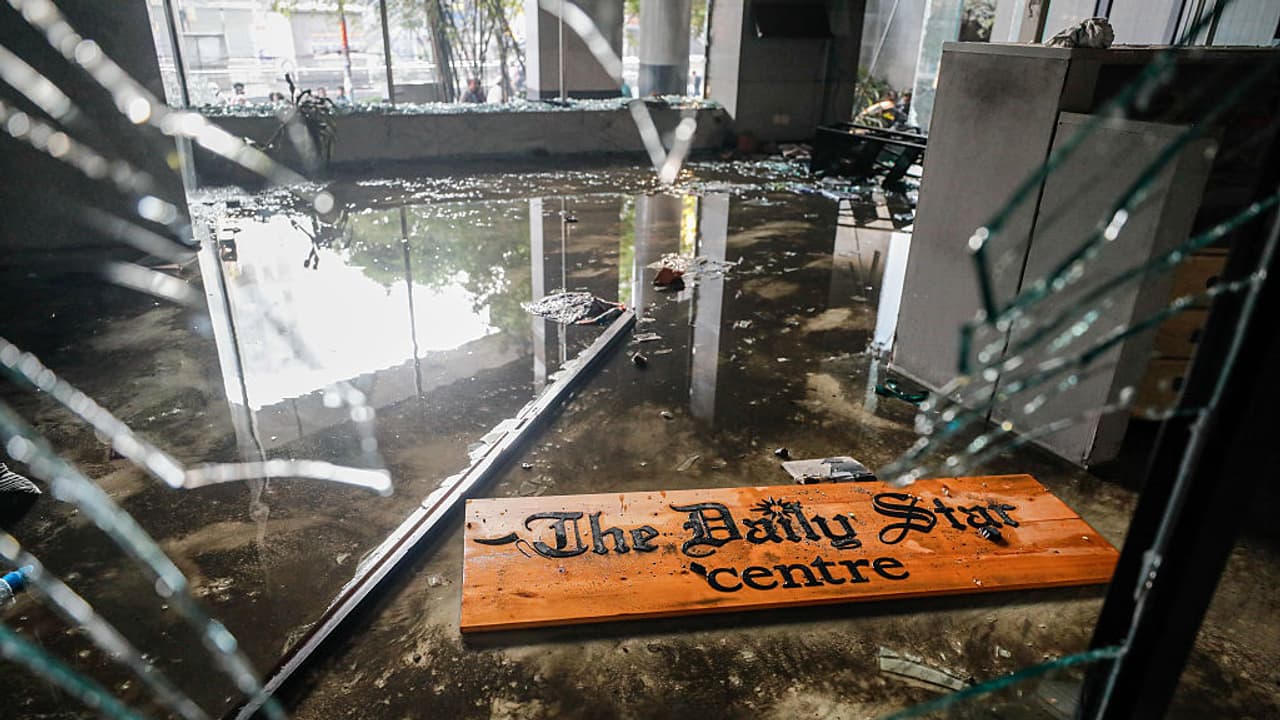
Offices of leading newspapers were vandalised in Dhaka’s Karwan Bazar area. Protesters attacked the offices of Prothom Alo and The Daily Star, damaging several floors while journalists and staff were reportedly trapped inside. A fire was also lit outside the building.
In the capital, demonstrators ransacked the office of cultural organisation Chhayanaut, dragging furniture outside and setting it ablaze. Elsewhere, protesters demolished an office of the disbanded Awami League in Rajshahi and vandalised the historic 32 Dhanmandi residence — a site deeply tied to Bangladesh’s pre-independence political history.
In Chattogram, bricks and stones were hurled at the residence of the Assistant Indian High Commissioner shortly after midnight. Though no damage was reported, police responded with tear gas and baton charges, detaining at least 12 protesters.
Senior officials later assured the Indian diplomat of enhanced security.
Mourning Turns Into Fury
As violence spread, anger increasingly took on a geopolitical edge.
On the Dhaka University campus, supporters of the National Citizen Party (NCP) — an offshoot of Students Against Discrimination — alleged that Hadi’s assailants had fled to India.
Chanting slogans, protesters demanded the closure of the Indian High Commission.
“The interim government, until India returns assassins of Hadi Bhai, the Indian High Commission to Bangladesh will remain closed. Now or Never. We are in a war!” said Sarjis Alm, a key NCP leader.
Authorities have not substantiated claims that the attackers fled the country.
A Grief-Stricken Return Home
Hadi’s body arrived at Hazrat Shahjalal International Airport in Dhaka at around 6 pm on Friday aboard a Biman Bangladesh Airlines flight from Singapore. Army personnel, Armed Forces Battalion members and police were deployed in large numbers as mourners gathered along the route from the airport to Shahbagh.
State-run agency BSS described scenes of widespread public mourning as Hadi’s coffin was transported to the Dhaka University Central Mosque.
Chief Adviser Yunus declared a one-day state mourning on Saturday. According to his press wing, Hadi’s funeral prayer will be held at 2 pm at the South Plaza of Parliament, with attendees requested not to carry bags or heavy items.
In a statement, Inqilab Mancha said Hadi would be buried beside national poet Kazi Nazrul Islam, in accordance with his family’s wishes.
There will be no public viewing of the body.
Government Appeals for Calm Amid Dark Undercurrents
The interim government appealed for restraint, blaming “a few fringe elements” for the violence.
“There is no space for such violence in the new Bangladesh,” it said, vowing that perpetrators would not be spared.
Yunus, addressing the nation, promised swift justice.
“No leniency will be shown,” he said. “I sincerely call upon all citizens — keep your patience and restraint.”
He added:
“No one can stop the democratic progress of this country through threat, terrorist activities or bloodshed.”
A Deeper Fear Beneath the Flames
Amid the chaos, another tragedy unfolded. In Mymensingh, a 25-year-old Hindu factory worker, Dipu Chandra Das, was lynched and his body set on fire over alleged blasphemy — a grim reminder of how quickly unrest can spiral into communal violence.
Political parties, including Khaleda Zia’s BNP, condemned the vandalism and warned that the interim government would be held accountable for maintaining order.