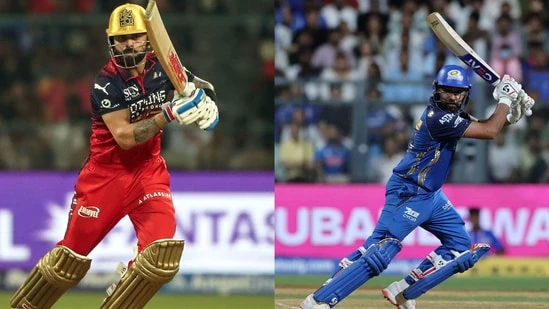
Mumbai Indians and Royal Challengers Bengaluru both began IPL 2026 with successful chases, but the two defining top-order knocks were built for different problems.
Virat Kohli’s 69 not out off 38 balls came in a chase of 202 that RCB ended with startling comfort. Rohit Sharma’s 78 off 38 came in a chase of 221 that Mumbai had to make feel normal before it could start feeling manageable.
That is why the same-ball comparison is so useful here. Both men used exactly 38 deliveries. But one innings was about constructing certainty at the top of the chase, while the other was about destroying scoreboard pressure before it could settle in. The numbers show that clearly.
Same 38 balls, different scoring logic
The first obvious difference is output.
Virat made 69 off 38 at a strike rate of 181.58. Rohit made 78 off 38 at 205.26. Rohit got nine more runs from the same ball count, and he did it mainly through superior boundary extraction.
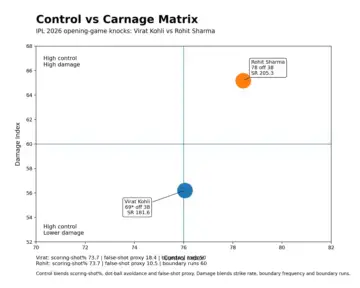
Virat’s boundary count was 5 fours and 5 sixes, giving him 50 boundary runs. Rohit hit 6 fours and 6 sixes, which meant 60 boundary runs. That is the cleanest separator between the two knocks. Their scoring-shot percentage was identical at roughly 76.3%, and both had 9 dot balls. So Rohit did not outscore Virat by wasting fewer deliveries. He outscored him by making the scoring deliveries heavier.
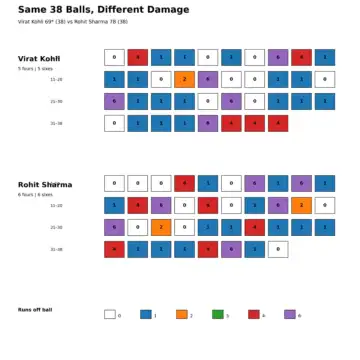 That difference also appears in boundary frequency. Virat found a boundary every 3.8 balls. Rohit found one every 3.17 balls. In T20 chase terms, that is the difference between a batter who is keeping the innings beautifully on line and a batter who is actively bending the game.
How the two chases shaped the innings
Virat opened with Phil Salt in a chase of 202. His innings progression was measured: 18 off the first 10, 30 off the first 20, 48 off the first 30, 69 off 38. That curve matters. It was not an all-out opening blitz. It was a layered innings. He handled the new ball, let the chase settle, kept the asking rate from becoming a talking point, and then finished with force.
His phase split captures that rhythm perfectly: 20 off 12 in the powerplay, 31 off 22 in the middle overs, and 18 off his final 4 balls. That is classic chase architecture. He did early control work and late finishing work in the same innings.
Rohit’s chase situation was more demanding on paper. Mumbai were chasing 221, and that target needed to be reduced quickly. His progression was much more aggressive: 19 off first 10, 43 off first 20, 60 off first 30, 78 off 38. By the 20-ball mark, Rohit had already opened up a huge gap over Virat. That tells you his innings was designed not to manage the chase first, but to distort it.
His phase split is equally revealing: 41 off 19 in the powerplay and 37 off 19 in the middle overs. He did not bat into a late finishing phase, because by the time he fell, the chase had already been shoved into a favourable lane. Virat’s innings made sure the chase never slipped. Rohit’s made sure the chase never looked intimidating.
 Kohli’s knock was tighter in design
Virat Kohli’s innings had more rotation stitched into it. He took 17 singles and 1 two, compared to Rohit’s 14 singles and 2 twos. That is a small but telling difference. Virat’s knock had a little more connective tissue. It moved like a proper chase-builder’s innings, one that kept partnerships healthy and left fewer loose passages in the chase.
Technically, too, it was a very “Virat” innings. He scored heavily off full balls (23 off 9), and good length (24 off 11), and his most productive scoring shot was the drive, which brought him 36 runs. This was not random violence. It was a batter controlling orthodox lengths and keeping the field under pressure through stable access points.
That is why his unbeaten finish matters. Because he opened, absorbed the early overs, and still had enough left to close the chase, the innings ended up carrying both the discipline of an anchor and the punch of a finisher.
Rohit’s knock was more destructive in match impact
Rohit Sharma’s innings was simply louder in what it did to the chase. He scored heavily not just off full balls, but also when KKR dragged back even slightly: 16 off 5 off short-of-length deliveries. He was savage on and around the off stump too, scoring 44 off 17 on an off-stump line and 28 off 13 outside off.
That tells you something important. KKR were not feeding him pads and freebies. Rohit was scoring hard even off bowling lines that are usually meant to keep a batter in check. His shot profile shows the same range. Along with drives and pulls, he added slog-sweeps and harder cross-batted release shots. Virat’s scoring map was cleaner and more classical. Rohit’s was more disruptive.
He also had slightly stronger control markers than you might expect from such an aggressive innings, with 31 balls of good connection compared to Virat’s 29. So this was an in-control attacking innings.
Verdict
If the question is which innings was more efficient from the same 38-ball resource, it was Rohit’s. He got more runs, more boundaries, and more early damage. His knock did more to alter the target’s psychological size.
But if the question is which innings was more complete in construction, Virat’s has a serious case. Opening a 202 chase, pacing it without drift, rotating smartly, then closing it out unbeaten is a different kind of excellence.
So the clean analytical verdict is this:
- Rohit Sharma’s 78 was the more destructive 38-ball knock.
- Virat Kohli’s 69 was the more structurally complete 38-ball knock.
One broke the chase open. The other made the chase feel inevitable.