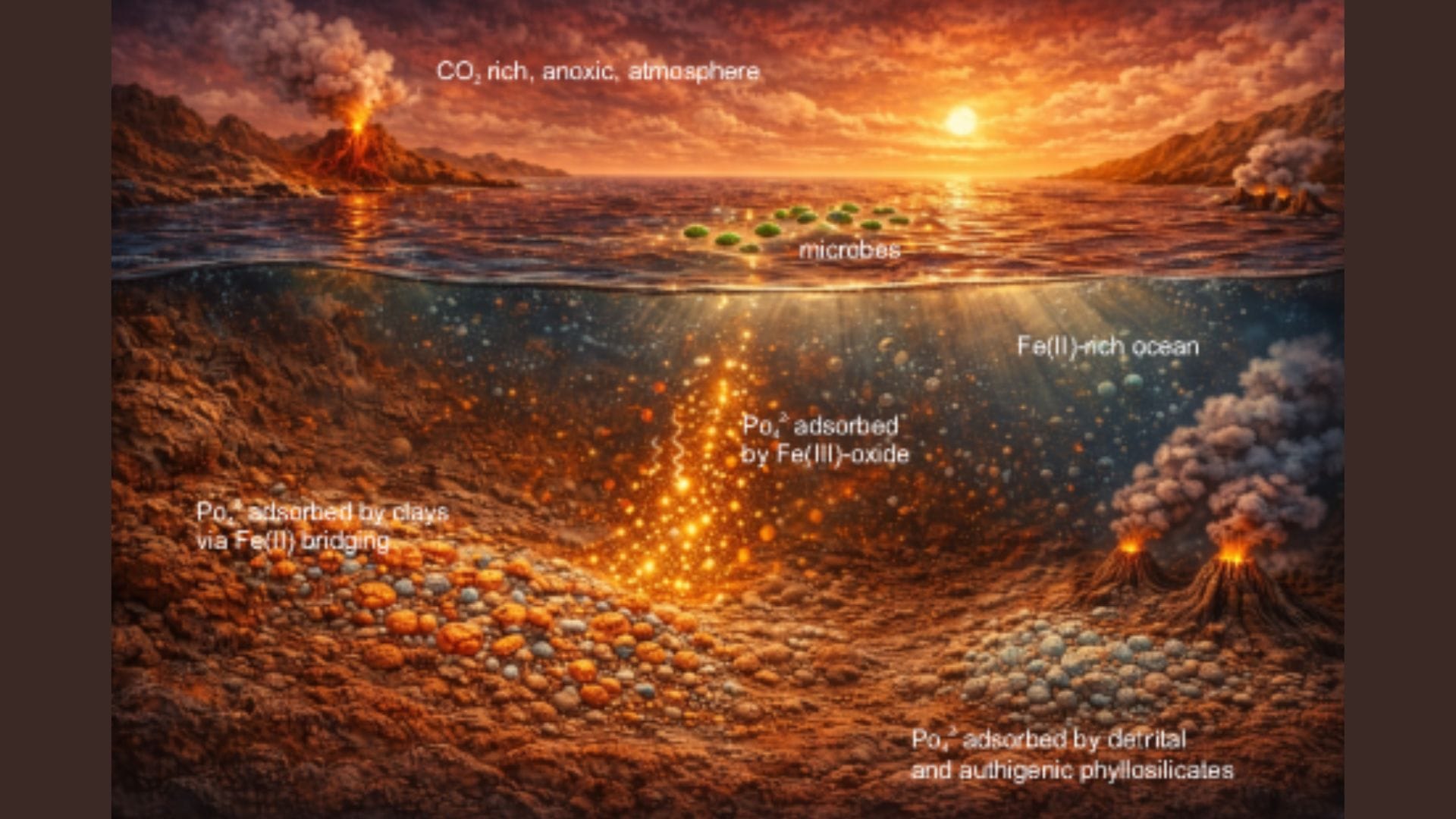
New Delhi: Scientists from China maty have solved a long-standing puzzle in the early history of the Earth. Oxygen-producing photosynthesis evolved hundreds of millions of years before atmospheric oxygen levels rose sharply during what is known as the Great Oxidation Event around 2.4 billion years ago. The delay was likely caused due to the limited availability of phosphorus, a nutrient essential for life, in the ancient oceans of the Earth. The iron-rich or ferruginous oceans of the Archean Eon between 3.2 and 2.5 billion years ago contained common phyllosilicate minerals such as kaolinite, montmorillonite, nontronite and lizardite, that acted as an efficient sink for dissolved phosphate.
These clay minerals trapped phosphate on their surfaces, enhancing phosphate adsorption, even though dissolved silica in the oceans partially competed with the phosphate for binding sites. As the continents emerged and weathering increased during the mid to late Archean, rivers carried large amounts of these detrital clay minerals to the oceans. In iron-rich rivers and coastal areas, the clays adsorbed phosphorous, which was rapidly buried in river sediments, preventing the phosphorus from reaching seawater. Seafloor weathering of the iron and magnesium rich mafic crust also produced phyllosilicates, that also sequestered phosphorus with the assistance of iron.
Phosphorus Sink delayed Oxygenation
Monte Carlo simulations, or repeated random samplings to estimate the probabilities of various outcomes, indicate that phosphorus sequestration driven solely by this phyllosilicate adsorption was comparable to the total reactive phosphorus input from rivers at the time. This made the phyllosilicates a major sink in the early phosphorus cycle, keeping bioavailable phosphorus levels low in the oceans. The resulting nutrient limitation constrained marine productivity, delaying the widespread buildup of oxygen, despite the earlier emergence of photosynthesis. The findings link mineral surface chemistry to biogeochemical cycles and offers insights into nutrient regulation on early Earth, and potentially other planets like Mars. A paper describing the research has been published in Nature Communications.