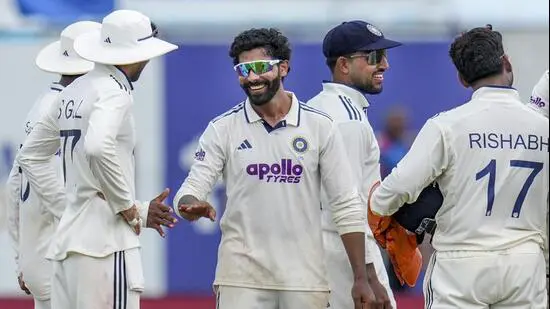
Kolkata: There are milestones that announce themselves with a roar. But Ravindra Jadeja’s 350th Test wicket arrived almost as an afterthought – a rebound off Yashasvi Jaiswal’s knee while taking evasive action to Keshara Nuwantha’s desperate drive, skipper Shubman Gill lapping it up with ease at cover.
Ninety Tests for this milestone to come, fewer than anyone in history, and you wouldn’t have known unless the names were being flashed immediately.
Leading the list is Kapil Dev with 5,248 runs and 434 wickets in 131 Tests, followed by Ian Botham with 5,200 runs and 383 wickets in 102 matches. The most recent is Daniel Vettori, who finished with 4,530 runs and 362 wickets in 113 Tests.
Nearly 38 but supremely fit, it won’t be too much to assume that Jadeja could eventually top this elite allrounders’ list (350 wickets and 4,000 runs). Jadeja now has 351 scalps and 4095 runs.
Jadeja, with 90 Tests, is the outlier – not merely because he has joined the club faster, but because he has done so while playing in an era of relentless international cricket and multiple formats. That is where the real value of Jadeja becomes difficult to measure.
He has been, at different points, India’s second spinner, third spinner, fifth bowler, lower-order aggressor, elite fielder and insurance policy. Jadeja can change the balance of an eleven without demanding that it be built around him. His sheer versatility has sometimes made his greatness look commonplace. It isn’t though.
Sooner than later, the question of succession will inevitably become louder. India have players such as Axar Patel and Manav Suthar who can occupy parts of the same space. Suthar has already made an impact in Galle alongside Jadeja, which itself can be a masterclass for any upcoming bowler. To Suthar, the standout skill to learn from Jadeja is his ability to keep pegging away at one spot.
“There are lot of things (to learn),” said Suthar at the press conference later. “For example, he can bowl on a stump. His consistency is world class. So, I want to learn from him that no matter what a batsman does, how long can you bowl on a stump and induce a false shot.”
Learning is one thing, but replacing Jadeja is not simply a matter of finding another left-arm spinner who can bat. He has to bat like a frontline all-rounder, bowl like a frontline spinner, field like a specialist and survive the demands of modern international cricket. Backing all those skills is the intent to be almost workmanlike, delivering exactly what the captain asks of him, irrespective of the surface or the situation at hand.
More importantly, he must alter the equation of team selection. That is what makes Jadeja’s career so unusual. Kapil was a fast-bowling force who could bat brilliantly. Botham was a volatile, match-changing presence. Vettori was a magnificent left-arm spinner who became a substantial batsman. Jadeja is built differently – a cricketer who has made completeness a skill. That was underscored by how Jadeja dismissed Dinusha.
It was a length delivery, the ball going straight instead of turning, trapping him on the crease. It was a typical Jadeja dismissal. No dramatic turn, no desperate search for the magic ball. Just angle, length, accuracy and the knowledge that, eventually, a batter will make the mistake of playing around the ball. Jadeja has never needed to be the most extravagant spinner in the world. He is relentlessly difficult to escape.
Perhaps that is the best way to understand Jadeja. His greatness has rarely depended on one extraordinary trait. It has come from being very, very good at almost everything.