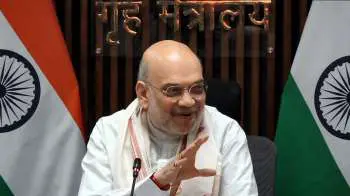
Union Home Minister Amit Shah on Thursday said that the Armed Forces (Special Powers) Act or AFSPA will be removed from the entire Northeast next year, barring one or two states.
While speaking at the signing of a tripartite MoU between the Centre, Assam and Nagaland to facilitate mineral oil operations in the Assam-Nagaland boundary areas, Shah said that shrinking of areas covered under AFSPA is an indicator of peace.
80% of Northeast region already freed from AFSPA: Shah
“I am fully confident that, except for one or two states, we will be able to completely remove AFSPA from the entire Northeast next year. Even today, more than 80 per cent of the Northeast region has already been freed from AFSPA,” he said.
Highlighting that the signing of the MoU was a “historic moment”, Amit Shah said the government has removed the last hurdle in Prime Minister Narendra Modi’s vision of a developed Northeast. The MoU is aimed at undertaking oil and mineral explorations in the disputed area belt (DAB) along the Assam-Nagaland border.
Amit Shah says exploration activities stalled in NE region
Exploration activities remained stalled for more than three decades in the region due to jurisdictional differences. “This will open new avenues for mineral exploration in the Northeast. The area not only has oil and gas but huge mineral deposits, which could not be explored due to law and order issues,” Amit Shah said.
With just one MoU, the extraction capacity of 1,000-1,500 barrels per day can be increased by 10 times, he said. “In one field alone, there are possibilities of recovery of more than Rs 15,000 crore. If we extract the oil deposits spread across Nagaland, we would be able to reduce dependence on foreign countries for our oil needs,” he said.
Shah also said that since Narendra Modi took charge, he kept his focus on the Northeast and became the prime minister with the highest number of visits to the region.
12 accords signed between various groups and state govts since 2019
Since 2019, 12 accords have been signed between various groups and state governments, which resulted in a significant drop of around 80 per cent in incidents of violence in the region, Shah said.
“The development of both Assam and Nagaland remained hampered for a long time because a consensus could not be reached for an MoU. The avenue that opened today will open doors for development for both states. It is the best example of cooperative federalism,” he said.
Last year, the Armed Forces (Special Powers) Act was extended for six months in entire Manipur, except the jurisdiction of 13 police stations, in view of the prevailing law and order situation there.
The AFSPA, under which a particular state or some areas are declared “disturbed”, has also been extended to nine districts in Nagaland and 21 police station areas in five other districts of the state for six months, according to a notification issued by the Union home ministry.
The law was also extended to Tirap, Changlang and Longding districts in Arunachal Pradesh and three police station areas, bordering Assam, in Namsai district in the state. The extension of the disturbed area in the particular areas in the three states will be effective from October 1 for six months. The AFSPA, often criticised as a draconian law, gives armed forces operating in disturbed areas sweeping powers to search, arrest and open fire if they deem it necessary.