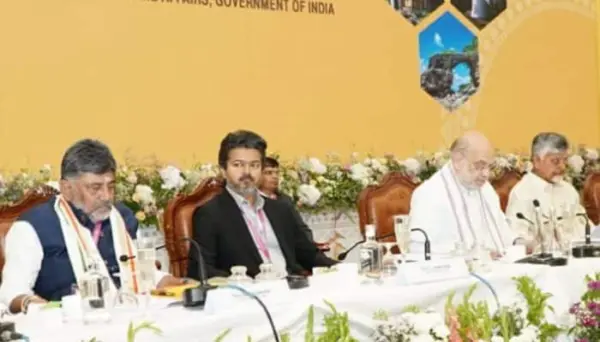
Union Home Minister Amit Shah chaired the 31st Southern Zonal Council meeting on August 20, 2026, at the Taj Fisherman’s Cove hotel in Kovalam, Chengalpattu district, near Chennai.
The Tamil Nadu government hosted the meeting, which brought together senior political and administrative leaders from across southern India. Tamil Nadu Chief Minister C. Joseph Vijay attended the meeting as Vice-Chairman, along with Andhra Pradesh Chief Minister N. Chandrababu Naidu, Karnataka Chief Minister D.K. Shivakumar, Kerala Chief Minister V.D. Satheesan and Telangana Chief Minister A. Revanth Reddy. Leaders and senior officials from the participating Union Territories also took part.
The Southern Zonal Council meeting is designed to discuss issues that affect more than one state or involve the Centre and states. Key areas include water sharing, inter-state disputes, infrastructure, education, law and order and other matters that need coordination between governments.
What is the Southern Zonal Council?
The Southern Zonal Council is a statutory advisory body created under the States Reorganisation Act, 1956. It provides a formal platform where states and the Centre can discuss common problems and work towards solutions.
- Legal basis: The council was established under Sections 15 to 22 of the States Reorganisation Act, 1956.
- Chairman: The Union Home Minister is the Chairman of the Zonal Council.
- Vice-Chairman: The Chief Minister of a member state serves as Vice-Chairman by rotation.
- Member states: Andhra Pradesh, Karnataka, Kerala, Tamil Nadu and Telangana.
- Union Territories: Puducherry, Lakshadweep and the Andaman and Nicobar Islands.
- Standing committee: A committee of Chief Secretaries examines issues raised by states before matters are placed before the Zonal Council.
Why does the Southern Zonal Council meeting matter?
- Inter-state disputes: The council gives states a place to discuss disputes and seek solutions through talks instead of allowing differences to remain unresolved.
- River water sharing: Water sharing is an important regional issue, including disputes involving rivers and projects that cross state boundaries.
- Infrastructure projects: States can raise issues linked to major projects, transport, civil aviation, housing and other areas where coordination is needed.
- Fast Track Special Courts: The council also discusses the implementation of Fast Track Special Courts for the speedy investigation and disposal of rape cases involving women and children.
- Education and public services: Education and other areas of public administration can be discussed when states face common challenges.
- Cooperative federalism: The council supports the idea of working together under Prime Minister Narendra Modi’s ‘TEAM BHARAT’ vision. The Centre describes the councils as a way to strengthen cooperation because strong states build a strong nation.
How does the council work?
The role of the Zonal Council is advisory. States first raise issues before the Standing Committee, where senior officials examine them. Matters that need wider discussion can then be placed before the full council.
This process allows chief ministers, ministers and senior officials to discuss problems involving two or more states or issues between states and the Centre. It can also help governments follow up on decisions taken at earlier meetings.
Why this meeting is important for southern India
The southern states have close economic and social links, but they also share complex issues involving rivers, infrastructure, borders, public safety and development. A regular forum for discussion can help governments coordinate their policies and address issues that cannot be handled by one state alone.
The Amit Shah Chennai visit and the 31st Southern Zonal Council meeting therefore go beyond a single government meeting. The wider purpose is to create a regular channel for dialogue between the Centre and southern states and to find practical solutions through cooperation.