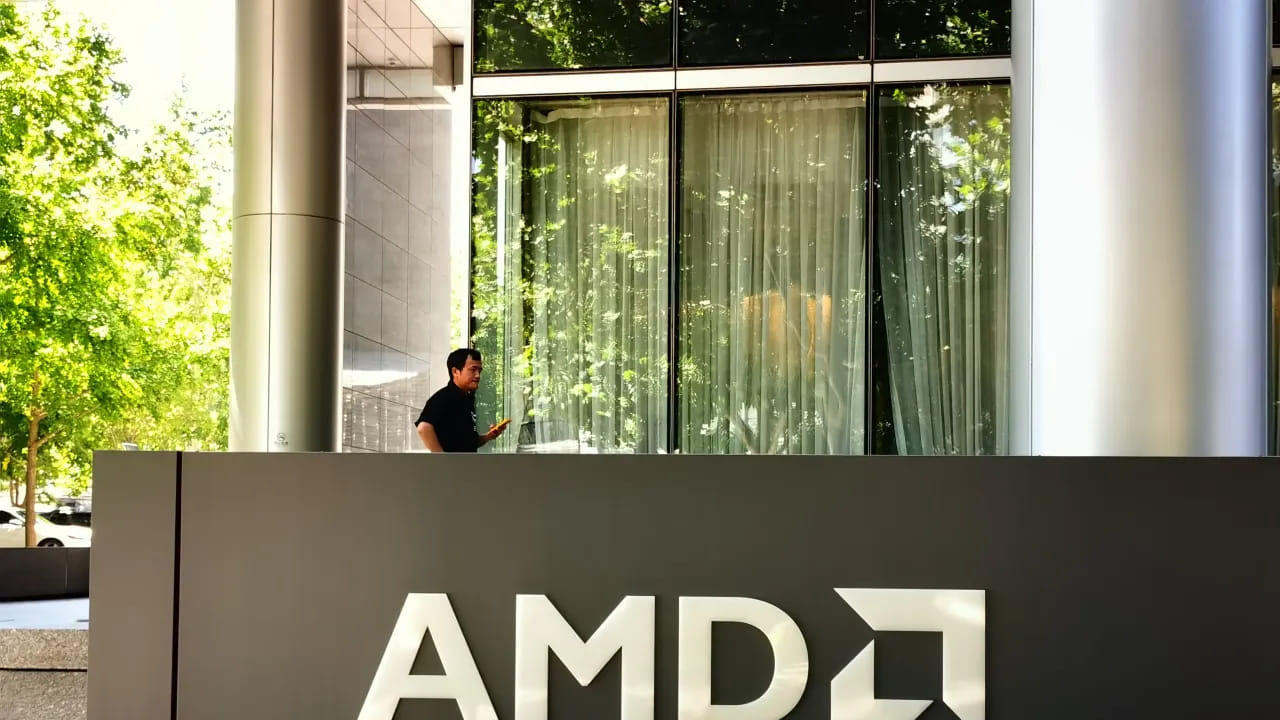
William Blair said Intel’s server roadmap delays and a less disruptive shift to Arm-based processors have also improved AMD’s competitive position.
- William Blair upgraded AMD to ‘Outperform’ without a price target, saying the risk/reward has shifted in the chipmaker’s favor.
- The firm expects AMD’s data-center AI revenue to surpass its server CPU business in Q4.
- BofA raised its AMD price target to $700 from $650, reiterating the chipmaker as its top CPU pick.
Advanced Micro Devices (AMD) was upgraded by William Blair on Thursday, with the brokerage citing an improving risk/reward outlook as its biggest AI chip rival, Nvidia (NVDA), faces leadership uncertainty.
The upgrade comes amid growing uncertainty at Nvidia following reports of CEO Jensen Huang’s alleged extramarital relationships, including one involving a woman suspected of having links to Chinese intelligence. Nvidia’s board is meeting to discuss Huang’s possible removal, raising questions about the chipmaker’s leadership succession.
According to a note cited by TheFly, William Blair upgraded AMD to ‘Outperform’ from ‘Market Perform,’ saying the stock has room to rise as Nvidia faces scrutiny and a leadership vacuum, while AMD’s competitive position improves and its valuation looks attractive.
At the time of writing in premarket trading, AMD stock was up 3% while NVDA stock was down nearly 7%.
Why William Blair Is Turning Bullish
William Blair said all four factors behind its previous rating have shifted in AMD’s favor since it initiated coverage in July.
Intel’s (INTC) Xeon server processor roadmap continues to face delays and supply shortages, while the transition toward Arm-based host processors has proved less disruptive than previously anticipated, Investing.com reported, citing the note.
The firm also noted that AMD’s valuation multiple has declined significantly even as earnings estimates have risen.
Analysts at William Blair expect AMD’s data-center AI revenue to surpass its server central processing unit (CPU) business in the fourth quarter, supported by its Helios AI systems ramping through 2027. It sees the potential for more than 80% revenue growth next year, over twice its longer-term model.
Nvidia’s Leadership Crisis Creates An Opening
AMD and Broadcom (AVGO) gained as investors considered whether Nvidia customers might diversify their chip suppliers.
Floodlines Research founder Anna Wu told Bloomberg, “AMD as a direct competitor, and Alphabet and Broadcom in the TPU space, are natural beneficiaries in the short term.”
Meanwhile, a Barron’s report cited Pepperstone analyst Chris Weston, who said markets appeared to distinguish between Nvidia-specific risks and the broader AI trade, suggesting investors were not treating Huang’s situation as a fundamental threat to AI demand.
BofA raised its AMD price target to $700 from $650, maintaining a ‘Buy’ rating, according to TheFly. The firm reiterated AMD as its top central processing unit (CPU) pick, citing its broad product portfolio, leadership across key segments, Zen 6 execution on 2-nanometer technology and improving supply visibility.
AMD’s Impressive Data Center Growth
AMD’s fiscal third-quarter revenue rose 45% year-over-year to $13.4 billion, while data-center revenue surged 97% to $8.5 billion, driven by strong sales of EPYC processors and Instinct graphics processing units (GPUs).
Management expects fourth-quarter revenue of around $17 billion, implying 66% year-over-year growth at the midpoint.
William Blair nevertheless flagged competition from custom application-specific integrated circuits (ASICs), particularly at Meta Platforms (META) and OpenAI, as a risk to AMD’s Instinct business. However, the firm sees these custom chip programs creating additional opportunities for AMD’s server CPUs, per the Investing.com report.
What Retail Thinks About AMD Stock
On Stocktwits, retail investors’ sentiment around AMD stock remained in the ‘extremely bullish’ territory amid high user message volume.
So far this year, AMD’s share price has more than doubled, surging by over 147%. In comparison, the Invesco NASDAQ 100 ETF (QQQM) and the State Street Technology Select Sector SPDR ETF (XLK), which hold the stock, have risen 12% and 21%, respectively, over the same period.
See Also: AI-Optimized Server Spending To Reach Nearly $957B In 2027, Says Gartner — Global AI Spending To Cross $4T
For updates and corrections, email newsroom[at]stocktwits[dot]com.<