
Andrej Karpathy’s study assessed automation risk using data from the BLS Occupational Outlook Handbook.
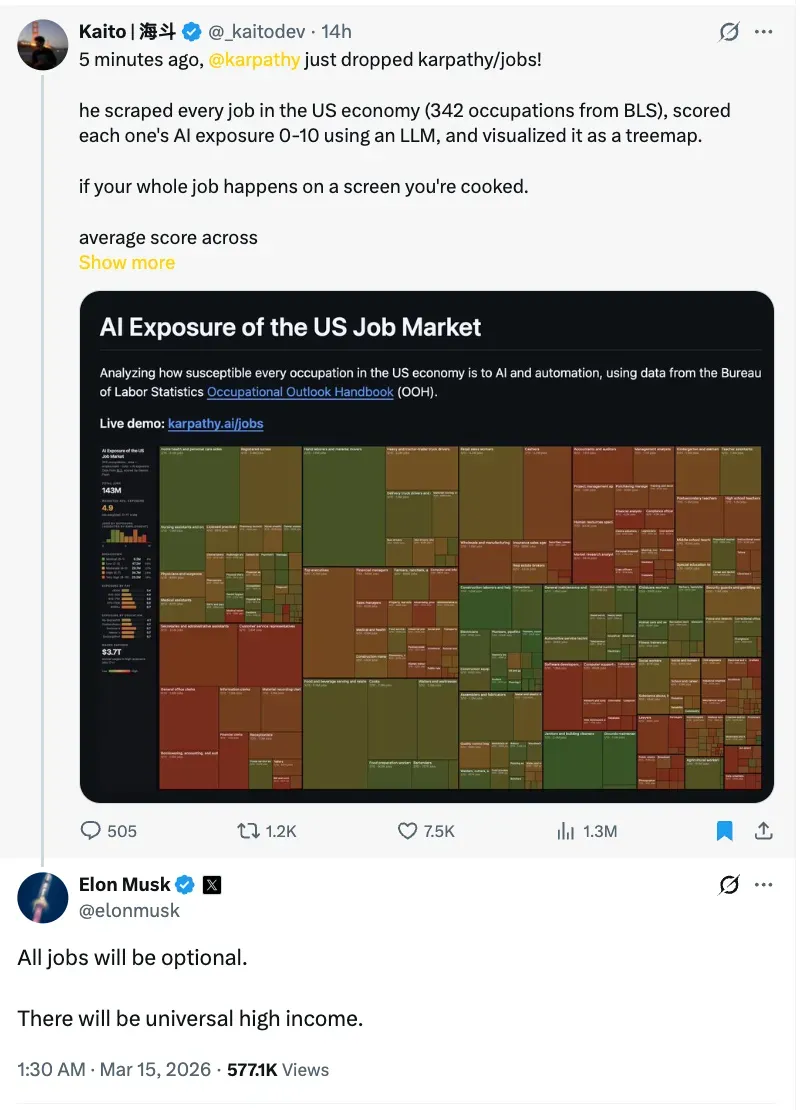
- Elon Musk suggested on X that advances in AI could make all jobs optional, potentially leading to universal high income.
- The commentary was in response to an analysis by Andrej Karpathy, a former AI researcher, examining AI exposure across various jobs in the U.S. economy.
- The average AI exposure score was 5.3, indicating moderate AI exposure across most jobs.
SpaceX marked its 24th anniversary on Sunday as CEO Elon Musk said advances in artificial intelligence could eventually make traditional jobs unnecessary.
Musk wrote on X that “all jobs will be optional,” responding to a viral post about a new analysis developed by Andrej Karpathy, a former AI researcher at Tesla (TSLA) and OpenAI. Musk added that “there will be universal high income,” suggesting that advances in AI could eventually transform how people work and earn. The billionaire has hinted at this vision for years. In December, Musk also wrote, “The future is going to be AMAZING with AI and robots enabling sustainable ABUNDANCE for all!”
Tesla (TSLA) was in the red in the after-hours. On Stocktwits, retail sentiment around TSLA remained in the ‘bullish’ zone, as chatter levels remained ‘high’ over the past day.
AI Could Disrupt Screen-Based Jobs
Karpathy’s tool looks at how likely AI and automation are to take over different jobs in the U.S. economy. His project looked at 342 jobs using data from the U.S. Bureau of Labor Statistics. For each job, it gave an AI exposure score from 0 to 10 based on how easily large language models could do the tasks. A treemap showed the results and how AI could affect the job market as a whole.
The analysis found that the average AI exposure score across jobs was 5.3, which means that people were exposed to AI at a moderate level overall. Some jobs got a lot higher scores, like medical transcriptionists, who got a perfect score of 10 out of 10, while software developers got scores between 8 and 9. According to Karpathy’s model, jobs with high scores are likely to be replaced by AI-driven automation. On the other hand, jobs that require physical labor, such as roofing, received scores between 0 and 1, indicating little exposure.
One user named Rohan Paul, an AI commentator on X, wrote that the analysis showed many screen-based jobs could be most affected, with roles in office administration, legal services, and some programming tasks having the highest exposure scores. Additionally, the visualization calculated that jobs with high AI exposure are associated with annual wages of roughly $3.7 trillion.
Karpathy’s project used occupational data from the Bureau of Labor Statistics’ Occupational Outlook Handbook and large language models to assess automation risk.
Read also: Crypto Reporting Databases Could Expose Bitcoin Holders To Crime, BitGo CEO Warns
For updates and corrections, email newsroom[at]stocktwits[dot]com.<