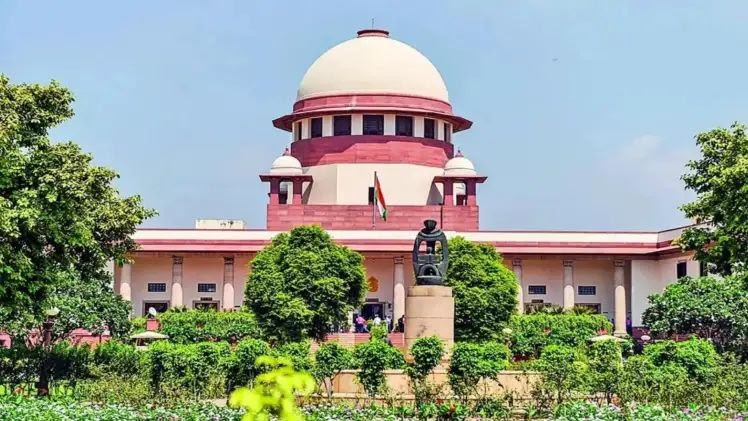
The Supreme Court has given an important decision regarding those taking advantage of reservation. The top court said that if a candidate avails the relaxation of reserved category (eg SC, ST) in the examination, then he cannot claim appointment on unreserved i.e. general seat.
This decision of the Supreme Court came in a case related to the Indian Forest Service (IFS) examination. This matter was related to the Indian Forest Service exam of 2013. There were two stages in this examination. Preliminary examination and main examination, followed by interview.
what was the whole matter
The cut-off for general category in the preliminary exam was 267 marks, while for Scheduled Caste (SC) candidates it was 233 marks. An SC candidate G. Kiran took advantage of the relaxation of 233 points. He scored 247.18 marks and passed the exam. Whereas, a general category candidate Antony S. Mariappa crossed the general cut-off by scoring 270.68 marks.
This is how the case reached the Supreme Court
However, when the final merit list came after the main examination and interview, Kiran was at 19th position and Antony was at 37th position. That is, Kiran’s final rank was better than Antony. However, when it came to allocating cadre (State), only one ‘Insider’ (Home State) seat was vacant for the General Category in Karnataka and there was no ‘Insider’ seat for the SC Category.
What did the High Court say in the decision
In such a situation, the government allotted the General Insider seat to Antony and sent Kiran to Tamil Nadu cadre. Kiran did not like this decision. He filed a petition in the Central Administrative Tribunal (CAT) and then in the Karnataka High Court. Both courts ruled in favor of Kiran. His argument was that Kiran’s final rank was better than Antony’s, hence she should get a general seat.
This is how the Supreme Court overturned the HC decision
However, the Union of India (government) did not agree with this decision and approached the Supreme Court. Supreme Court Justice J.K. The bench of Justice Maheshwari and Justice Vijay Bishnoi overturned the decision of the Karnataka High Court. The Supreme Court said that the IFS examination is an integrated selection process, in which passing the preliminary examination is necessary to appear in the main examination.
SC gave order under these rules
The Supreme Court cited Rule 14(ii) of the IFS Examination Rules. There is one condition in this rule. According to this, only those reserved category candidates can be considered for unreserved seats, who have not taken any relaxation or concession in any phase of the examination. The court clearly said that Mr. Kiran had taken advantage of the relaxation given for SC category in the preliminary examination. In such a situation, even if he has secured a better rank than the general category candidate in the final merit list, he cannot be entitled to an unreserved seat.
‘Once you have taken advantage of the quota…’
Justice Maheshwari wrote in his judgment that once a reserved category candidate avails the relaxation, he cannot be considered for unreserved vacancies. He also said that the relaxation given in the prelims exam cannot be ignored in the later phase. The top court also mentioned an old case (Union of India Vs Sajib Roy) in the decision. In that case also, it was said that if a reserved category candidate takes any relaxation in age, cut-off or any other matter, he cannot go to the unreserved seat unless the rules clearly allow it.