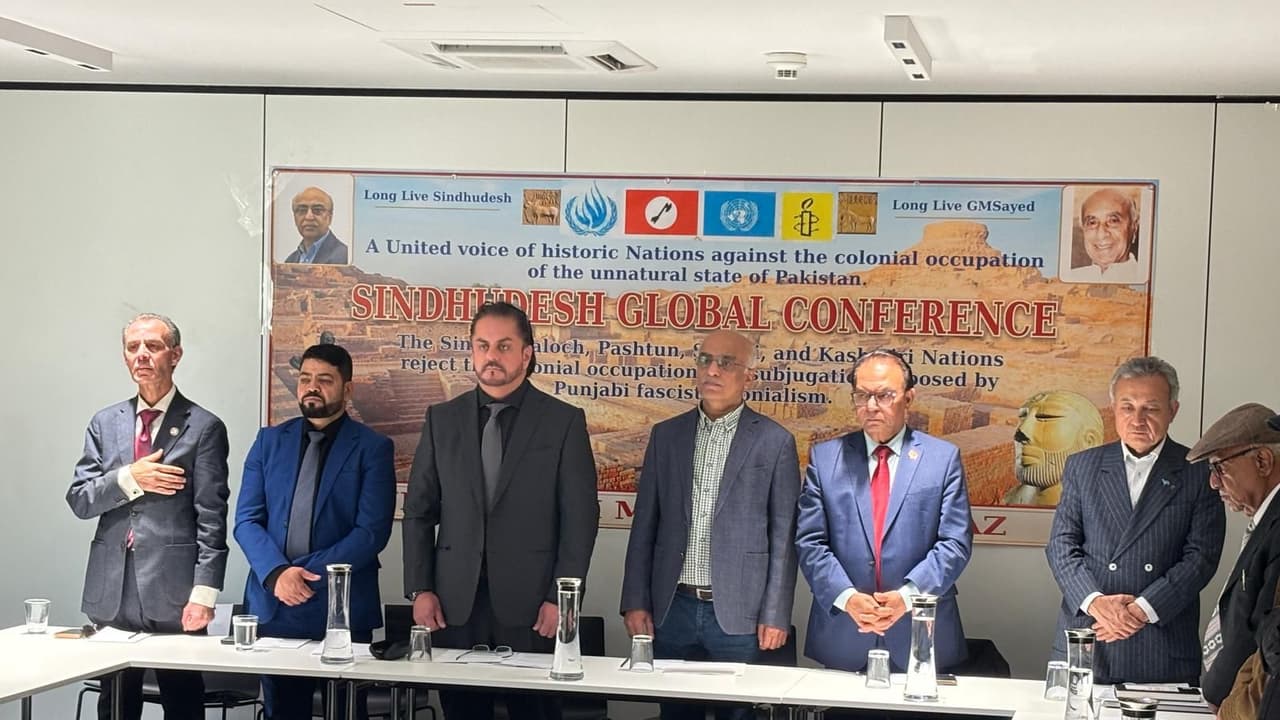
Political leaders and activists gathered in Frankfurt to launch an Anti-Colonial Alliance, demanding self-determination and condemning alleged exploitation and hegemony within Pakistan’s current political structure.
Global Conference Formulates Strategy Against Colonialism in Pakistan
Political leaders, activists and representatives of various national movements gathered in Frankfurt, Germany, for the Sindhudesh Global Conference, where they adopted a strategic framework for a joint international campaign against what they described as Punjabi imperialism and colonial exploitation in Pakistan. Hosted by the Jeay Sindh Muttahida Mahaz (JSMM), the conference brought together representatives of Sindhi, Baloch, Pashtun, Kashmiri, Saraiki and Gilgiti communities, along with international human rights advocates and political leaders.
The gathering aimed to strengthen political and diplomatic cooperation among what the organisers described as historically subjugated nations seeking national liberation and the right to self-determination. One of the key outcomes of the conference was the establishment of an international ‘Anti-Colonial Alliance’, with prominent Baloch national leader Mehran Marri appointed to lead the initiative. The alliance is intended to coordinate diplomatic efforts and bring together the liberation movements of Sindhi, Baloch, Pashtun, Kashmiri and Saraiki communities on an international platform.
Demands for Sovereignty and Self-Determination
Addressing the gathering, JSMM Chairman Shafi Burfat presented a formal demand to international bodies and the United Nations for a UN-monitored national referendum to restore Sindhudesh’s sovereignty, political and economic independence, cultural integrity and territorial identity. Representing what he described as the seven-crore Sindhi nation, Burfat called for international intervention to address what the organisation termed political oppression and economic exploitation.
In his keynote address, Burfat described Pakistan as an unnatural state formed through forced annexation and argued that its political structure functioned as an internal colonial system dominated by Punjabi hegemony. He maintained that the historic nations within Pakistan were not seeking administrative concessions or economic accommodations but complete liberation from what he termed internal colonialism. He also called for a unified, multinational resistance front.
Prominent Baloch national leader Mehran Marri, in his address, emphasised that the political future, territorial integrity and national freedom of Balochistan and Sindhudesh must be determined exclusively through the free and uncoerced consent of their respective populations. Marri questioned the legality of Balochistan’s 1948 annexation, arguing that forced signatures and historical coercion could not establish legitimate consent under international law. He also highlighted the continuing concerns surrounding enforced disappearances, extrajudicial killings and military repression targeting political voices in Balochistan.
Concerns Over Economic Exploitation and Human Rights
Drawing attention to the region’s natural resources, Marri said that the wealth generated from Sui gas, Saindak and Reko Diq had failed to benefit the indigenous population. He also criticised infrastructure and development projects, including the China-Pakistan Economic Corridor (CPEC) and Gwadar Port, alleging that they represented economic exploitation and dispossession carried out without the consent of local communities. Marri further called for coordinated diplomatic efforts between Sindhi and Baloch movements, while outlining his vision of an independent Balochistan based on democratic accountability, equal citizenship, gender equality, minority protection and international human rights standards.
The conference also raised concerns over enforced disappearances and extrajudicial detentions of political activists in Sindh and Balochistan, the diversion of Indus River waters, the alleged expropriation of agricultural land and the control of ports and natural resources. Delegates also condemned what they described as state violence against peaceful Kashmiri political demonstrations and the targeting of young political activists. The gathering raised concerns over military operations in Pashtun regions, the use of landmines in civilian areas and alleged attempts to detain or harm Pashtun political leaders Manzoor Pashteen and Ali Wazir.
International Dimension and Regional Security
The international dimension of the conference was further highlighted by the participation of World Uyghur Congress leader Dolkun Isa, who represented the Uyghur community. In his address, Isa spoke about alleged political oppression, economic marginalisation and cultural repression faced by Uyghurs under Chinese rule. He also expressed his moral and political support for the national liberation movements of Sindhudesh and Balochistan. The conference, in turn, condemned China’s treatment of the Uyghur population.
The gathering also discussed the broader geopolitical situation, arguing that existing international institutions were increasingly unable to address contemporary conflicts and the concerns of historically marginalised communities. Invoking the writings of Frantz Fanon, participants discussed the political, economic and psychological dimensions of colonialism and the role of resistance in challenging systems of domination.
On regional security, the conference accused Pakistan’s military and intelligence establishment of contributing to instability through alleged support for militant groups operating across borders in India and Afghanistan. Delegates also raised concerns over Pakistan’s nuclear capabilities and called upon the international community and the United Nations to ensure the security of its nuclear arsenal.
Future Resolutions and Diplomatic Cooperation
The conference’s concluding resolutions included an appeal to the United Nations and the international community to facilitate a binding referendum on Sindhudesh’s independence. Participants also discussed the possibility of a voluntary, secular and democratic confederation between independent Sindhudesh, Balochistan and Saraiki Wasaib, based on mutual consent and modelled on the European Union.
The conference was attended by several prominent political figures and representatives, including UKPNP Chairman Shaukat Kashmiri, Baloch Voice Association President Munir Mengal, Baloch Peoples Congress General Secretary Waja Siddique Azad, UKPNP Foreign Affairs Representative Jamil Maqsood, Gilgit Workers Party leader Sherbaz Khan, PTM Europe Coordinator Mashreq Wal Khan, PTM Germany representatives Manzoor Khan, Hazrat Ullah Khan and Rasul Karoti, and SOZ Human Rights Representative Hilam Jurani. Senior JSMM representatives, including Vice Chairman Sajjad Shar and General Secretary Shahnawaz Bhutto, were also present alongside political activists and diaspora intellectuals. The conference concluded with participants expressing their commitment to strengthening international diplomatic coordination and advancing their respective demands for national self-determination, sovereignty and international recognition.
(Except for the headline, this story has not been edited by Asianetnews Editorial staff and is published from a syndicated feed.)