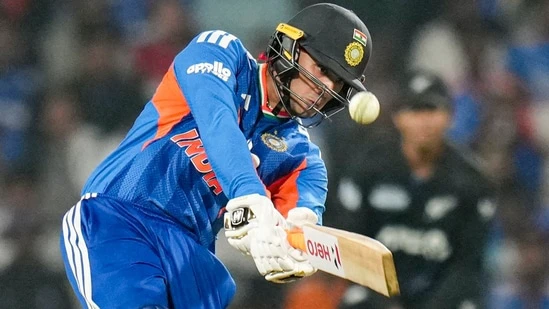
Abhishek Sharma’s 84 off 35 against New Zealand in Nagpur came with the usual headline fuel, but the bigger detail sat in the career ledger.
During the innings, the left-hander became the quickest batter in men’s T20 cricket to reach 5000 runs by balls faced.
He got there in 2898 balls, the fastest on record, ahead of Andre Russell (2942). Tim David (3127), Will Jacks (3196) and Glenn Maxwell (3239) complete the top five on the same metric, underlining how rare it is for a high-volume scorer to keep this kind of pace over multiple seasons.
For T20 analysis, “balls faced to 5000 runs” is a particularly revealing way to frame the achievement because it removes much of the noise created by innings-based milestones. Innings can be distorted by not-outs, batting position, the number of times a player is stranded at the non-striker’s end, and even shortened chases. Balls faced is closer to a pure measure of tempo: how quickly a batter turns opportunities into runs, regardless of role.
Convert Abhishek’s mark into a simple rate and scale becomes clearer. Five thousand runs off 2898 balls equates to a strike rate of roughly 172. That is not just elite for an innings; it’s extreme as a career rhythm. Russell’s 5000 off 2942 comes in around 170, while rest of the top five sit below the 160 line at the same point – evidence of how hard it is to sustain boundary pressure without sacrificing consistency, access to strike, or both.
The timing of the record, arriving in a high-profile international innings, also matters how opponents plan. Abhishek’s damage is typically front-loaded: he looks to win the powerplay rather than simply survive it. That forces captains into defensive fields earlier than they want, changes the risk equations for bowlers, and can pull a side out of its preferred match-ups in the first three to four overs. In practical terms, it means teams often have to choose between protecting boundaries and taking wicket options, because doing both simultaneously is difficult when the batter’s baseline scoring speed is already high.
For India’s T20 framework, the number strengthens a growing selection argument: an opener who scores at a finisher’s tempo compresses the innings for everyone else. If the top order gets ahead early, middle overs can be played with more control, the finishing roles become cleaner, and the side has more freedom to carry bowling depth without feeling under-batted. In a World Cup cycle where margins are often decided by two overs of momentum, an opener who can shift the required rate before it even forms is a structural advantage.
Records don’t guarantee future returns, and T20 form can swing quickly. But this one is less about a hot streak and more about what Abhishek has repeatedly been across: a batter whose first instinct is acceleration, and whose career numbers say it has not been a short-live phase.
If Nagpur was the sage, 2898 balls was the statement – a benchmark that paces Abhishek Sharma at the sharpest edge of modern T20 scoring.