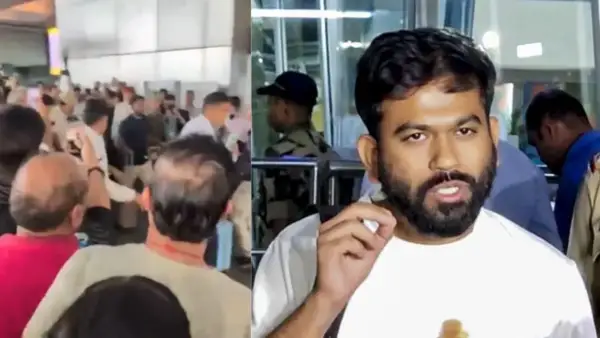
In another latest confrontation, Cockroach Janata Party (CJP) founder Abhijeet Dipke faced public backlash on Wednesday after a man shouted at him while he was leaving Delhi’s Indira Gandhi International Airport.
In a video of the incident, the man can be heard repeatedly asking Dipke, “Why are you ruining the country?” ( Kyu Desh Ko Kharab Kar Raha Hai?)
Dipke, who was surrounded by security personnel, responded by raising his hand and showing a thumbs-up before continuing towards the exit.
The confrontation comes amid growing tensions surrounding the CJP’s protests against Chief Election Commissioner Gyanesh Kumar. The party has demanded Kumar’s resignation over alleged irregularities in electoral rolls, while the Election Commission has maintained that its procedures are lawful.
Abhijeet Dipke Returns To Delhi After Family Bereavement
Dipke came back to Delhi by air from Nagpur, after having been arrested by Delhi Police prior to the CJP’s planned demonstration on October 10.
After his release, Dipke had gone to his native place in Maharashtra’s Chhatrapati Sambhajinagar district after the demise of his grandmother, and it had been alleged that he had spent about 24 hours in custody.
As Dipke came to the IGI Airport on Wednesday, some people could be seen clicking pictures of him. At this moment, one person started yelling at the CJP founder asking him why he was “destroying the country”.
Dipke did not indulge in any prolonged exchange of words with this individual. He pointed towards him and gave a thumbs-up sign as he moved away, surrounded by security guards.
CJP Leaders Faced Opposition On Delhi-Bound Flight
Dipke had faced a similar situation on October 10, when he arrived in Delhi with CJP colleagues Saurav Das and Ashutosh Ranka.
Delhi Police detained the three leaders shortly after their flight from Mumbai landed at IGI Airport. The detention took place ahead of the planned demonstration against Chief Election Commissioner Gyanesh Kumar.
Videos from the flight showed some passengers expressing anger towards the CJP leaders. Some were heard using slogans and words such as “traitor” and “shame on you”.
The leaders’ detention became one of the key developments surrounding the protest, which had drawn a large police deployment and led to the detention of thousands of people in Delhi.
The CJP has argued that its campaign is aimed at demanding accountability over alleged electoral-roll irregularities. The Election Commission has denied wrongdoing.
Dipke Has Faced Other Public Confrontations
The CJP founder has also faced confrontations at other public events. According to reports, a man slapped him during an incident in Jaipur. During an earlier protest at Delhi’s Jantar Mantar over the alleged NEET paper leak, ink was reportedly thrown at his face.
The incidents have kept Dipke in the public spotlight as the CJP’s campaign has expanded from examination-related concerns to electoral issues.
The party initially gained attention through social media and subsequently mobilised supporters for street protests. Its demands now include the resignation of the Chief Election Commissioner.
Dipke Attacks PM Modi Over Detention Of CJP Colleagues
After the detention of Saurav Das and Ashutosh Ranka, Dipke launched a sharp attack on Prime Minister Narendra Modi while speaking to reporters at the airport.
Calling Modi a “cowardly dictator”, Dipke questioned why his colleagues had been sent to jail for five days. He claimed that they were being punished for raising the national flag at Jantar Mantar.
“I want to ask Modi: Is hoisting the Tricolour in this country a crime?” Dipke said, according to the remarks reported from the airport.
He described the action against his colleagues as a sign of authoritarianism and compared the situation with the period when India was under British rule. He also questioned whether Modi deserved to remain Prime Minister.
Dipke’s comments were part of his criticism of the police action against the CJP leaders. The remarks reflect his position on the detentions and should be understood as political allegations rather than established findings about the reasons for the legal action.