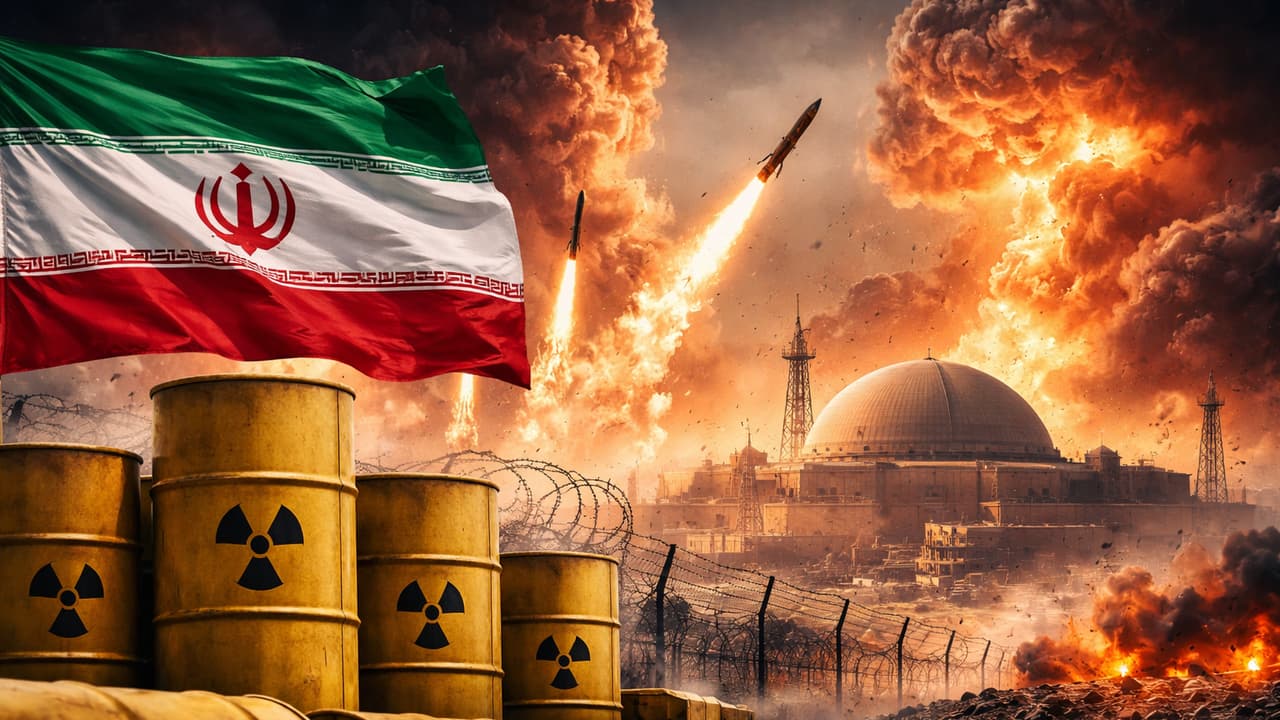
Experts warn the Israel-US war on Iran could push Tehran toward nuclear weapons as oversight of enriched uranium weakens. With strikes spreading across the Middle East, fears of a wider conflict are rising.
As the Middle East war triggered by US-Israeli strikes on Iran intensifies, security experts are warning of a far more dangerous consequence: Tehran may accelerate efforts to build a nuclear weapon.
The conflict — sparked by airstrikes that killed Iran’s Supreme Leader Ayatollah Ali Khamenei — has already spread across the region, drawing in multiple countries and disrupting global energy markets. But analysts say the long-term fallout could be the collapse of Iran’s long-standing restraint on nuclear weapons.
Also read: Did Nostradamus Predict US-Israel-Iran War? Chilling ‘7-Months Great War’ Prophecy Resurfaces
Experts Warn Iran May ‘Go Nuclear’
Security analysts say the strikes may harden Iran’s resolve to build nuclear weapons rather than deter it.
Global security expert Jeffrey Lewis warned that Iran still possesses the expertise and infrastructure needed to rebuild its nuclear programme, even if key facilities were damaged.
“If the strike does not succeed in removing a regime there remain thousands of people in Iran capable of reconstituting a programme like this,” he was quoted as saying in a DailyMail report.
Lewis added that Iran may ultimately reach the same conclusion as North Korea about the need for nuclear deterrence.
“The technology itself is decades old, and a vengeful Iran is likely to reach the same conclusion that North Korea reached – that it’s a dangerous world with the United States, and it’s better to go nuclear.”
Analysts say the war itself may reinforce the belief among Iran’s leadership that only nuclear weapons can prevent future attacks.
Khamenei’s Fatwa May No Longer Hold
Before his death in the strikes, Khamenei had issued a fatwa — a religious decree — prohibiting the development of nuclear weapons.
While the authenticity and enforcement of that position were often debated, the decree served as a formal ideological barrier against weaponisation.
Experts now warn that the next generation of Iran’s leadership may abandon the ruling entirely.
With Khamenei gone and the country under military pressure, analysts believe the political and religious restraint that once slowed Iran’s nuclear ambitions could disappear.
Concerns Over Iran’s Uranium Stockpile
Another major concern is the location and security of Iran’s existing stockpile of enriched uranium.
Before US strikes on Iran’s nuclear infrastructure during Operation Midnight Hammer, the International Atomic Energy Agency (IAEA) estimated that Iran possessed around 440 kilograms of uranium enriched to 60 percent.
If further enriched to 90 percent, that amount could theoretically produce up to ten nuclear bombs.
However, the exact status of the material is now unclear.
IAEA Director General Rafael Grossi said the agency has lost its “continuity of knowledge” regarding the stockpile following the attacks.
Grossi believes most of the enriched uranium may still be stored at the Isfahan nuclear facility, but monitoring the material has become extremely difficult amid the war.
Risk of Nuclear Terrorism
Experts are also warning of another scenario — the possibility that Iran’s nuclear materials could fall into the wrong hands.
Kelsey Davenport, director for non-proliferation policy at the Arms Control Association, said the war has increased the risk of Iran moving toward weaponisation regardless of whether the regime survives.
“The remnants of the current leadership would be pushing Iran towards weaponisation no matter how this conflict ends, because of the nature in which it started,” she told The Guardian.
Davenport warned that if Iran’s government collapses, its nuclear material could be stolen or lost.
“There’s a real nuclear terrorism risk to Trump’s regime change objective that I have not heard the administration acknowledging.”
In such a scenario, the United States could face pressure to deploy ground forces in Iran to secure nuclear facilities.
Nuclear Justification for the War
Preventing Iran from developing nuclear weapons has been one of the main justifications offered by Washington and Israel for launching the strikes.
While early rhetoric from both countries suggested regime change was a possible objective, US officials have increasingly focused on Iran’s nuclear programme.
Before the latest strikes, special envoy Steve Witkoff claimed Iran was “a week away” from obtaining “industrial grade bomb making material.”
However, no public evidence has been released to support that claim.
War Expands Across the Middle East
Meanwhile, the conflict itself continues to spread.
Israel launched a fresh wave of strikes on Iran on Thursday, while Tehran stepped up attacks on Gulf nations including Qatar and Bahrain.
AFP reporters in Tehran and Doha reported hearing massive explosions as the fighting intensified.
In the Qatari capital, thick black smoke was seen rising on the horizon after powerful blasts.
The war, which began with US-Israeli attacks on Iran last Saturday, has now drawn in several countries and expanded across multiple fronts.
Fighting Spreads From Lebanon to the Gulf
In Lebanon, Israeli strikes targeting Iran-backed Hezbollah positions reduced buildings to rubble in parts of Beirut.
Lebanon’s authorities say at least 72 people have been killed, 437 wounded and 83,000 displaced since Monday.
A pre-dawn Israeli drone strike in Beddawi, a Palestinian refugee camp near Tripoli, killed senior Hamas official Wassim Atallah al-Ali and his wife.
Hezbollah leader Naim Qassem vowed the group would intensify its fight against Israel in his first speech since the conflict escalated.
Meanwhile, Iran said it had carried out strikes against Kurdish groups based in Iraq amid reports the United States may be seeking to arm Iranian Kurdish fighters.
Iran Targets Gulf Cities and Energy Infrastructure
Iran has expanded its retaliation beyond Israel by targeting Gulf states and critical energy infrastructure.
Qatar said it intercepted incoming Iranian missiles on Thursday as loud explosions shook Doha.
Authorities had earlier evacuated residents living near the US embassy after threats of attacks.
Iranian missiles and drones have also been intercepted over Saudi Arabia, the United Arab Emirates, and Qatar, including a drone believed to be targeting Saudi Arabia’s massive Ras Tanura oil refinery.
Across the Gulf region, 13 people have been killed, including seven civilians and an 11-year-old girl in Kuwait.
War Reaches Far Beyond the Battlefield
The conflict has also spread beyond the Middle East.
Near Sri Lanka, a US submarine torpedoed an Iranian warship in the Indian Ocean.
Azerbaijan has threatened retaliation after a drone strike hit one of its airports, warning that the attack “will not go unanswered.”
Turkey has also been pulled into the crisis after NATO air defences intercepted a missile launched from Iran heading toward Turkish airspace.
A Turkish official said the missile may have been aimed at a British base in Cyprus.
Also read: How the US Navy’s Mark-48 Torpedo Sent an Iranian Warship to the Ocean Floor
Heavy Casualties and Damage Inside Iran
Iran’s official IRNA news agency says 1,045 military personnel and civilians have been killed since the war began, though the figure has not been independently verified.
Iranian media reported extensive damage in Tehran, including a sports complex, football stadium, municipal buildings and several commercial areas.
At the same time, Iran has been largely cut off from the outside world.
Internet monitoring group Netblocks said connectivity inside the country has dropped to around one percent of normal capacity.
Global Economic Shock
The escalating war is also sending shockwaves through global markets.
Iran’s Revolutionary Guards have claimed the closure of the Strait of Hormuz, a key shipping route through which around a fifth of the world’s oil supply passes.
According to market intelligence firm Kpler, oil tanker traffic through the strait has dropped by 90 percent.
International Monetary Fund chief Kristalina Georgieva warned the conflict could usher in a “prolonged period of flux” for the global economy.
Countries are already preparing emergency responses. South Korea has activated a $68-billion market stabilisation fund, while China has reportedly instructed oil refiners to halt exports of diesel and gasoline.
Tourism and Travel Collapse
The conflict has also devastated tourism across the region.
Flights have been cancelled, travellers stranded and bookings wiped out just as the high travel season begins.
Nazih Rawashdeh, a tour guide in northern Jordan, said the impact on the industry has been immediate.
“My last group of tourists left three days ago, and all the other groups planned for March have been cancelled,” he said.
“This is the start of the high season here. It’s catastrophic.”
As the war spreads across multiple countries and tensions continue to escalate, the biggest fear among analysts is that the conflict could push Iran toward a nuclear decision that would reshape global security for decades to come.
(With inputs from AFP)