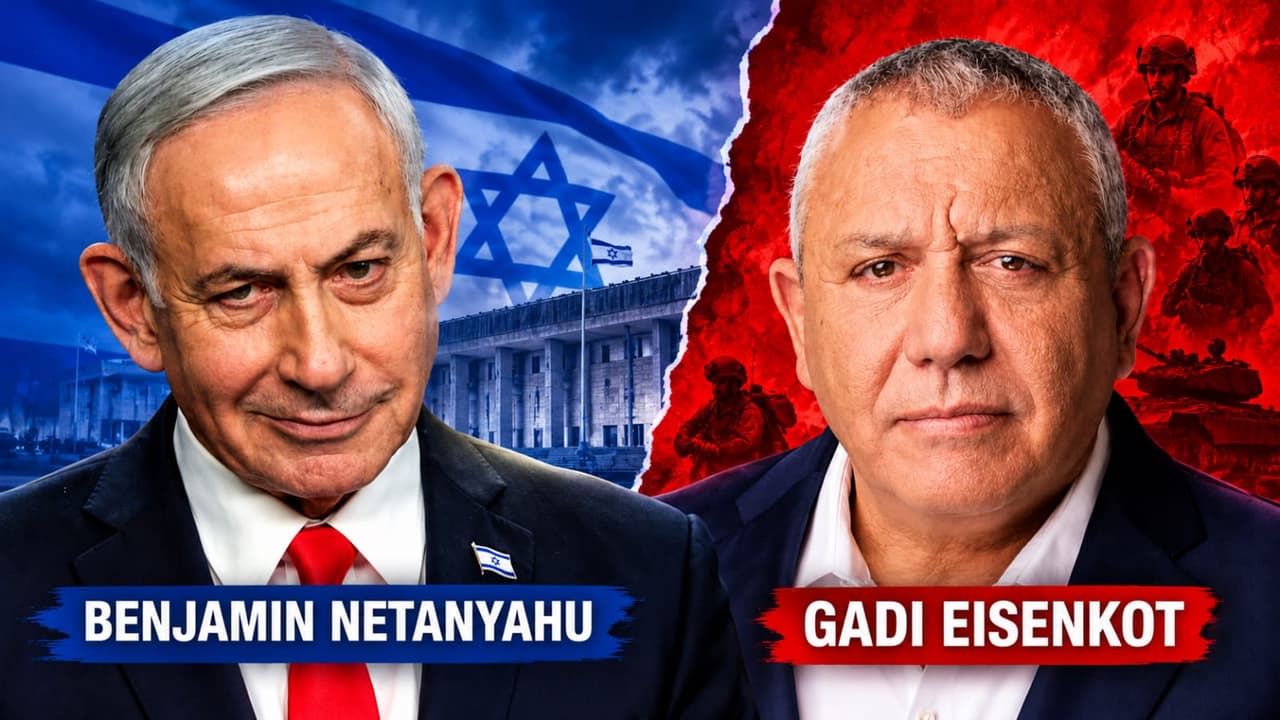
Gadi Eisenkot carries one advantage that needs no explanation: he is not Netanyahu. For voters weary of the Prime Minister, that alone may decide their ballot.
Israel votes today, October 27, in what many call the most consequential election in its history, and the man standing in Benjamin Netanyahu’s path is a 66-year-old former general who spent four decades in uniform before ever addressing a rally. Gadi Eisenkot carries one advantage that needs no explanation: he is not Netanyahu. For voters weary of the Prime Minister, that alone may decide their ballot.
The deeper story lies in his roots. Eisenkot’s parents came from Morocco, making him a Mizrahi Jew, a term for families from the Middle East and North Africa. This community has long been the loyal base of Netanyahu’s Likud party, and Israel has never had a Mizrahi Prime Minister. The second of nine children, and father of five, he grew up far from power, in Tiberias beside the Sea of Galilee and in Eilat on the Red Sea, a world away from Netanyahu’s Jerusalem childhood among the well-connected. He seldom mentions this heritage, yet analysts believe it quietly draws voters. A year ago his party polled below ten per cent; today he leads the opposition.
That heritage was dragged into view when Yinon Magal, a television presenter close to Netanyahu, called Eisenkot a “monkey” of Mizrahi-Moroccan origin controlled by “Ashkenazi elites”, Jews of European descent. Outrage followed. Magal claimed he had used criminal slang for a front man steered from behind, not a racial slur. Even Netanyahu, who rarely admits error, rebuked him. The episode reopened old wounds over unequal treatment between Israel’s European and Middle Eastern Jews.
Eisenkot joined the Golani Brigade, an infantry unit built for ground combat, in 1978 and rose to Chief of Staff of the Israel Defense Forces, the country’s top soldier, from 2015 to 2019, under Netanyahu himself. His defining test came in 2016, when Sergeant Elor Azaria shot dead a wounded Palestinian attacker in Hebron. Despite pressure from right-wing leaders including Netanyahu, Eisenkot backed an investigation and trial, insisting an army without discipline and moral limits is no army at all.
He entered politics in 2022 with fellow former army chief Benny Gantz. After the Hamas-led attack of October 7, 2023, both joined Netanyahu’s emergency war cabinet, then quit in June 2024, saying the government had no plan for what Gaza would look like once the fighting stopped. By then the war had reached his own home: in December 2023 his youngest son Gal, 25, was killed in Gaza, and two nephews also fell. Writing in the newspaper Yedioth Ahronoth in April 2026, Eisenkot described a vow made at Gal’s grave that no soldier’s sacrifice, known to him or not, would be wasted. That promise, he says, keeps him in the race.
His party, Yashar, Hebrew for “straight”, borrows from freed hostage Eli Sharabi’s words that the right path is neither left nor right. Posters call him a warrior, a leader and a unifier. He promises an independent inquiry into the security failures behind October 7, which Netanyahu resists, and compulsory military or national service for everyone. That directly challenges the deeply religious ultra-Orthodox parties, whose followers are exempt from service and whose votes keep Netanyahu’s coalition alive.
On security, as CNN International has observed, the two men stand close. Eisenkot backed operations in Gaza, Lebanon and Iran, shares Netanyahu’s goals of denying Tehran a nuclear bomb and weakening the armed groups it funds, and championed two army doctrines: the “Dahiyeh Doctrine”, which hits roads, power and buildings in enemy-linked areas with overwhelming force to deter future attacks, and the “campaign between wars”, a series of quiet, limited strikes that wear down an enemy without open warfare. His quarrel is with execution: no plan in the latest Iran conflict, victories unbacked by diplomacy, and a Gaza war he says Netanyahu prolonged for political survival at the hostages’ expense.
He pledges to end Hamas rule within 18 months, through US President Donald Trump’s ceasefire plan or “creative” military means, and argues Hamas survives only while Netanyahu governs. He once warned that permanent control of the West Bank would create one shared country of Jews and Palestinians, ending the Zionist dream of a Jewish homeland. After October 7 he turned against a separate Palestinian state, calling its supporters “delusional”, yet offers no alternative. He still opposes annexing the West Bank and building settlements there, called the E1 settlement plan near East Jerusalem a “mistake”, and brands some settler attacks “Jewish terrorism” the government has shielded.
Polls give Yashar 20 to 23 of the 120 seats in the Knesset, Israel’s Parliament, ahead of Likud, with Eisenkot preferred as Prime Minister. But winning the most seats is not enough. Israel’s President hands the job to whoever can gather 61 seats, and neither bloc is projected to reach it. CNN International reports Eisenkot would need partners from left, right and centre, perhaps a minority government kept alive by Arab parties voting for it without joining, an arrangement some right-wing allies may reject.
Trump has hailed Netanyahu as a “great warrior prime minister”, warning America might face Iran alone otherwise, despite opposition appeals through Republican donor Miriam Adelson to stay out. Their partnership spans the 2017 Jerusalem embassy move, the 2018 exit from the Iran nuclear deal, the 2020 Abraham Accords and strikes on Iran in 2025 and 2026. Asked by journalist Barak Ravid about a new leader, Trump said, “Maybe I will, maybe I won’t.” Yet Netanyahu’s strikes in Lebanon and Gaza have frustrated Trump’s peace ambitions. A government without far-right ministers Itamar Ben-Gvir and Bezalel Smotrich could ease a Saudi peace deal, though Riyadh still demands a credible path to Palestinian statehood.