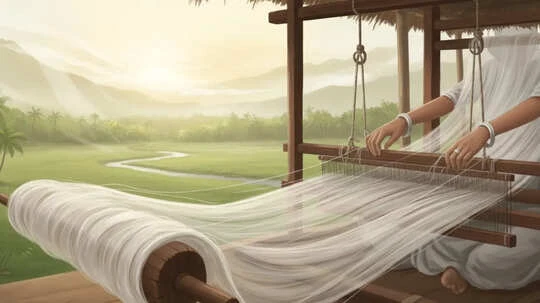
India is the land of antiques-and it not only refers to artifacts but also to spices and textiles. There was once a fabric born on these lands that was too fine to be real.
On the lush plains of undivided Bengal, muslin was first crafted, and it was nothing short of a marvel. The material was so fine that it felt light like air, and because of this, it was also known as ‘woven air.’ At present, it is one of India’s most celebrated contributions to the world.
Why was muslin nicknamed ‘woven air’?
superior to any fabric that we can find today. Muslin achieved an unmatched level of finesse, which made a full saree weigh less than 100 grams. Several yards could easily glide through a ring, thereby earning it poetic names like “Aab-e-Rawan” (flowing water) and “Baft Hawa” (woven air).
“Muslin” as a term is derived from Mosul, where European traders first found it. In India, it is fondly known as malmal, a name rooted in Indian textile vocabulary.
Read more: Famous Fabric Prints That Are Deeply Rooted In Indian Heritage
Muslin was the pride of Indian royalty
Muslin was not a fabric of the common folk-in India, it was a symbol of prestige across the courts of Mughal emperors. Akbar and his queens adorned outfits made of muslin, as they were breathable, soft, and simply luxurious. The fabric went well with the tropical climate of the subcontinent as well. Muslin gained popularity among European aristocracy too-royalty in France and Britain prized it as a luxury commodity, and it was valued at par with gold. Its texture made it unbelievable that the fabric was handwoven.
Rooted in Indian history
Muslin’s legacy is rooted in Indian history. Greek historian Megasthenes once visited the court of Chandragupta Maurya and was impressed with the fine textiles worn by Indians. Archaeological evidence also suggests that terracotta figurines from Bengal hint at the fabric’s ancient origins.
Colonial exploitation
Despite being globally popular, muslin’s decline began under British rule. When the British East India Company arrived, it changed the course of this thriving craft forever. Britain flooded the market, and consequently, skilled artisans were pushed into poverty. Once prosperous and celebrated for their art, many reached a point where they were struggling to make ends meet. Over time, the cultivation of Phuti Karpas dwindled, and everything disappeared along with the foundation of muslin.
A faded craft struggling to return
In the 21st century, muslin struggles to attain its former glory. Modern versions, in an effort to replicate the original, typically achieve a thread count of 40 to 80. Even the finest revival efforts have reached a thread count of 700, far from the historic peak of 1200. However, UNESCO has brought global attention to the art. In India and Bangladesh, artisans are working to revive ancient techniques and restore muslin to its former glory.
Not just a fabric, but India’s legacy
Muslin is a piece of India’s cultural soul, one that was created with precision and patience and is truly timeless. In a fast-paced world, muslin is a reminder of the stature India once held before the colonial decline. Artisans now hope to revive the art and, with these fine threads, somehow weave and reconnect us to our past.