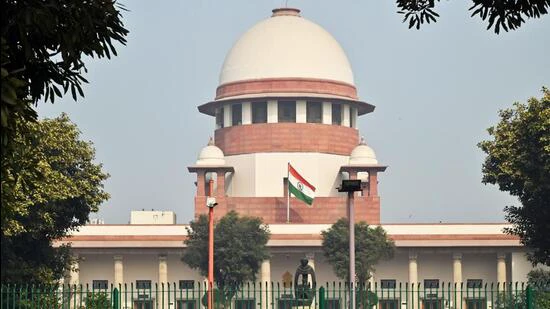
The Supreme Court on Friday rejected a plea by the Mizo Chief Council claiming absolute ownership of land in the erstwhile Lushai Hills (modern-day Mizoram) and seeking enhanced compensation, settling a decade-old legal dispute over land acquired by the State under a 1954 law.
Drawing curtains on the tussle over the land which effectively encompasses the entire state, the court held that the Mizo council are not the owners of the land as they failed to provide any conclusive proof in support of their claim.
The council approached the top court with a writ petition in 2014, challenging the validity of the Assam Lushai Hills District (Acquisition of Chief’s Rights) Act, 1954 and a subsequent notification of March 23, 1955 by which the rights and interests of the chiefs in their land were transferred to and “absolutely” vested in the State. At the time the law was passed, the Mizo Council had 259 chiefs who were paid a total of ₹14,78,980 as compensation under the Act.
The bench of justices JB Pardiwala and R Mahadevan said, “For establishing title to the land, the petitioners primarily relied on accounts and writings of scholars and officials of the British government. Upon a meticulous perusal of the said material, it is, at the very outset, highly ambiguous whether these texts unequivocally recognise the Mizo chiefs as the absolute owners of the land.”
Accusing the petitioners of approaching a “profoundly complex legal issue” in such a simplistic and superficial manner without providing alternate evidence, the court said, “It is legally untenable for this court to rest a decision of such magnitude on the fragile foundation of such flimsy submissions and woefully inadequate proof.”
The Mizo council relied on boundary papers provided by British rulers who demarcated territorial boundaries for every chief. But, these documents “remotely” failed to confer or recognise their absolute ownership of land, the court said.
“The petitioners have woefully failed to discharge their burden of proving title over the subject land…To substantiate such an extravagant demand, the petitioner ought to have relied on alternative sources of evidence, such as government documents, official notifications, and administrative orders, to build a coherent understanding of their alleged title,” the bench said.
The petition was opposed by the Centre, led by Attorney General R Venkataramani and Solicitor General Tushar Mehta, who said that a writ jurisdiction of the Supreme Court cannot be invoked to reignite settled matters that culminated in 1955. Both the Centre and the Mizoram government argued that whatever customary authority the chiefs historically wielded was extinguished following the advent of the British administration in the Lushai Hills district, now forming the state.
“The entire district was brought under the supervision of the British officials, and the chiefs were reduced to mere intermediaries, exercising administrative control over specific tracts of land strictly on the basis of boundary papers issued by the British regime,” the AG had said. Further, he submitted that the Act disbanded the traditional chieftainship system exercised over their respective lands and the statutory compensation provided to them was to make up for the loss of these specific administrative rights.
The court held that the law challenged was from a period when the right to property under Articles 19(1)(f) and 31 was a fundamental right under Part III of the Constitution. This right ceased to be a fundamental right only with the passing of the Constitution (Forty-fourth Amendment) Act, 1978. “To successfully establish a violation of their fundamental right to property, the petitioner must necessarily succeed on two distinct fronts – it must prove a clear title of the Mizo chiefs over the subject lands and only upon proving the ownership, they must satisfy the other parameters under Article 31 which states: no person could be deprived of his property without the authority of law.
Since the title over the land was not proved, the court held there was no violation of fundamental rights. Even regarding the long delay in challenging the 1955 notification, the bench took a lenient view and said, “Undeniably, there has been an inordinate delay of nearly six decades…When this Court is confronted with claims that are inextricably linked to notions of historical wrong or systemic injustice, the judicial scales must largely tilt in favour of granting access to the court.”