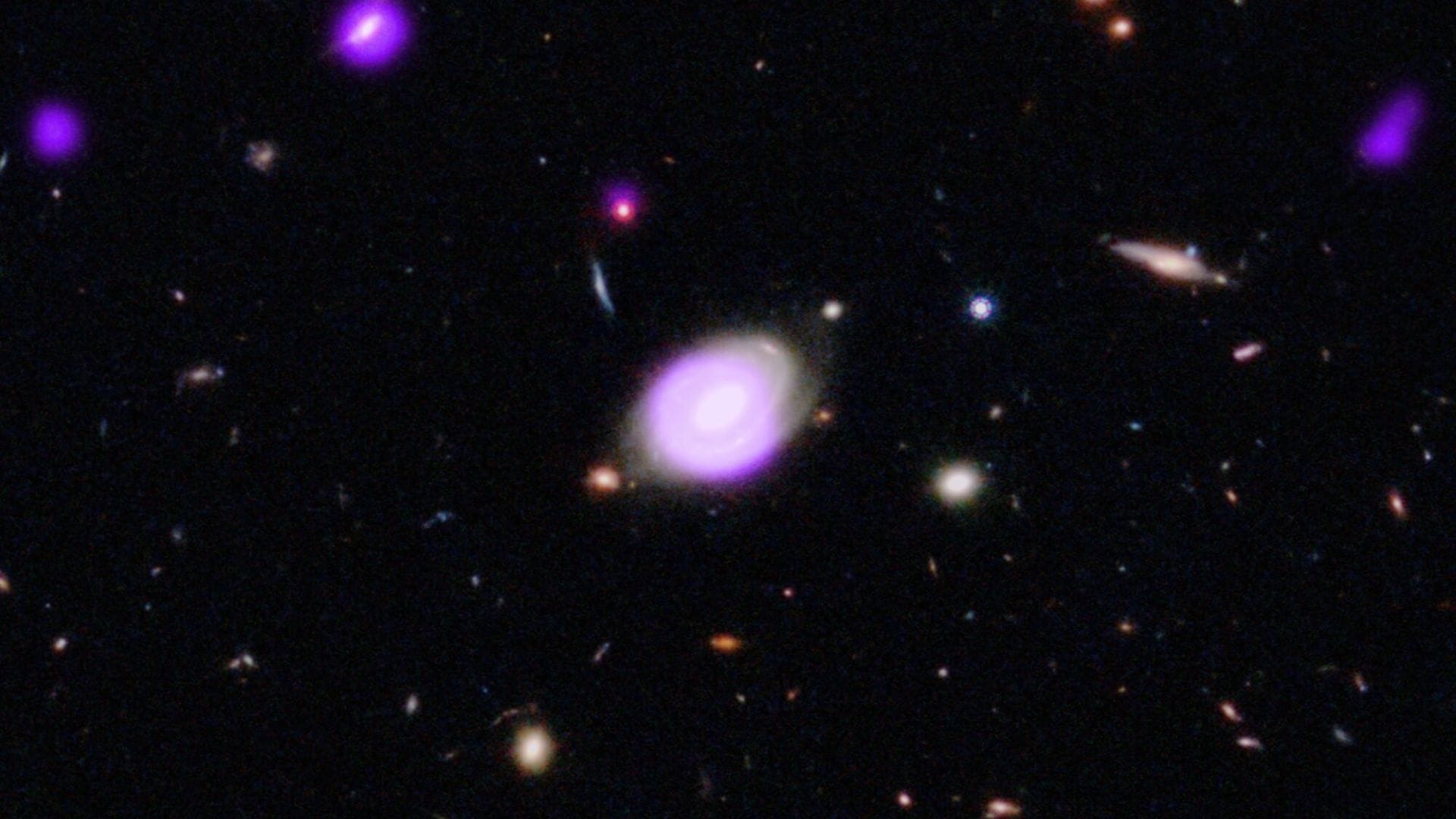
New Delhi: Astronomers may have resolved a long-standing cosmological mystery on why supermassive black holes are growing much more slowly than a period in the early universe, about 10 billion years ago, known as the ‘Cosmic Noon’. New research indicates that some of the decline results from the reduced availability of cold gas for black holes to consume, leading to less efficient accretion rates. The early, pristine universe contained vast clouds of hydrogen and helium gas. Cold gas is packed together more densely than warm gas, allowing black holes in cold environments to scoop up more material more quickly.
The researchers examined X-ray observations of about 1.3 million galaxies, containing about 8,000 actively growing supermassive black holes. The researchers used data from NASA’s Chandra X-ray Observatory, ESA’s XMM-Newton instrument and the German-Russian eROSITA telescope. During the cosmic noon, supermassive black holes containing millions to billions of solar masses grew at peak rates by accreting vast quantities of material. The intense radiation from the tortured material swirling into the black hole heats the infalling gas, producing X-rays that are detectible over astronomical distances. Observations have indicated a sharp slowdown in black hole growth since the cosmic noon, but scientists do not understand why.
Scientists have a few theories though
The researchers have proposed a few possible scenarios including fewer actively growing black holes, smaller average masses of black holes, and less efficient consumption of material. By using optical and infrared data to estimate the masses of black holes independently of accretion rates, the researchers isolated the variables. This showed that the ratio of galaxies with active black holes and typical black holes have not changed sufficiently to explain the decline. Instead, the data suggests that black holes are growing more slowly simply because of the reduced supply of cold gas as the universe ages. For this reason the slowdown is expected to continue into the future. It seems like the buffet for black holes closed at cosmic noon.