
New Delhi: The Artemis II crewed lunar flyby mission to the Moon has been successfully launched by NASA from its spaceport in Florida, in fair weather conditions after a nominal two-day countdown. This is the first integrated flight of brand new hardware developed for the ambitious Artemis programme to establish a sustained human presence on the lunar surface. This includes the Orion spaceship, and the Space Launch System rocket. The crew consisting of Commander Reid Wiseman, Pilot Victor Glover, and mission specialists Jeremy Hansen and Christina Koch will be validating the systems, rehearsing docking operations required for future crewed missions to the surface, while ushering in a new era of space exploration.
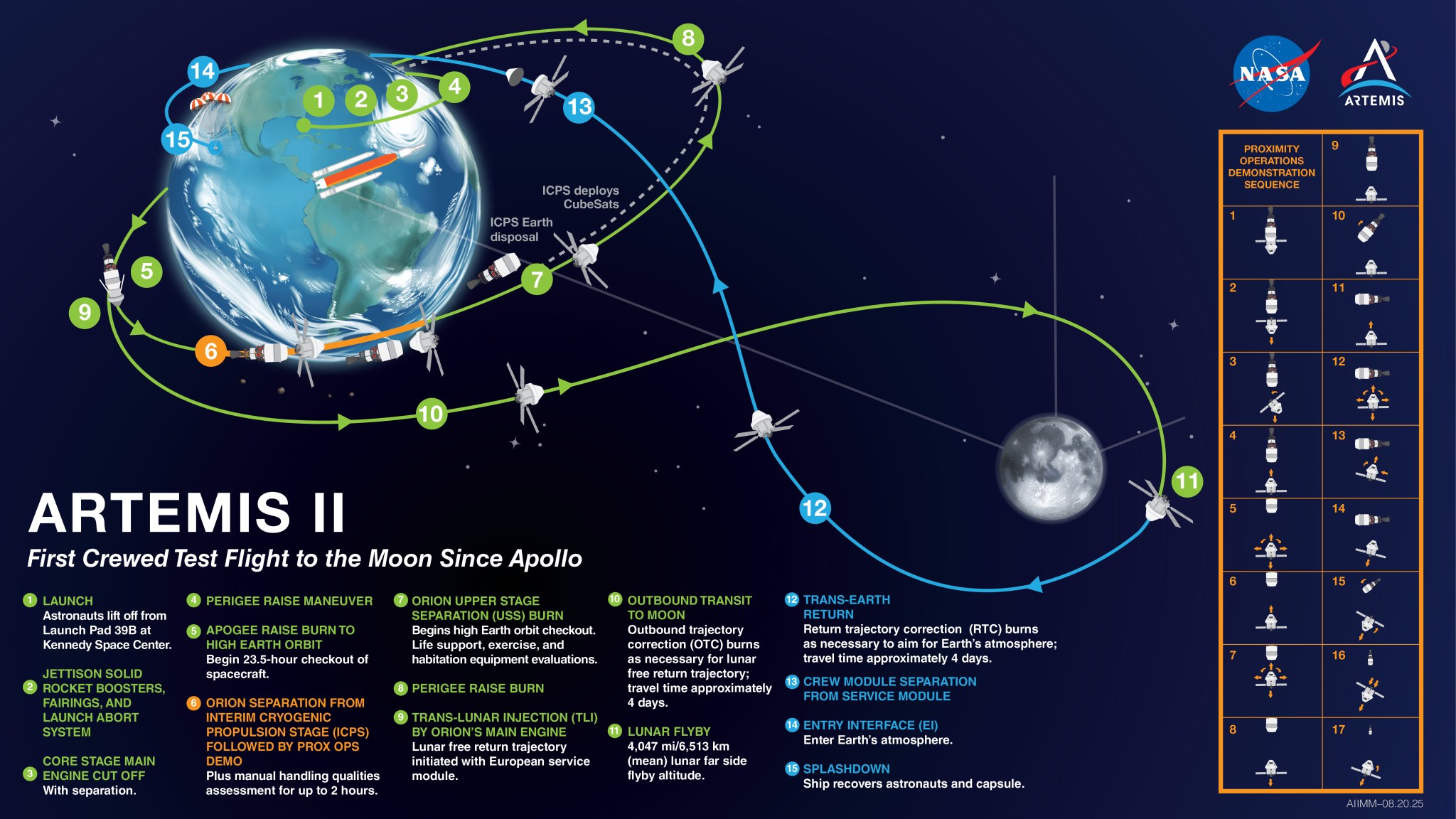
The Artemis II mission profile. (Image Credit: NASA).
After a gap of over 50 years, humans are returning to deep space. The Artemis II mission is expected to break the record for the longest distance a crewed spaceship has reached from Earth, set by Apollo 13 at 400,171 kilometres in April 1970. The crew will not be landing on the surface, and will slingshot around the Moon using a free-return trajectory, one that does not require a burn from the engine. The Artemis II mission is for demonstrating the capabilities of the Orion spaceship, and heralds humans as an interplanetary species. Building a Moon Base is a priority of the Trump administration, with NASA putting on hold plans for the Gateway cislunar orbital complex.
Lunar Land Grab
The discovery of water in the highlands surrounding the south pole of the Moon has resulted in renewed interest in lunar exploration. All the major spacefaring nations in the world have plans of building bases, and the prime real estate is at the south pole, where sunlight never reaches the permanently shadowed craters. Ancient water delivered by impacts of icy bodies in the chaotic infancy of the Solar System can remain undisturbed at the floors of these craters, at or close to the surface. Apart from supporting humans, water can be used to make rocket fuel, and being able to launch from the Moon significantly reduces the cost of deep space missions to the outer solar system, such the ice moons of the gas giants, and Mars.
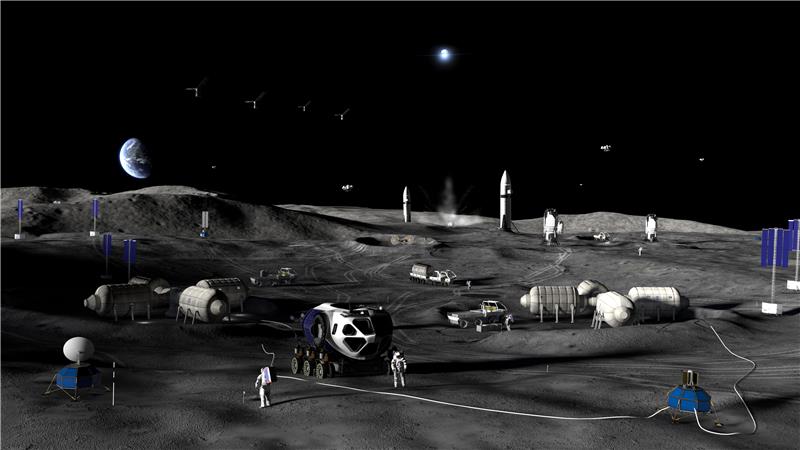
A Moon Base concept. (Image Credit: NASA).
Under the Trump Administration, NASA Administrator Jared Isaacman accelerating plans for crewed lunar missions, with crewed surface landings scheduled from 2028 onwards. For the Artemis programme, NASA is working with a number of international partners through its Artemis Accords, that includes India. The main aim here for NASA is to land a crewed mission at the lunar south pole before China. China plans to land a crewed mission on the Moon by 2030, and build a lunar base by 2035, known as the International Lunar Research Station (ILRS), with Russia as a close collaborator. China is aggressively partnering with countries around the world on the ILRS and has invited India to join as well. The ILRS is a rival to the Artemis Basecamp.