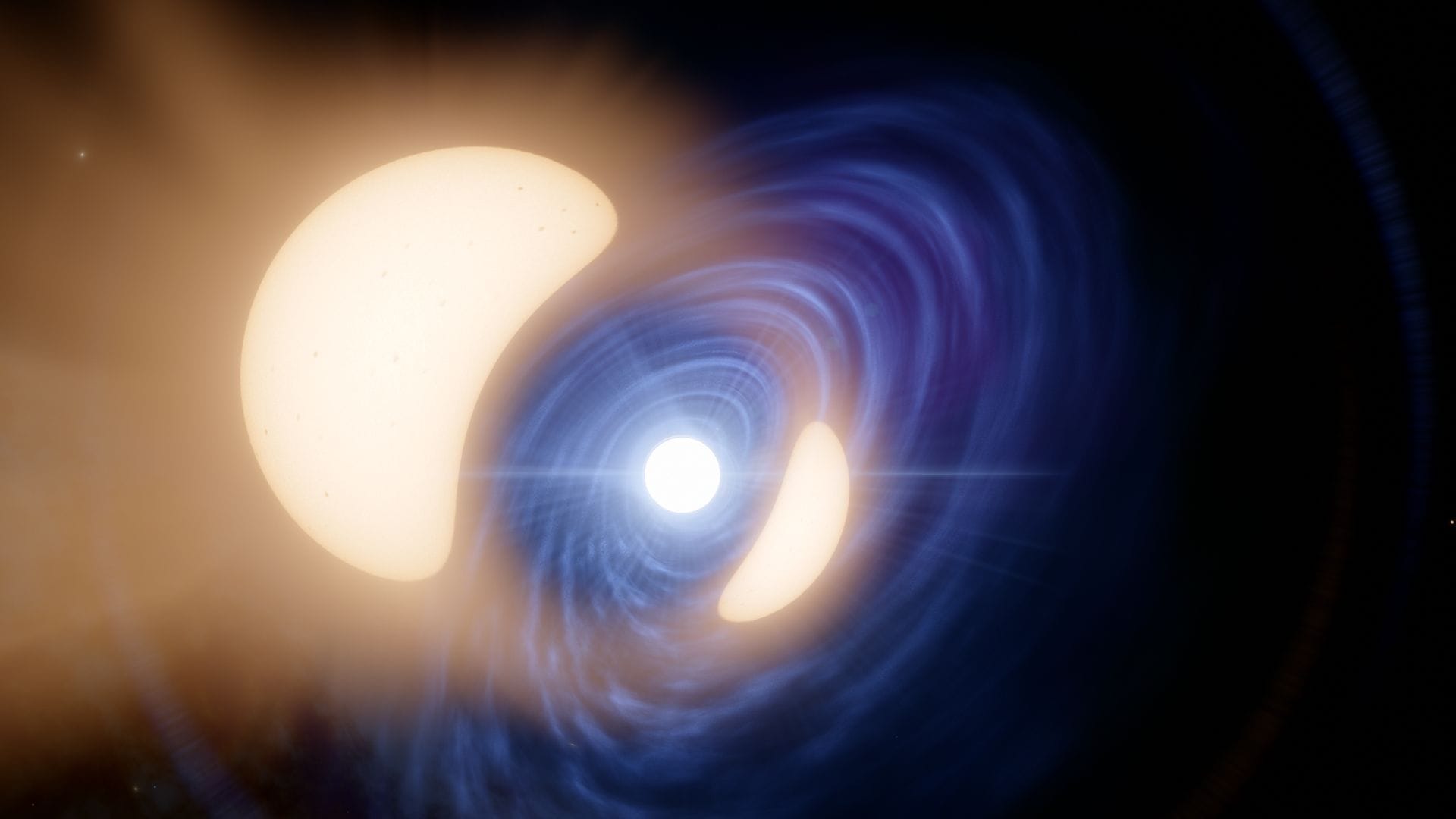
New Delhi: Astronomers from the Raman Research Institute (RRI) have investigated a burst from a repeating X-ray source designated as ULX M74 X-1 located in the spiral galaxy designated as M74, at a distance of about 32 million lightyears from the Earth. The ULX here stands for Ultraluminous X-ray Sources, that are systems featuring a compact object, the dense core of a massive dead star, such as neutron stars or black holes, that is accreting material from a binary companion. Such systems are called accreting binary systems, where a stellar remnant is siphoning off the outer atmosphere of a main sequence star.
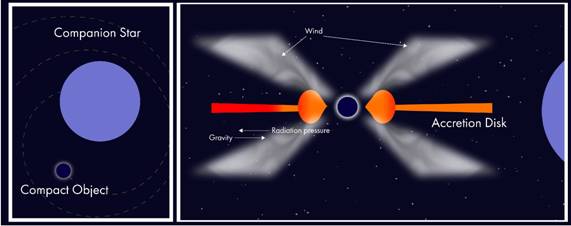
The physical systems around a stellar remnant in an accreting binary system. (Image Credit: RRI).
The system repeatedly flashes in X-rays, but not at a neat, fixed rate, indicating that a wobbling accretion disk can lead to interesting physics. Such a wobbling accretion disk has also been observed recently in a magnetar. Celestial objects have a limit to how rapidly they can scoop up material, as the energetic light from the tortured infalling material pushes away any more material from falling in. This is known as the Eddington Limit, and depends on the mass of the object. ULXs systems can accrete material beyond the Eddington Limit, at times by over 100 times. The exact physical processes that allow ULXs to shine beyond the theoretical limits are a subject of intense research.
Is the compact object a black hole?
ULX M74 X-1 was earlier studied in 2005 by another group that reported seeing flares from the system, with considerable variation in the luminosity over a short period of time. For this ULX, this was about half an hour. The researchers from RRI examined the flaring and non-flaring data from the source. A telltale bump in the spectrum of the star indicated the presence of wind in the system, where the radiation from the bright object peels of layers from the inner region of the accretion disk. The wind is blown in all directions apart from the axis of rotation of the accretion disk. The researchers have suggested that the wobbling of the accretion disk could explain the flaring state as well as the non-flaring state of the system.
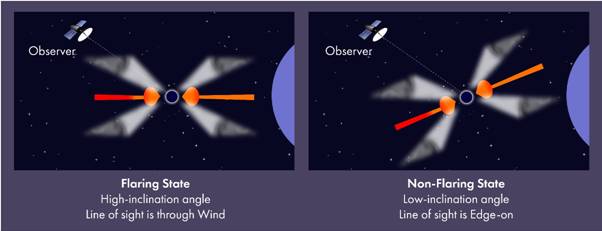
Illustration of the wobbling of the accretion disk. (Image Credit: RRI).
Just like the wobble of a spinning top,, the accretion disk wobbles too, with the wind moving in and out of the line of sight of astronomical instruments, leading to the irregular changes in the luminosity of the system. The researchers estimated the mass of the compact object, and determined it to contain about seven times the mass of the Sun. Such an object would be a stellar mass black hole, produced from the death of the most massive stars. However, the observations are a close match to ULXs with neutron stars, so the dense object may just be an unusually massive neutron star. More observations are necessary to confirm the nature of the compact object in the system. A paper describing the research has been published in The Astrophysical Journal.