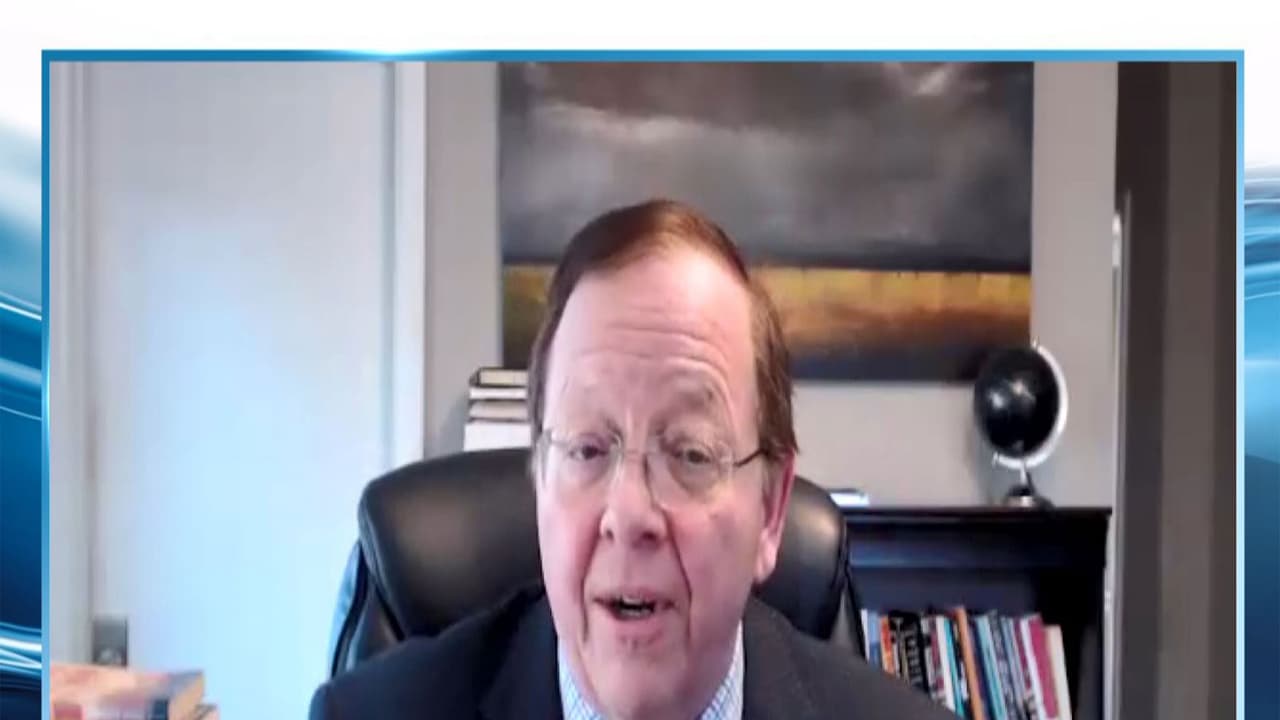
Top US Air Power Expert Robert Pape has called Iran one of the top five most powerful countries. He outlined a three-stage escalation in West Asia, highlighting Iran’s rise as an oil hegemon on the cusp of having nuclear weapons.
Top US Air Power Expert and advisor to multiple US Presidents, Professor Robert Pape, underlined the emergence of Iran as one of the top five most powerful countries in the world. He made the remarks in an exclusive interview with ANI as tensions continue to escalate in West Asia and the Gulf region.
The Three Stages of Escalation
Professor Pape spoke about Iran’s rapid rise and highlighted the escalation dynamics in the region, with three key stages–stage one being US strikes in the region, stage two being Iranian retaliation, and stage three being the US upping the ante with ground forces and said that right now it is between stages one and two. “Stage one was US bombing; doesn’t hit target, not strategically successful. Stage two- Iran reaction, lashback in different ways. And then stage three is U.S. up the ante again, go up the rung to ground forces. So that’s a very simplistic way to think about it, but it is quite accurate. And we’re in between stage two, the Iranian horizontal escalation. Now they’ve got the Strait of Hormuz. They still have that enrichment for nuclear weapons. And they’re on the cusp now, six months, a year from now, from being the richest country in the world with oil and nuclear weapons. So this is what we’re talking about. And that means they will be even more powerful. So that’s why they’re heading to stage three, which is the groundwork”, he told ANI.
He added that while Iran might not be eager to go to stage three, the country is being “sucked” into it. Highlighting that there is no easy way out, he underlined how Tehran’s oil wealth is an undeniable power. “I’m not saying they want stage three. I’m not saying they’re eager to go to ground operations. I’m saying they’re being sucked into that because there just are no other off-ramps. There’s no golden off-ramp. There’s no easy way out.”
Iran’s Swift Rise to Power
Noting that while we are in between Stage one and Stage two as of now, Professor Pape said, “This is not as a month ago. This is not Iran, like the 20th most powerful country on the planet. This is now Iran as in the top five. So now what’s happened with Iran is they’ve really shot up, and as time goes on, we just have to remember this wealth, this oil, this 20%… This has been the power, for decades and decades,” he added.
He explained how four decades of diplomacy did not bring changes however, with four weeks of war, the country has emerged as an oil hegemon on the cusp of nuclear weapons, saying, “Four decades of diplomacy by Iran have got Iran nowhere. No power, no growth, no nuclear weapons. And all we do is complain, not good enough, not good enough. And then what happens? We use four weeks of war, and we’ve made them the oil hegemon on the cusp of nuclear weapons.”
Dilemma for US President
Professor Pape also touched on several other themes and said that an attrition war with Iran could cost US President Donald Trump his presidency. Pape, while talking to ANI, said that slowly, all Republicans may distance themselves from Trump if they sense he is losing.
“As President Trump is on the horns of a dilemma, he can cut bait now, cut a deal now, pay that high price, break Israel’s elbows, threaten to cut off all the raid, do what I’m just describing here, super high price, but possibly his presidency will be recoverable. Or he can go to the other side, the military, the battlefield side, and then go across stage three and start to use military force to physically open the Strait of Hormuz, physically with military force,” he said.
Pape is a professor of political science at the University of Chicago with a specialisation in security affairs. Professor Pape has a popular substack named the Escalation Trap, which informs the reader when conflicts are changing phases and the various dimensions that happen at each stage. (ANI)
(Except for the headline, this story has not been edited by Asianet Newsable English staff and is published from a syndicated feed.)