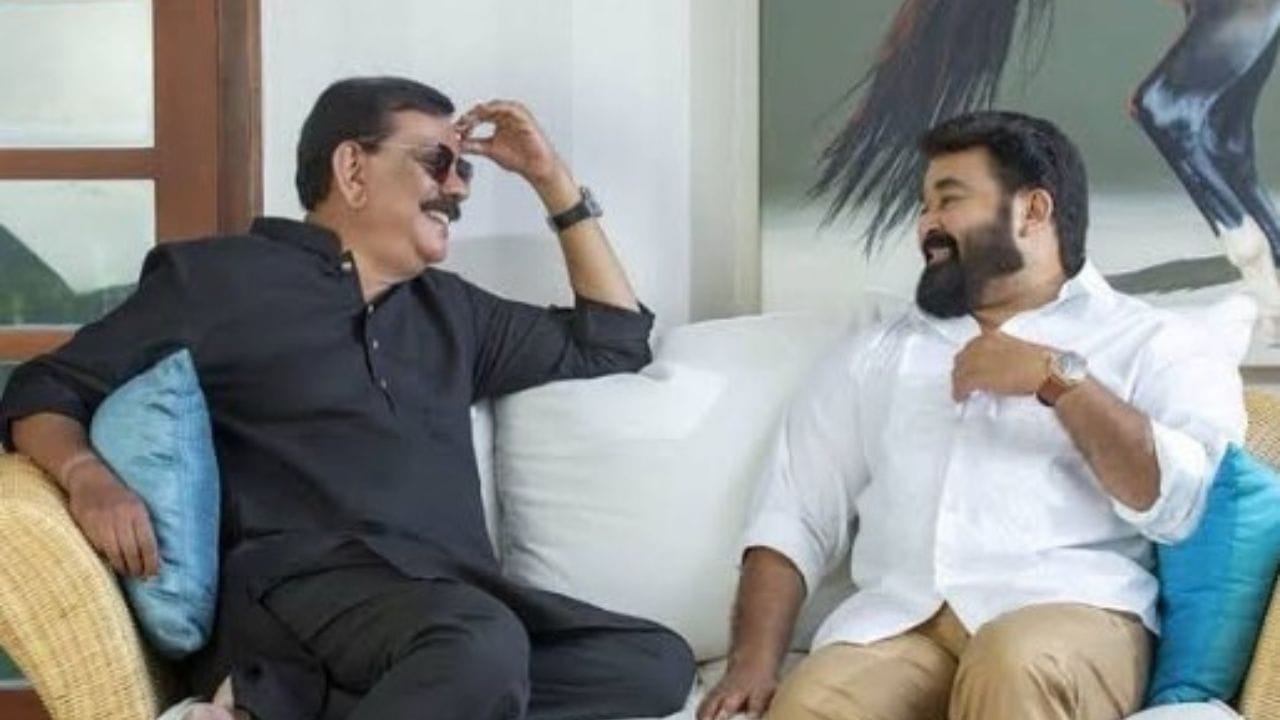
Mumbai: When Priyadarshan stepped behind the camera for the first time in 1984, he had a screwball comedy, an untested script and a young actor named Mohanlal by his side. Forty-two years, dozens of classics and countless laughs later, that same young actor, now one of Indian cinema’s most celebrated talents and superstars, is standing beside him again. This time, the occasion is even more extraordinary with Priyadarshan stepping into his 100th film and Lalettan (as Mohanlal is fondly referred to in Kerala) leading it.
The iconic duo, who first worked together in Poochakkoru Mookkuthi (1984) have shared a prolific partnership spanning over four decades, delivering more than 40 films together. Their body of work reads like a syllabus of Malayalam cinema ‒ Boeing Boeing (1985), Chithram (1988), Vandanam (1989), Kilukkam (1991), Thenmavin Kombath (1994), Kaalapani (1996) and Oppam (2016); these are films that shaped not just box-office records but the very cultural imagination of Kerala. For an entire generation of filmgoers, the Priyadarshan-Mohanlal combination wasn’t just a creative pairing. It was an emotion.
View this post on Instagram
But before any of that, there were two boys growing up in Thiruvananthapuram. Priyadarshan was raised in the Poojappura neighbourhood of the city, and it was during this period that he first became friends with Mohanlal, along with others who would go on to form a celebrated circle that included actor-screenwriter Jagadish and singer-composer MG Sreekumar. Their friendship goes all the way back to their college days in their shared hometown, and it was soaked in the ordinary textures of Kerala life ‒ neighbourhood lanes, campus canteens and most memorably, the daily KSRTC bus. Priyadarshan once revealed that he and Mohanlal used to board the same state transport bus during their college years.
That camaraderie eventually translated into their first film venture together, Thiranottam (1978), an amateur production made entirely by Mohanlal and his friends, including Priyadarshan, Maniyanpilla Raju and others. “It was quite by accident that we both landed in cinema,” the filmmaker recalled. “There was nothing like a common dream to make it to films. Along with a group of friends, we used to discuss films during our college days in Trivandrum. I was brought in to help with the script of Thiranottam because I was doing my MA in psychology and the film had a psychological subject.” It never saw a theatrical release, but it planted a seed.
Their friendship also had its share of drama. According to an anecdote Priyadarshan has shared in interviews, the two men very nearly came to blows before they became friends ‒ a college rivalry over a girl. Priyadarshan was all set to confront the rival at the Pallayam bus stand, only to meet Mohanlal for the first time. The altercation never happened, but a lifelong friendship did.
When Lal was cast in Manjil Virinja Pookkal, I used to tag along to the sets, and that’s how I met Fazil and Jijo Punnose, who asked me to write scripts. I used to stay with Lal in lodges and hotels because I couldn’t afford a place in Chennai then. He also supported me financially, and we grew close.
Priyadarshan often becomes emotional when he describes how Lalettan shaped his entire journey. In an earlier interview, Priyadarshan put it plainly, “What I am today is all because of him. If he had not become a superstar, I would not have become one either. He really encouraged me in making films and supported my career.” In another interview, he recalled, “When Lal was cast in Manjil Virinja Pookkal (1980), I used to tag along to the sets and that’s how I met filmmakers Fazil (director of 1993-National Award-winning Malayalam classic Manichitrathazhu as well as father of Fahadh Faasil) and Jijo Punnose, who asked me to write scripts. I used to stay with Lal in lodges and hotels because I couldn’t afford a place in Chennai then. He also supported me financially, and we grew close.”
It is a rare kind of gratitude where a director pays a tribute to a star, not for the fame he brought, but for the belief he extended before either of them had much to show the world.
In a touching announcement video of his 100th film, Priyadarshan said, “It’s not just a milestone because this is my 100th film and I am doing it with you (addressing the actor), but this is a milestone because it is the first time in film history that the same director has made his first film and his 100th film with the same hero.” He called it a record that would never be broken. Mohanlal, a man of few words, characteristically let the weight of the moment do the talking.
In an emotional message on social media, Mohanlal wrote, “Some milestones do not belong to one person alone. They belong to everyone who stood close enough to witness the journey.” He described a hundred films not as a numerical achievement but as “a lifetime of stories told with passion and countless mornings driven by belief in the magic of cinema.”
Their journey, of course, has not been without its phases. After a particularly rich run through the late 1980s and 1990s when their comedies and family dramas became the defining popular entertainment of the Malayalam film industry, both men expanded into wider territories. Priyadarshan made his mark in Bollywood with Hera Pheri (2000), Bhool Bhulaiyaa (the Hindi remake of Manichitrathazhu) and several others, becoming one of the most successful crossover directors from the South.
Mohanlal, meanwhile, built a filmography of astonishing range, from action thrillers to quiet character studies, as evident even as Police Commissioner Veerappallil Srinivasan in the rare Hindi film that he did with Ramgopal Varma’s Company (2002). Their reunions, when they came, carried the weight of everything their audiences remembered.
Their last collaboration was the ambitious historical epic Marakkar: Arabikadalinte Simham in 2021, a sprawling naval saga very different in tone and scale from the breezy comedies that made them household names. It was a statement of ambition and a reminder that this partnership had always been willing to reinvent itself.
The 100th film appears set to reinvent itself again. Priyadarshan described it as ‘a very good entertainer with music and drama’. When Mohanlal pressed him on whether there would be action, Priyadarshan laughed and conceded, “It’s not possible to do a film with a star like Mohanlal without action anymore, so that’s surely a part of it.” The film is set to begin shooting in late 2026. To mark the occasion, Priyadarshan is also releasing his memoir that includes a heartfelt chapter about their friendship. He revealed, “I want to complete my memoir by 2027 as I should wrap up my 100th film by then. I want to end my book with the last chapter on him (Lalettan).”
Meanwhile, the two continue to orbit each other even outside this landmark project. Priyadarshan’s upcoming Hindi film, Haiwaan, starring Akshay Kumar and Saif Ali Khan and said to be an adaptation of their thriller Oppam, will also feature Lalettan in a surprise cameo. Even in each other’s side projects, they find their way back.
The friendship has now spanned two full generations. Priyadarshan’s daughter Kalyani and Mohanlal’s son Pranav have been close friends since childhood, the sons and daughters of a bond that began on the streets of Thiruvananthapuram decades ago.
Cinema has seen many great and enduring actor-director partnerships, Scorsese and De Niro, Kurosawa and Mifune, Kamal Haasan’s with K Balachandran, Mani Ratnam and Shankar. The Priyadarshan-Mohanlal collaboration sits comfortably in that company, not just for the quality of the work but for its extraordinary duration and its rootedness in genuine friendship. When the cameras roll on film number 100, it will not simply be the start of another production. It will be the closing of a circle that began four decades ago with two young men, a borrowed script and the stubborn belief that their stories were worth telling.
Some records, as Priyadarshan put it, will never be broken.