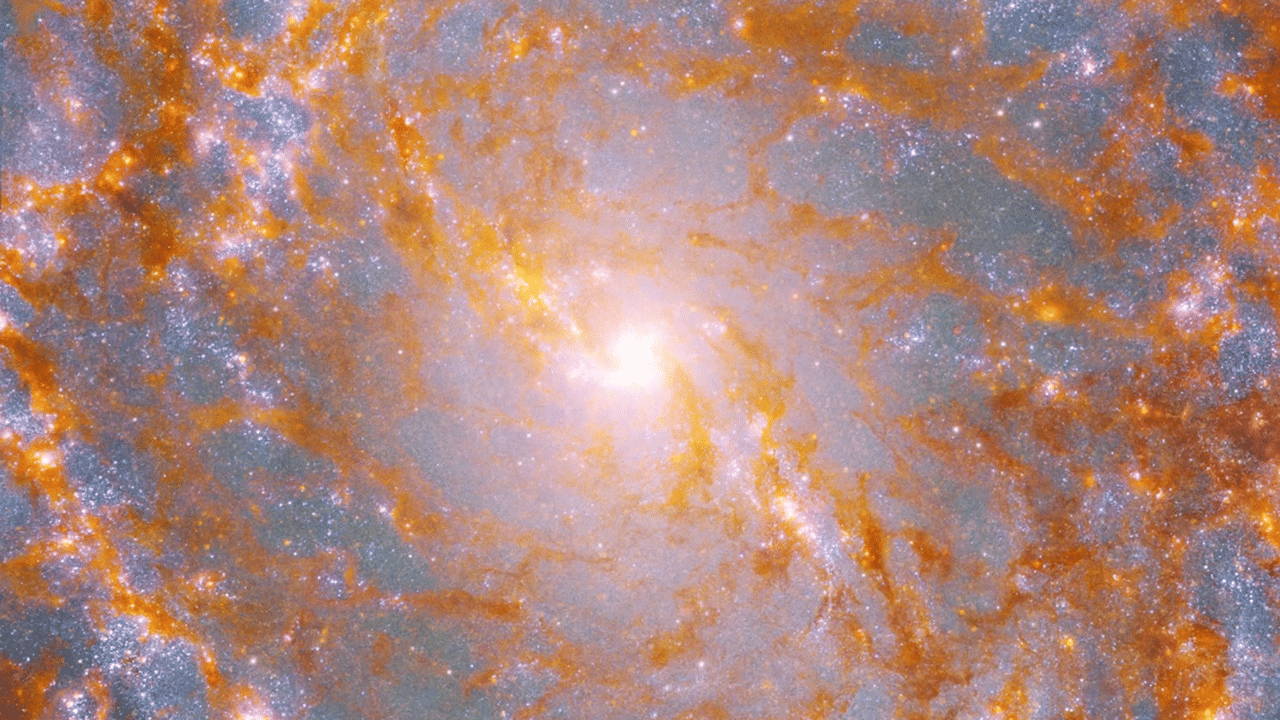
New Delhi: NASA has released a striking new view of the Pinwheel Galaxy, captured through a powerful collaboration between the Hubble Space Telescope and the James Webb Space Telescope. This picture, dated March 16, 2026, enlarges the bright centre of the galaxy, disclosing the details of its structure and activity of stars in it. The nearest face-on spiral galaxy that can be studied is Messier 101, which is approximately 25 million light-years away but very close to the Earth and is clear.
By combining data across ultraviolet, visible and near-infrared wavelengths, the scientists can now view the galaxy in a more complete form than they have ever been able to do before. The collective sight indicates the formation, growth, and manner in which the spiral arm of galaxies is formed by the stars. It also shows the way in which working together with several telescopes can open the doors to the universe and its secrets.
A closer look at a galactic neighbour
The direct view of the Pinwheel Galaxy as a face-on galaxy provides the astronomers a direct view of the spiral structure. This view has enabled researchers to trace star clusters, gas clouds, and dust lanes with a lot of precision. The most recent picture devotes attention to the thicker core, where stars are closely crowded and forming.
Combining the power of two telescopes
The Hubble Space Telescope added data with ultraviolet and visible light; the information is used to determine young and hot stars, as well as the general structure of a galaxy. At the same time, the James Webb Space Telescope provided observations in near-infrared which showed the colder stars and the regions obscured by dust. These datasets combine to give a more detailed perspective that could not be had by either of the telescopes.
These observations are helping the scientists to understand more about the way the spiral galaxies grow and evolve over time. Through the observation of the patterns of stars and gas distributions in Messier 101 it becomes possible to track the trends of star formation and determine what factors are influencing the galaxy. This local system is also able to provide insights that can be used to explain the behaviour of the more distant galaxies in the universe.