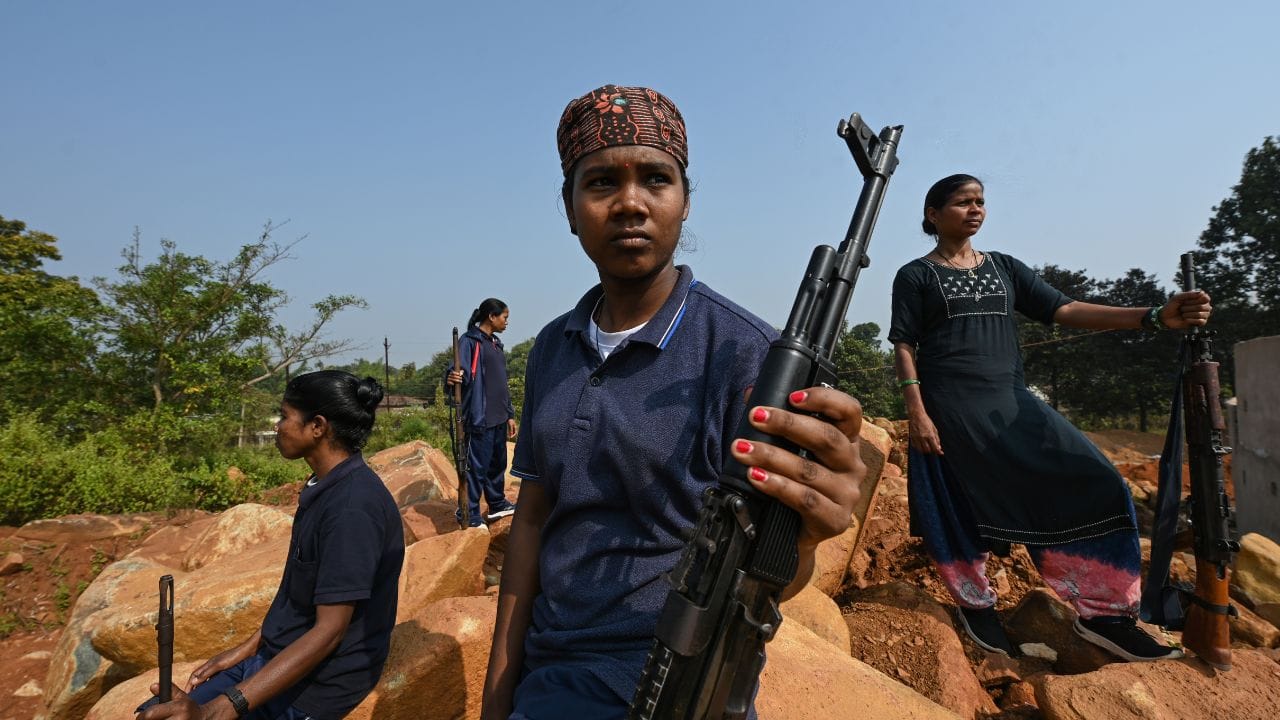
New Delhi: The numbers tell a story that would have been difficult to imagine a decade ago. Across India’s once-volatile “Red Corridor”, the geography of Left Wing Extremism has contracted sharply, violence has ebbed, and the state has pushed deeper into territories it once scarcely governed. What explains this shift is not simply the force of arms, but the steady application of a development strategy that has altered the economic and political landscape of insurgency.
At its peak in 2010, Maoist violence produced over 1,100 fatalities annually. Today, both the scale and intensity of conflict have declined dramatically, while the number of affected districts has fallen from 126 in 2013 to just 38 in 2024. This contraction reflects a structural transformation in regions where insurgency once thrived on isolation, poverty, and state absence.
As a recent ORF Special Report edited by Niranjan Sahoo and Ambar Kumar Ghosh notes, Maoist influence expanded most strongly in regions where deprivation coincided with a weak administrative presence marked by acute deprivation and minimal governance, allowing insurgents to construct parallel systems of authority. The strategic pivot to India’s approach over the past decade lay in the recognition that Left Wing Extremism was fundamentally rooted in a development failure. India’s response to Left Wing Extremism evolved into a hybrid model that integrated development economics with security strategy. Durable peace required the expansion of both state capacity and economic potential.
The strategy centred around three pillars. One, coordinated public investment across roads, telecom, finance, and security helps overcome coordination gaps that lock regions into persistently low-development trajectories. Two, the role of state capacity in correcting market failures: where private investment would not enter due to risk and remoteness, the state has acted as the primary investor in infrastructure and institutions. Three, the integration of lagging regions into national markets to reduce inequality and weaken the economic foundations of conflict. The policy response that followed has therefore combined coercive capacity with a sustained expansion of public goods.
Nowhere is this more visible than in the transformation of physical connectivity. Road construction has compressed both distance and time in previously inaccessible regions. Government sources say that in the Bastar division, for instance, the Narayanpur–Dantewada–Jagargunda corridor has seen travel distances reduced from 295 kilometres to 201 kilometres, cutting journey times from nearly ten hours to under five. Similarly, the Bijapur–Pamed route has been shortened from 250 kilometres to 110 kilometres, halving travel time. These improvements represent a fundamental reduction in “economic distance”—lowering transaction costs, enabling labour mobility, and integrating local economies into wider markets.
Telecommunications expansion has reinforced this shift, sources add. In Bastar alone, mobile tower coverage has expanded from just 581 towers serving 3,244 villages in 2021 to a dense and rapidly growing network, with over 700 new towers installed in 2024–25 and hundreds upgraded from 2G to 4G. This transition from sparse connectivity to near-saturation has profound implications. It enables direct benefit transfers, expands financial inclusion, and breaks the information monopolies that insurgent groups once relied upon.
Such investments generate multiplier effects. Connectivity reduces market frictions, improves access to services, and raises the returns to both labour and capital. In conflict zones investment has a political dimension. It makes the state visible and accessible, and allows a compression of governance gaps.
This infrastructural push has been complemented by a substantial expansion of state capacity. Over 574 companies of Central Armed Police Forces have been deployed across affected regions, supported by significant fiscal outlays. Since 2014, more than RS. 3,400 crore has been channelled through the Security Related Expenditure scheme, alongside Rs. 1,700 crore under the Special Infrastructure Scheme, which has funded hundreds of fortified police stations, according to sources. Additional allocations exceeding Rs. 1,200 crore have strengthened central agency operations. These investments have created a dense grid of security presence, but crucially, one that is now embedded within a developmental framework.
The integration of local populations into this security architecture is equally significant. More than 1,100 tribal youth have been recruited into specialised units such as the Bastariya Battalion, aligning employment generation with security objectives.
Security infrastructure has been repurposed as a vehicle for development delivery. Police camps are no longer merely operational bases but nodes of governance. From these camps, new bus services have been launched, connecting dozens of previously inaccessible villages for the first time since independence. Community initiatives, such as the opening of 73 libraries signal a broader normalisation of civic life.
These micro-level changes offer important economic signals. Rising sales of two-wheelers, tripling to over 5,000 units in interior tribal regions, suggest growing disposable incomes and expanding local markets. In Gadchiroli, the prospect of large-scale industrial investment, including the development of a major steel hub with the potential to generate 1.5 lakh jobs, points to the early stages of structural transformation. These are the building blocks of a transition from subsistence economies to diversified, market-linked systems.
The cumulative effect of these interventions is visible in the changing dynamics of violence. As connectivity and state presence have expanded, the operational space for insurgents has narrowed. Data from recent years shows a clear inverse relationship: areas that have seen rapid infrastructure and telecom expansion have also experienced sharp declines in violent incidents. development interventions are increasingly displacing insurgent influence by altering both opportunity structures and incentive systems.
At the organisational level, the Maoist movement has struggled to adapt to this new environment. Leadership attrition has been severe. Only a small fraction of its central leadership remains active by end-2025 down to a series of localised, reactive units. Crucially, this decline is intertwined with positive changes in the socio-economic conditions that once sustained recruitment and mobilisation.
From the standpoint of development politics, the most consequential shift has been in the nature of state legitimacy. In regions where the state was once absent or mistrusted, it is now increasingly associated with tangible benefits—roads, connectivity, welfare, employment. This transformation reflects a broader principle: legitimacy is built not only through authority, but through delivery. By embedding itself in everyday economic life, the state has begun to displace insurgent narratives of neglect and exclusion.
None of this suggests that the challenge has been fully resolved. Persistent issues around land rights, forest governance, and the implementation of protective legislation in Scheduled Areas continue to generate friction.
Nevertheless, the result so far is a quiet but profound transformation. Villages that once lay beyond the reach of the state are connected by roads and mobile networks; local economies are beginning to stir. The “Red Corridor” is now being transformed by connectivity, markets, and institutions—evidence that development, when systematically deployed, can succeed where force alone could not.
(Vivek Y. Kelkar is a researcher and analyst whose work explores global power shifts, strategy, trade transitions, and the geopolitics of systemic risk.)