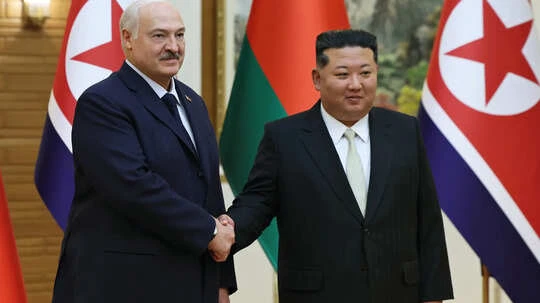
On Thursday, Belarusian President Alexander Lukashenko and North Korean leader Kim Jong Un convened in Pyongyang, where they signed a friendship and cooperation treaty.
This agreement marks a significant step in enhancing ties between the two nations, both of which are aligned with Russia amid rising tensions with the West.
Lukashenko, who is on a two-day official visit to North Korea, described the treaty as ‘fundamental,’ indicating that bilateral relations are ‘entering a new stage.’ The leaders also discussed fostering high-level cooperation and shared perspectives on various international and regional issues, according to North Korea’s state media.
Growing Alliance
Belarus maintains a close alliance with Russia, having permitted Moscow to use its territory for military operations during the invasion of Ukraine in February 2022. Additionally, Lukashenko has authorized the deployment of Russian tactical nuclear weapons within Belarus, further solidifying the partnership.
In parallel, Kim Jong Un has increasingly aligned North Korea’s foreign policy with Moscow, providing military support to Russian President Vladimir Putin’s efforts in Ukraine. This collaboration reflects a broader strategy to present a united front against perceived threats from Washington.
Diplomatic Engagements
During their meeting, Lukashenko and Kim also signed multiple agreements covering various sectors, including education, healthcare, and agriculture. These initiatives aim to deepen cooperation between the two countries across different fields.
After the talks, Lukashenko expressed satisfaction with the intensified cooperation, acknowledging past shortcomings in their bilateral relations. ‘Yes, we didn’t have close cooperation, largely due to our own fault. But I am sincerely pleased to note that cooperation has now significantly intensified,’ he remarked.
International Context
According to Chang Yoon-jeong, spokesperson for South Korea’s Unification Ministry, the meeting aligns with Kim’s strategic focus on establishing a ‘multipolar world order’ and fostering an ‘anti-West alliance.’ This reflects a broader shift in North Korea’s foreign policy, aiming to counteract U.S. influence.
Lukashenko highlighted the necessity for independent nations to strengthen their alliances amid global transformations that challenge international law and sovereignty. ‘In today’s reality of a global transformation, when the global powers openly ignore and violate international law, independent countries need to cooperate more closely,’ he stated.
Cultural Exchange
As a gesture of goodwill, the leaders exchanged gifts, with Kim presenting Lukashenko with a sword and a decorative vase featuring his image. In return, Lukashenko gifted Kim an assault rifle manufactured in Belarus, humorously noting, ‘Just in case enemies show up.’
The visit also included cultural activities, such as an ice-skating show hosted by Kim for Lukashenko, underscoring the efforts to strengthen personal ties between the leaders.
Stalled Dialogue with the U.S.
Since the breakdown of negotiations with the U.S. in 2019, Kim has suspended meaningful dialogue with Washington and Seoul, rejecting offers for talks unless the U.S. drops its demands for North Korea’s nuclear disarmament. This ongoing stalemate further complicates the geopolitical landscape in the region.