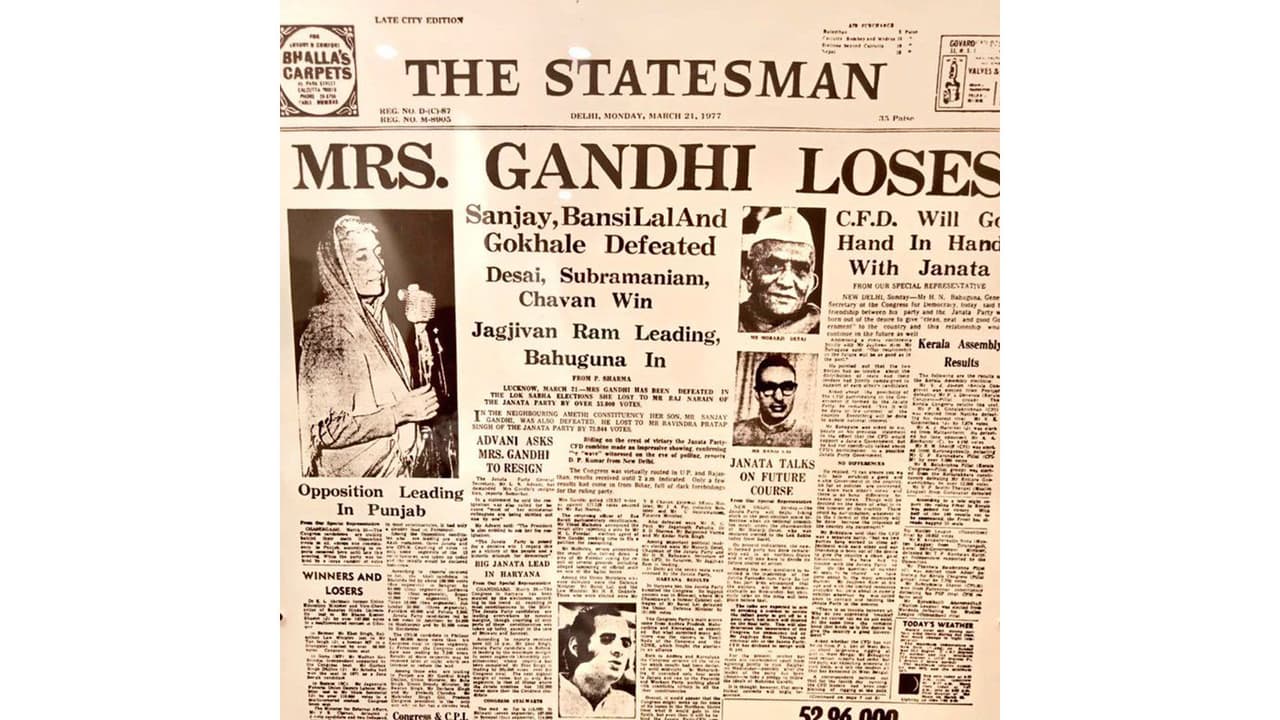
The BJP launched a social media campaign criticising past Congress governments. It recalled the Emergency as ‘India’s darkest era’ and faulted the handling of the 1985 Gujarat riots and the 1993 Mumbai and Kolkata bomb blasts.
BJP slams Congress over Emergency
The Bharatiya Janata Party (BJP) shared a series of posts on social media recalling key historical events, strongly criticising past Congress governments while framing them as lessons for India’s democracy.
In a detailed post marking March 21, 1977, the party described the end of the Emergency as “the darkest era in independent India’s history,” stating, “For 21 long months, Bharat had lived in fear… Voices were silenced, newspapers were mutilated by censorship, and the Constitution itself was bent to serve one family’s hunger for power.”
Slamming the then Congress during the Emergency, the post added, “This was not governance. This was the systematic dismantling of democracy by a party that could not tolerate dissent.”
Referring to the defeat of former Prime Minister Indira Gandhi, the BJP wrote, “The fall of Indira Gandhi was not just an electoral loss — it was a civilisational correction. Democracy, bruised and battered, stood back on its feet.”
The post further emphasised that the day should serve as a warning, adding, “Nations do not lose freedom in one day, they lose it when people forget the cost at which it was saved.”
The party also cited figures from the Emergency period, claiming that “over 1,10,000 citizens were jailed without trial” and “nearly 1.1 crore Indians were forcibly sterilised,” while asserting that the press was “gagged and turned into a mouthpiece of the regime.”
𝟐𝟏 𝐌𝐚𝐫𝐜𝐡 𝟏𝟗𝟕𝟕. 𝐓𝐡𝐞 𝐞𝐧𝐝 𝐨𝐟 𝐭𝐡𝐞 𝐝𝐚𝐫𝐤𝐞𝐬𝐭 𝐞𝐫𝐚 𝐢𝐧 𝐢𝐧𝐝𝐞𝐩𝐞𝐧𝐝𝐞𝐧𝐭 𝐈𝐧𝐝𝐢𝐚’𝐬 𝐡𝐢𝐬𝐭𝐨𝐫𝐲. 📖 Newspaper headlines carried the weight of a nation’s pain, resistance, and eventual redemption: ’𝐌𝐫𝐬 𝐆𝐚𝐧𝐝𝐡𝐢 𝐋𝐨𝐬𝐞𝐬 — 𝐉𝐚𝐧𝐚𝐭𝐚… pic.twitter.com/34yR7nXtAF — BJP (@BJP4India) March 21, 2026
Criticism over 1985 Gujarat Riots
In another post under its “This Day, That Year” series, the BJP referred to the 1985 Gujarat riots during the tenure of former Prime Minister Rajiv Gandhi.
“As Gujarat burned in communal violence, Prime Minister Rajiv Gandhi landed in Ahmedabad, touring riot-hit neighbourhoods in a bid to calm a state spiralling into chaos. The visit was meant to signal control and reassurance. Instead, the violence continued even after the Prime Minister’s departure, exposing deep cracks in governance and law enforcement,” the BJP’s post on X read.
The party further cited findings of the Justice VS Dave Commission, alleging “police inaction, intelligence failures, bias in enforcement, and a near collapse of the rule of law under the Congress administration.” It also noted that then Chief Minister Madhav Singh Solanki stepped down months later amid political pressure.
“What began as a daylong visit to project stability ultimately became a stark reminder of how fragile governance had become during one of Gujarat’s most turbulent phases,” the post further read.
𝐓𝐡𝐢𝐬 𝐃𝐚𝐲, 𝐓𝐡𝐚𝐭 𝐘𝐞𝐚𝐫 | 𝟐𝟑 𝐌𝐚𝐫𝐜𝐡 𝟏𝟗𝟖𝟓 As Gujarat burned in communal violence, Prime Minister Rajiv Gandhi landed in Ahmedabad, touring riot-hit neighbourhoods in a bid to calm a state spiralling into chaos. The visit was meant to signal control and… pic.twitter.com/Q4qRm1JKIY — BJP (@BJP4India) March 23, 2026
1993 Blasts: BJP Alleges Governance Failure
Highlighting incidents from March 1993, the BJP recalled the 1993 Mumbai bomb blasts and a subsequent explosion in Kolkata’s Bowbazar area.
“In March 1993, India witnessed one of the darkest chapters in its history. A series of coordinated bomb blasts ripped through Mumbai, killing over 250 people and injuring hundreds more. The nation was still reeling from that devastating act of terror. Five days later, tragedy struck again. In Kolkata’s crowded Bowbazar area, a powerful bomb exploded shortly after midnight. Most residents were asleep when the blast brought down two apartment buildings, trapping dozens under the rubble. At least 50 innocent lives were lost in a single moment of terror,” the post read.
The party added, “Two major terror attacks within days of each other — another painful reminder of an era when terror networks operated with impunity.” It further alleged that the Congress government at the time “failed to protect the nation.”
𝐓𝐡𝐢𝐬 𝐃𝐚𝐲, 𝐓𝐡𝐚𝐭 𝐘𝐞𝐚𝐫. In March 1993, India witnessed one of the darkest chapters in its history. A series of coordinated bomb blasts ripped through Mumbai, killing over 250 people and injuring hundreds more. The nation was still reeling from that devastating act of… pic.twitter.com/cXxugrsJBb — BJP (@BJP4India) March 16, 2026
In 1977, India was under the rule of Prime Minister Indira Gandhi (Congress) during the Emergency (1975-1977), and on 21 March 1977, the Emergency ended with the Janata Party coming to power following the general elections, marking a major democratic shift. In 1985, Prime Minister Rajiv Gandhi (Congress) was in office when Gujarat faced severe communal violence. Later, in 1993, Prime Minister PV Narasimha Rao (Congress) was in power when coordinated bomb blasts struck Mumbai and Kolkata.
(Except for the headline, this story has not been edited by Asianet Newsable English staff and is published from a syndicated feed.)