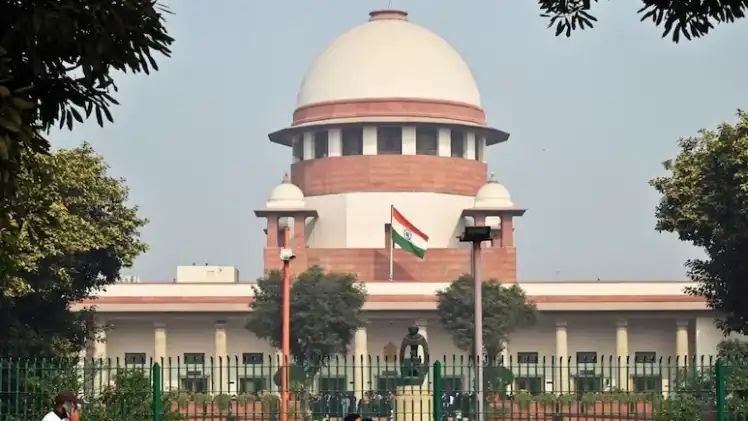
The Supreme Court has made it clear in the matter of abuse that merely using abusive, abusive or vulgar language cannot be considered as ‘obscenity’ under section 294 of the Indian Penal Code i.e. IPC.
The bench clarified that obscenity and indecency are different concepts in the eyes of law. The court made it clear that in the eyes of the law, obscenity is different from abusive language or abusive language. A bench of Justice Sanjay Karol and Justice Vipul M Pancholi made this comment while hearing the appeal of a 70-year-old man from Tamil Nadu. The case was related to a fight that took place during a land dispute in 2017, in which the accused was accused of abusing, threatening and attacking with a billhook (sharp weapon).
what was the whole matter
Prosecution Alleges In August 2017, during an argument over a land dispute, the Appellant abused the Complainant in obscene language and assaulted her, causing injury to her nasal bone. The Trial Court convicted him under the IPC and the Scheduled Castes and Scheduled Tribes Act, but the Madras High Court acquitted him of the offenses under the SC/ST Act. The court acquitted the accused of charges under Section 294(B) (uttering obscene words in a public place) and Section 506(II) (criminal intimidation), however upheld the conviction under Section 326 (causing grievous hurt by dangerous weapon). Considering the age of the accused, poor health and the nature of the dispute, the court reduced his sentence to ‘imprisonment till the hearing of the court’ and imposed a fine of Rs 50,000 on him.
Supreme Court gave this definition
The Supreme Court said that in the eyes of the law, mere abuse, abusive language or indecent language in itself is not obscene; for Section 294 to apply, it is necessary to prove that the words used are full of sensuality, create sexual excitement or lustful interest and have a tendency to corrupt or deform the moral character of people. The court said that merely hurting someone’s sentiments or the language being vulgar is not enough. The Supreme Court made it clear that to prove this crime, the prosecution will have to prove two things. The alleged obscene words were uttered in or around any public place. Those words must have caused real distress to other people present. In the present case the court found that both these conditions were not proved.
Mere threat uttered in anger does not constitute the offense of intimidation
The court said that mere threat uttered in anger during a quarrel does not constitute the offense of intimidation under Section 506(II). It must be proved that the purpose of the threat was to create fear in the other person or to force him to do or not do something. No such evidence was found in this case, however, the Supreme Court accepted that the accused had broken the nasal bone of the complainant by attacking with a billhook, which is a serious injury as per the law. The medical report and the statements of eyewitnesses corroborate each other, hence the conviction under Section 326 is correct. Referring to several important decisions in its decision, the Supreme Court said that from time to time the court has made it clear that indecent or derogatory language and obscenity are not the same. Obscenity will be determined based on contemporary social standards and its sexual or erotic impact.