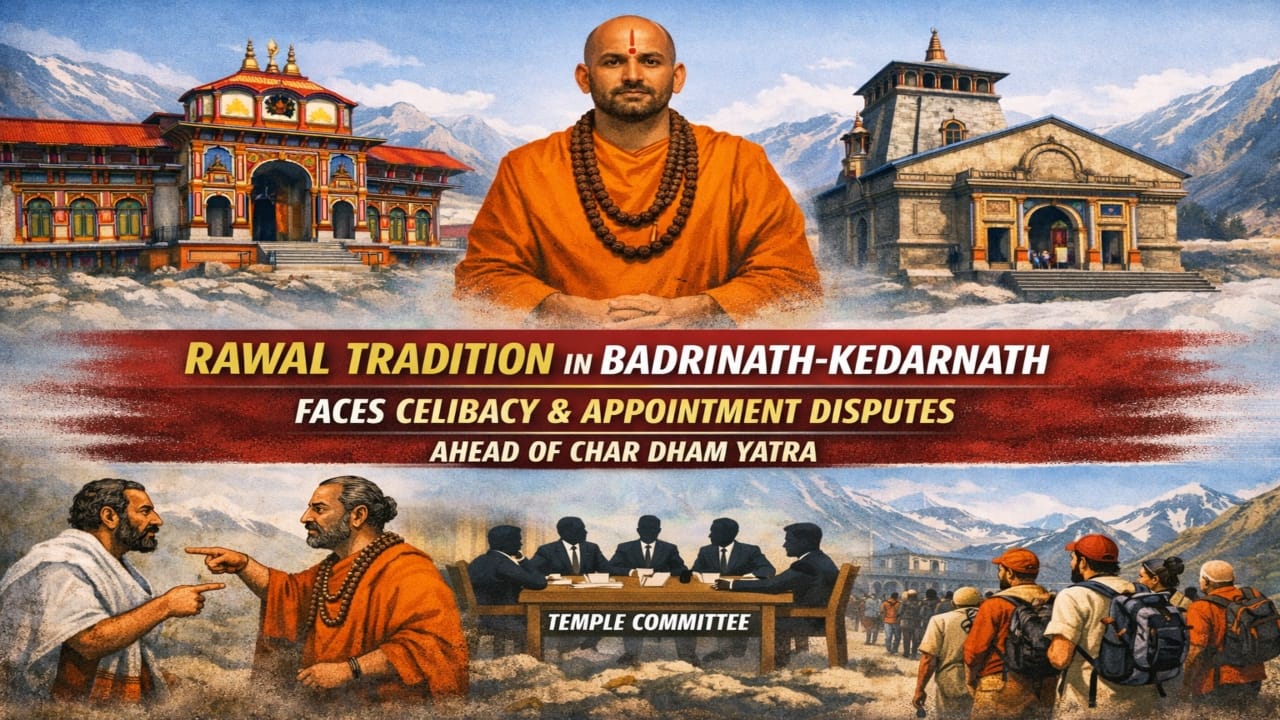
Dehradun: The Rawal system in Kedarnath and Badrinath shrines has long been a symbol of India’s cultural unity. Established by Adi Guru Shankaracharya centuries ago, it brought priests from South India to serve in the northern Himalayas, connecting traditions across regions.
But ahead of Char Dham Yatra 2026, controversies have erupted over the appointment and conduct of Rawals, raising questions about tradition, discipline, and authority.
The Role of Rawal in Badrinath
Badrinath Dham, located in Chamoli district, is one of the most sacred Hindu pilgrimage sites. Lord Vishnu is worshipped here in the form of Badrinarayan. The chief priest, known as the Rawal, plays a central role in daily rituals.
According to tradition, only ‘Nambudiri Brahmins from Kerala’ can be appointed as Rawal at Badrinath. They must be proficient in Vedic knowledge, Sanskrit, and Vaishnava practices. Candidates are proposed by monasteries in South India, evaluated for their conduct and discipline, and formally appointed by the Badrinath-Kedarnath Temple Committee (BKTC) with government approval.
The Rawal performs the main rituals inside the sanctum sanctorum and must follow strict rules of purity, celibacy, and limited social contact. During winter, when the temple closes, the Rawal continues rituals at the Narasimha Temple in Jyotirmath, ensuring continuity of worship.
The Role of Rawal in Kedarnath
Kedarnath Dham, in Rudraprayag district, is one of the 12 Jyotirlingas and a major Shaivite shrine. Here, the Rawal is traditionally chosen from ‘Veerashaiva or Lingayat Brahmins of Karnataka and South India’.
Unlike Badrinath, the Rawal at Kedarnath does not directly touch the Shivalinga. Local priests perform the worship, while the Rawal oversees rituals and traditions. This reflects the Shaivite practice where the Rawal’s role is spiritual leadership rather than direct ritual performance.
The Current Controversy
Ahead of the 2026 yatra, disputes have emerged. Reports claimed that outgoing Kedarnath Rawal Bhimashankar Ling performed a coronation ceremony in Nanded and declared his successor. The BKTC responded by issuing a notice, stating that only the temple committee has authority to appoint Rawals.
Rawal Bhimashankar Linga Shivacharya Mahaswami is going to retire after 25 years of service due to health reasons and named Shivacharya Shanti Linga (Kedar Linga) as the 325th Rawal during a ceremonial event in Nanded, Maharashtra.
BKTC President Hemant Dwivedi clarified: “The temple committee receives the first proposal regarding the appointment of the Rawal. Only after that, the process begins. No such proposal has been received, nor has any new Rawal been appointed.” This has sparked debate about whether Rawals can independently declare successors, or whether the committee’s authority is final.
Celibacy Debate in Badrinath
Another controversy surrounds celibacy rules for Rawals at Badrinath. A video surfaced showing a former Rawal marrying, which raised questions about whether lifelong celibacy is mandatory.
Religious experts like Jagadamba Prasad Sati argue that Rawals must remain celibate for life. “Anyone who resolves to be a lifelong celibate cannot return to householder life. Marriage after such a vow is considered a downfall,” he said.
Ashutosh Dimri, president of the Shri Badrinath Dimri Religious Central Panchayat, cited the 1939 BKTC Act, which clearly mentions lifelong celibacy for Rawals.
However, BKTC Chairman Hemant Dwivedi offered a different view. He said celibacy is mandatory only while serving as Rawal. After stepping down, former Rawals may marry and live a personal life. Supporting this, former Rawal Ishwar Prasad Nambudiri noted that several ex-Rawals married after leaving office, which he believes is acceptable.
Symbol of Unity
Despite the controversies, the Rawal system remains a powerful symbol of unity. Adi Shankaracharya’s vision was to connect India’s spiritual centres by appointing priests from different regions. The presence of South Indian Brahmins in Uttarakhand’s Himalayan shrines reflects this cultural bridge.
Administrative Changes
Adding to the tension, the CEO of BKTC, Vijay Thapliyal, was removed from his post on March 17 and reassigned. This has left questions about who will lead the committee during the crucial yatra season.