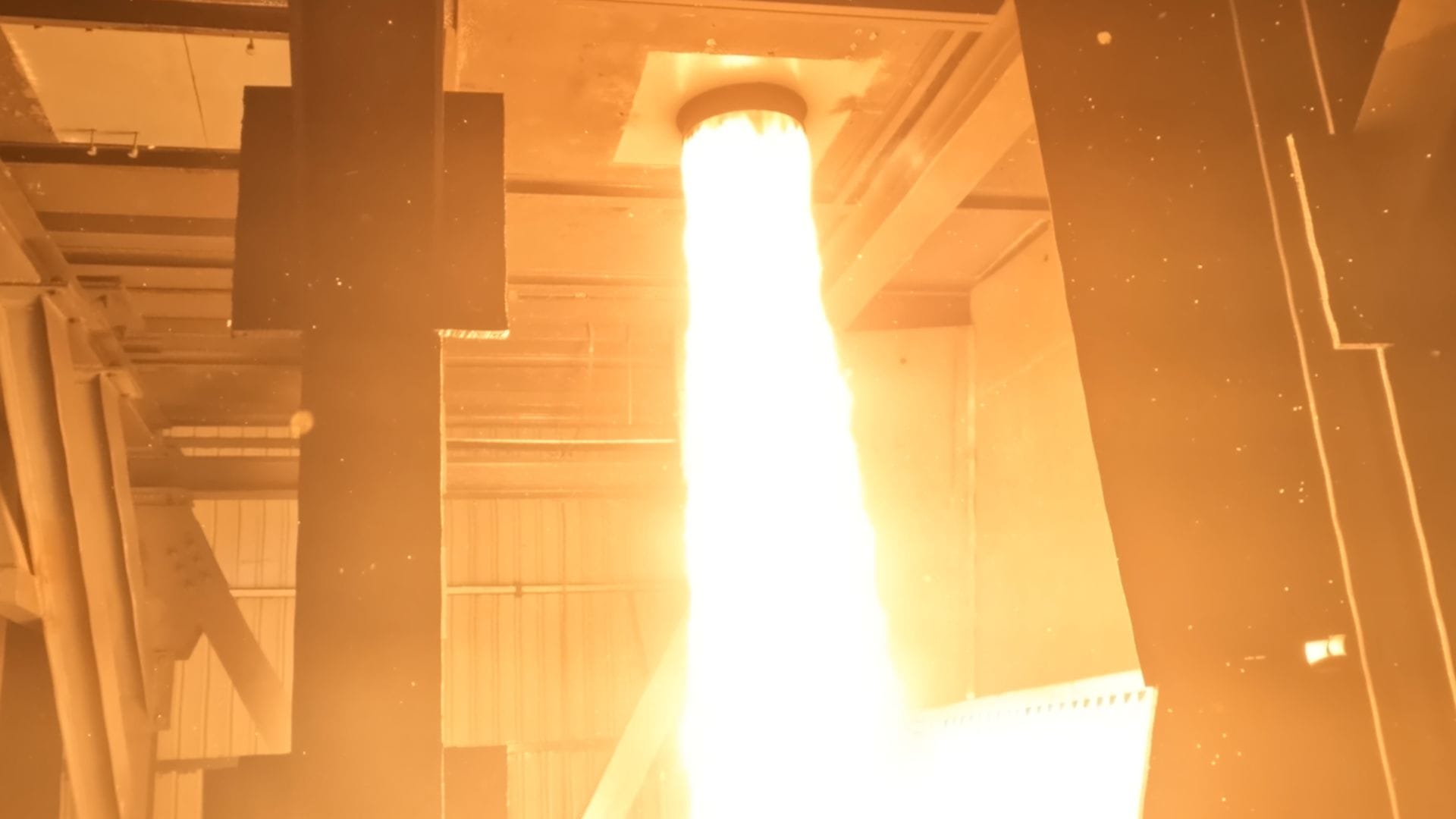
New Delhi: Chennai-based New Space startup Agnikul Cosmos has successfully conducted a test firing of its Agnite 3D printed semicryogenic engine. Unlike traditional engines that can take several months to manufacture, the Agnite engine can be 3D printed in just a week, dramatically reducing production complexity and turnaround time. The capability allows for faster launch responses, with missions ready to go at a much shorter notice than the industry norm. For satellite operators, this translates to a secure and firm launch schedule, access to custom orbital trajectories, and the ability to plan missions at a level of certainty that ride-sharing launches cannot offer. Agnite is a metre in length, and is the largest Inconel rocket engine ever built as a single piece.
Humbled to announce the successful firing of our single piece Agnite engine. Agnite engines power Agnibaan’s booster stage. These engine chambers are a full meter long, fully 3d printed as a single piece of hardware and made of Inconel. Agnite engines are driven by pumps that are… pic.twitter.com/dGlAJEt0Md
— AgniKul Cosmos (@AgnikulCosmos) March 25, 2026
Agnite is also the first engine of its scale to be tested by electric motor driven pumps. The engine was validated at Agnikul’s in-house test facility in Chennai Agnikul now operates a fully integrated launch ecosystem, with in-house mission control, dedicated ground stations and propulsion systems that have been demonstrated in missions. In a post on X, former ISRO Chairman S Somanath said, “A significant accomplishment indeed from AginiKul Cosmos. They are moving steadily to the goal of having a reusable rocket of medium size which is based on liquid propulsion technology. Capability to manufacture large size engines through MAM in-house is very noteworthy. Congratulations.”
Agnikul poised to scale rapidly
Cofounder and CEO of Agnikul Cosmos, Srinath Ravichandran said, “We chose single-piece Inconel construction and electric pump architecture specifically to solve our customers’ schedule problem and enhance automation of engine making. Traditional engines take months to build because you’re machining, welding, and assembling dozens of parts. Ours prints in a few days, which means we can respond to launch demand faster than the industry standard. Electric pumps are simpler than gas generators, fewer parts to refurbish between flights, which is critical for our reusability roadmap. These aren’t just technical choices but are the reasons why we can commit to low turnaround and actually deliver on it.”
Co-founder and COO of Agnikul Cosmos, Moin SPM said, “This engine test validates that our propulsion systems are ready to operate at the scale required for multiple launches per quarter. Our manufacturing capabilities are enabling us to produce engines in line with customer demand, rather than limiting it. With propulsion now largely de-risked, our focus is firmly on execution and demonstrating consistent launch cadence and mission reliability that can translate this pipeline into long-term partnerships and repeat business.” Last month, Agnikul test-fired a cluster of three semi cryogenic engines.