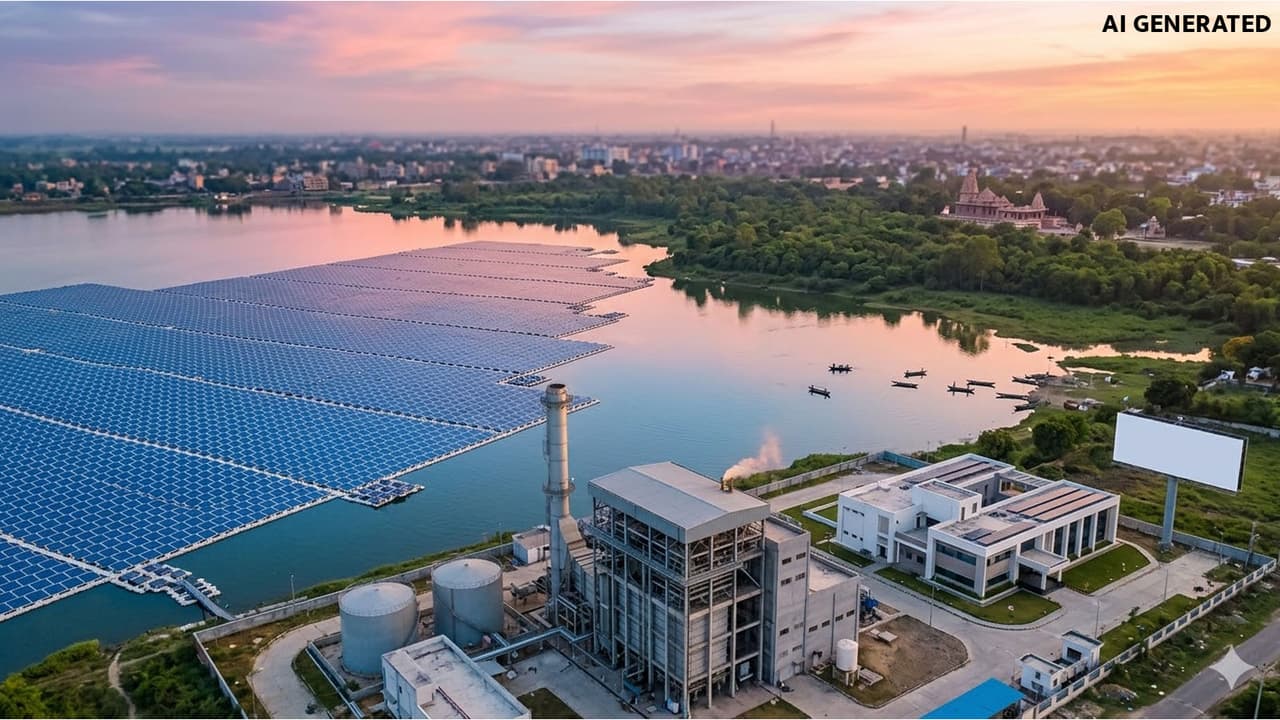
Approval for 20 MW floating solar plant has been given to make Gorakhpur a solar city. Also, coal block development and treated water policy will promote cheap electricity, water conservation and green energy.
Lucknow. An important decision has been taken to develop Gorakhpur as a solar city in the cabinet meeting chaired by Chief Minister Yogi Adityanath. Under this initiative, a 20 MW capacity floating solar power plant will be set up in Chiluatal, which will boost green energy production in the state.
Solar City target: 10% reduction in conventional energy in 5 years
As per the rules of the Ministry of New and Renewable Energy, any solar city has to reduce the consumption of conventional energy by at least 10% within 5 years. It has been targeted for Gorakhpur that approximately 121.8 million units of energy will be obtained from renewable sources, so that the energy needs of the city can be met in an environment-friendly manner.
Floating solar plant to be built on 80 acre area in Chiluatal
This floating solar plant will be installed on about 80 acres of water area in Chiluatal of Tehsil Sadar area of Gorakhpur. This land is under the Tourism Department, Revenue Department and Hindustan Fertilizers and Chemicals Limited. 11.4181 hectares (28.20 acres) of tourism department land will be given to Coal India Limited free of cost for the project. The company will set up a 20 MW capacity plant with its own resources. This land belongs to the pond category and comes in the safe category, hence planting floating plants on it will not have any negative impact on the environment and the nature of the water body will be preserved.
33.29 million units of green energy production every year
This solar project will generate at least 33.29 million units of green energy every year, which will be connected to the electricity grid. From this:
- Gorakhpur’s electricity needs will be met
- Dependence on traditional energy will reduce
- Environmental protection will be promoted
- Employment opportunities will increase at the local level
Floating solar plants already running in Auraiya and Khurja
Energy Minister A.K. Sharma said that already 20 MW floating solar plants are working in Auraiya and 11 MW in Khurja in the state. This new project of Gorakhpur will also be developed by Coal India Limited. This will further strengthen clean energy production, investment and employment in the state.
Pachwara South Coal Block approved: path to cheap electricity
The development of Pachwara South Coal Block has also been approved in the cabinet meeting. The total cost of this project is ₹2242.90 crore. The project will be operated by Neyveli Uttar Pradesh Power Limited (NUPPL), a joint venture between UP State Electricity Generation Corporation and NLC India Limited.
Financing Structure:
- 70% loan: ₹1570.03 crore
- 30% equity
This coal will be used in Ghatampur Thermal Power Plant (3×660 MW) in Kanpur city. Mining work has started from 19 December 2025 and coal production is targeted from August 2026.
Benefit of cheap electricity: Reduction up to Rs 1 per unit
According to the Energy Minister, this project will bring a major reduction in the cost of power generation. It is estimated that:
- Reduction by about 80 paise per unit
- Overall cheap electricity up to ₹ 1 per unit
This will ensure cheap and uninterrupted power supply in the state.
Treated Water Reuse Policy: A big step towards water conservation
Yogi government has prepared to implement a new policy for reusing treated water. Its purpose is to clean the waste water and reuse it.
Water management will be strengthened through STP and FSTP
The demand for water is increasing rapidly in the state. Keeping this in mind, the government is planning to clean the water and use it through Sewage Treatment Plant (STP) and Fecal Sludge Treatment Plant (FSTP).
Treated water policy will be implemented in three phases
This policy will be implemented in three phases:
first stage
- municipal use
- construction work
- gardening and irrigation
second phase
- Industry
- Agriculture
- Railway
third step
Supply of non-potable water to households through dual pipe system
Water conservation and environmental protection will get a boost
From this policy:
- Drinking water will be saved
- water pollution will reduce
- There will be better use of water resources
- Energy consumption will decrease
The government aims to strengthen water management through technology and innovation.