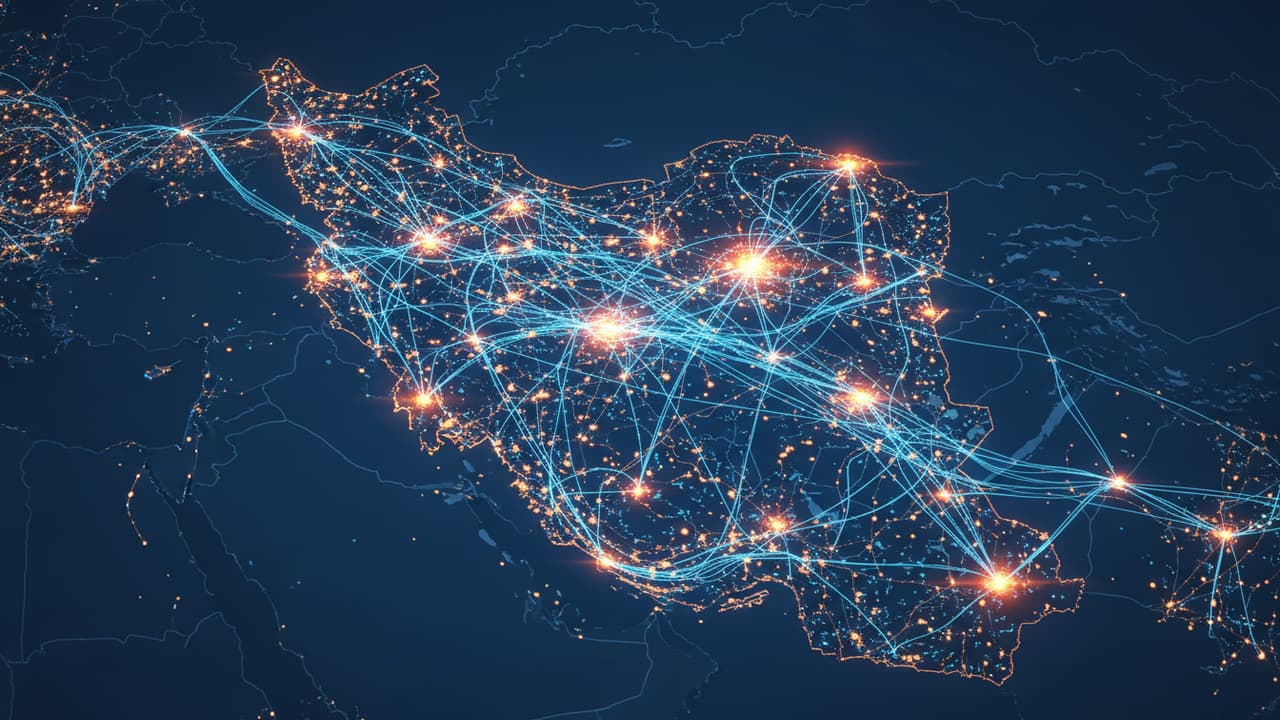
A warning by Trump about targeting Iran’s power plants has raised questions about how strong the country’s electricity system is. Experts say Iran’s grid is highly spread out and depends mainly on thermal plants, making it hard to shut down quickly. Even if major plants are hit, wide network mean power cuts would likely be local and temporary.
The United States President Donald Trump recently warned that Iran’s power plants could be targeted if trouble continues in the Strait of Hormuz — a critical sea route through which millions of barrels of oil travel every single day. This warning made the whole world stop and ask one simple question: Is Iran’s electricity system actually easy to destroy?
The honest answer is — no, it is not. And here is exactly why.
A Country Powered by Heat, Not Water
Iran supplies electricity to roughly 40.6 million users, out of which 32.3 million are ordinary homes — families cooking dinner, children studying under a bulb, hospitals keeping patients alive. That is a massive responsibility.
Now, you might think a country like Iran depends on rivers and dams for power. Not really. Even though official figures say hydropower contributes 13.4% of electricity capacity, the actual contribution is below 5% — because rivers and reservoirs are running low due to drought. So Iran leans almost entirely on thermal power plants — the kind that burn fuel like gas or oil to produce heat, which then generates electricity. These plants produce more than 95% of Iran’s total electricity.
There are roughly 130 such thermal power plants spread across the country, with a combined capacity of 78,000 megawatts. To give you a sense of scale — that is enough electricity to power hundreds of millions of homes.
The Big Plants — And Why Destroying Even One Is Not Simple
Among these 130 plants, around 20 are very large — each producing over 1,000 megawatts. Three of them are giants, producing over 2,000 megawatts each.
The biggest is the Damavand Power Plant, also called the Pakdasht Plant, located about 50 kilometres southeast of Tehran. It can generate approximately 2,900 megawatts and spreads across 200 hectares — imagine an area nearly 30 times the size of a large football stadium. It cost close to 2 billion euros to build.
Then there is the Neka Power Plant near the Caspian Sea, producing about 2,200 megawatts, and the Rajaei Power Plant near Karaj, generating around 2,000 megawatts.
Now here is the important part — even if the Damavand Plant is completely destroyed in a military attack, it would reduce Iran’s total electricity capacity by only about 3.7%. Iran can partially cover that loss by stopping electricity it currently exports to neighbouring countries — around 400 megawatts worth. So the damage, though serious, would not cripple the entire nation.
A Web So Wide, It Cannot Be Torn Easily
What truly makes Iran’s electricity system difficult to destroy is not just the number of plants — it is how the system is connected and spread out.
Iran’s main electricity transmission lines stretch for 133,000 kilometres. When you add local city and village lines, the total network crosses 1.3 million kilometres. That is longer than travelling from Earth to the Moon and back — nearly twice.
Supporting this massive network are around 857,000 transformers and somewhere between 2,000 to 5,000 large and medium substations placed across the country. A substation is basically a switching point that controls and distributes electricity to different areas.
Even if a few substations are bombed, the lights may go out temporarily in some neighbourhoods — but they come back. This has already happened near western Tehran and Karaj, where bright blue flashes lit up the sky — likely from substation explosions — causing brief blackouts that were later restored.
So, Can Iran Be Pushed Into Total Darkness?
Simply put — no. Not with a few targeted strikes.
Because the system is so large, so spread out, and so deeply connected across the country, hitting one plant or even a handful of substations cannot bring Iran to its knees electrically. The rest of the network absorbs the shock, and life — though disrupted in pockets — continues.
To truly switch off Iran’s electricity would require a massive, simultaneous, and sustained military campaign targeting hundreds of locations at once. That is not just difficult — it is a near-impossible task without causing a full-scale war.
Iran built its power system — perhaps without intending to — in a way that makes it surprisingly resilient against exactly this kind of threat.
(Girish Linganna is an award-winning science communicator and a Defence, Aerospace & Geopolitical Analyst. He is the Managing Director of ADD Engineering Components India Pvt. Ltd., a subsidiary of ADD Engineering GmbH, Germany.)
Disclaimer: The opinions expressed are solely those of the author and do not reflect the views or stance of the organization. The organization assumes no responsibility for the content shared.