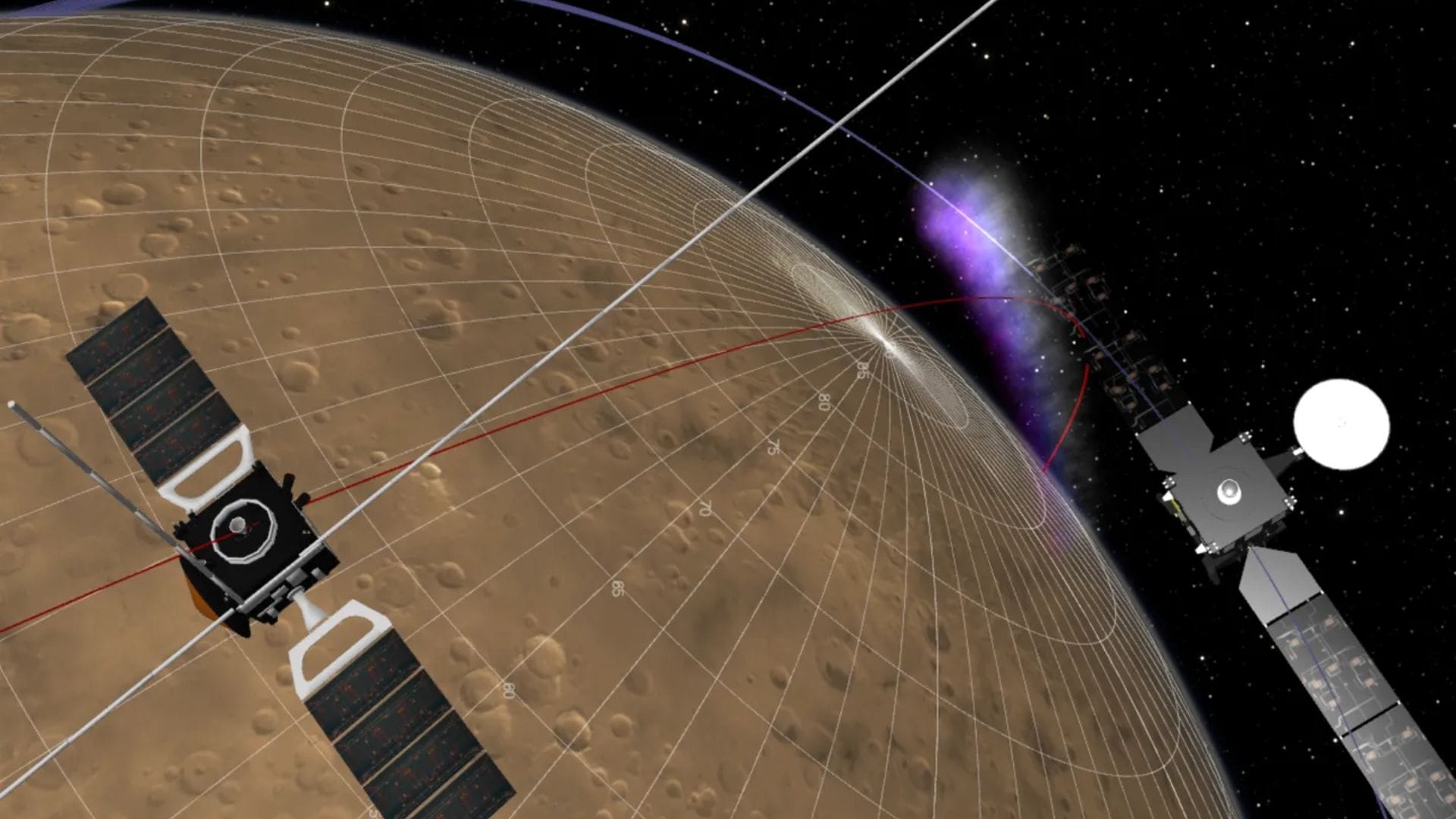
New Delhi: Earth was struck by the most intense solar storm in 20 years in May 2024, that also struck Mars. The event occurred as the Sun neared the peak of its 11-year activity cycle. The spectacular polar lights were visible in lower latitudes, as far south as London, Mexico and Mainland Europe. Serendipitously, the two Mars orbiters of the European Space Agency, Mars Express and the ExoMars Trace Gas Orbiter (TGO) were in perfect position to observe the response of the tenuous Martian atmosphere. The instruments on the spacecraft registered a surge of charged particles and severe disturbances in the upper atmosphere of Mars.
The strom resulted in a dramatic increase in electron density, with the lower ionospheric layer expanding to 278 per cent of its typical size. The radiation monitor on the TGO was exposed to 200 normal days of radiation in just 64 hours. The intense radiation also caused temporary computer errors on both the spacecraft, but they were able to recover quickly as they have been radiation-hardened by design. The researchers used a technique developed by ESA called mutual radio occultation to probe the atmosphere, with Mars Express transmitting a radio signal to TGO as it passed beyond the horizon. The signal passed through the layers of the atmosphere, bending in response to the charged environment, before reaching TGO, allowing researchers to reconstruct the structure of the Martian atmosphere as a response to the solar superstorm.
How Mars responds to Solar Activity
The research revealed that the atmosphere of Mars reacts differently to solar activity than the Earth. The magnetic field of the Earth deflects many incoming particles, transporting others towards the polar regions. These particles induce the spectacular polar lights as they enter the atmosphere. Mars is not protected by a geomagnetic field, and is directly exposed to the solar wind. Fast-moving solar plasma and X-rays stropped electrons from neutral atoms in the upper atmosphere, rapidly filling it with charged particles. A paper describing the research has been published in Nature Communications.