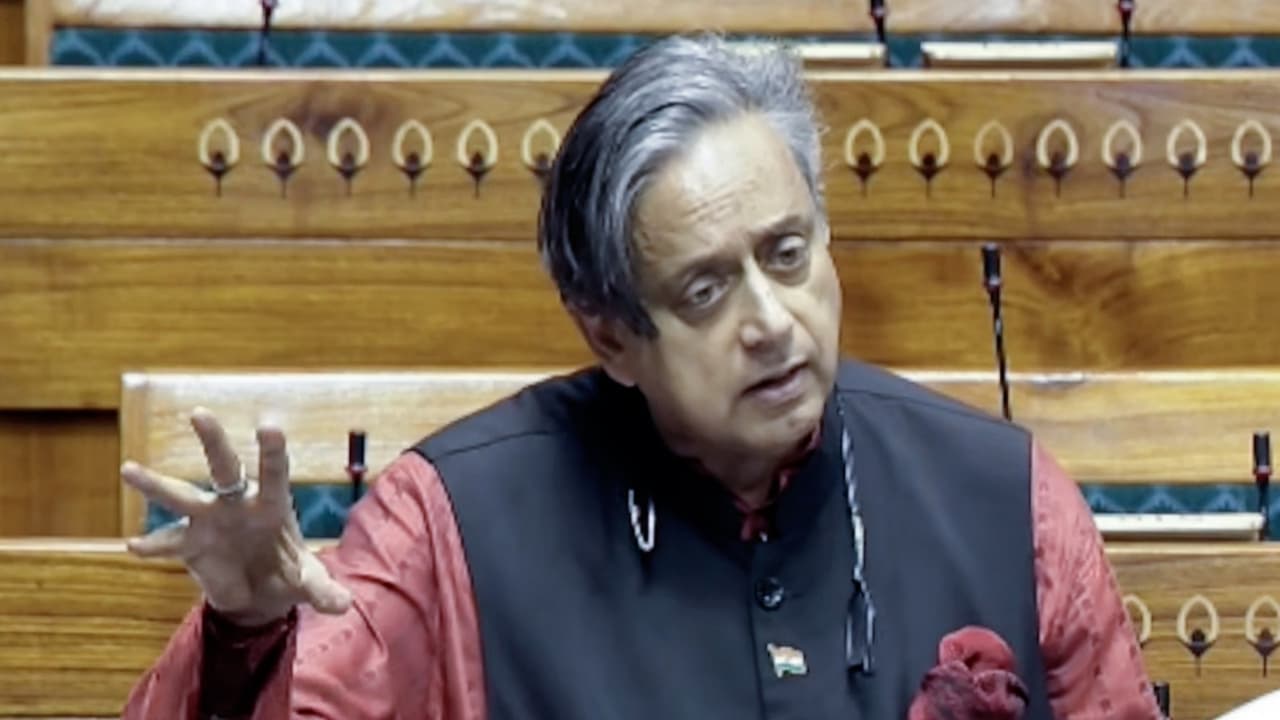
Congress MP Shashi Tharoor slammed the Transgender Persons Amendment Bill, 2026, as ‘deeply regressive.’ He said it reverses the landmark NALSA judgment by deleting the right to self-perceived gender identity in favour of medical verification.
Tharoor Criticises ‘Regressive’ Amendments
Congress MP Shashi Tharoor on Sunday criticised the newly introduced Transgender Persons (Protection of Rights) Amendment Bill, 2026, in Parliament, labelling it a “deeply regressive” proposal that threatens to reverse rights for the community. In a post on X, the Thiruvananthapuram MP expressed deep concern that the Bill was tabled “surreptitiously and without proper stakeholder consultation”.
Undermining Self-Perceived Gender Identity
Tharoor argued that the amendments undermine the landmark 2014 Supreme Court NALSA judgment by deleting Section 4(2) of the 2019 Act, which guaranteed the right to self-perceived gender identity. “The Bill appears to represent a fundamental reversal of the rights-based framework established after the Supreme Court’s landmark NALSA (2014) judgment. The amendments delete Section 4(2) of the 2019 Act, which guaranteed the right to self-perceived gender identity, and replace it with systems of medical board verification and bureaucratic certification before identity can be recognised,” Tharoor stated.
The proposed Bill seeks to give a precise definition for proper and definitive identification and protection of transgender persons to whom the benefits of Transgender Persons (Protection of Rights) Act, 2019 must reach.
Claiming that the new definition of “transgender person” is drastically narrowed, the MP said that it “risks excluding trans-men, trans-women, non-binary and gender-diverse persons who were previously recognised under the law, while reducing gender identity to biological markers or a handful of socio-cultural categories.”
Privacy Concerns and Call for Scrutiny
Furthermore, the MP raised alarm over privacy concerns regarding the mandatory reporting of gender-affirming surgeries to government authorities. Tharoor added that this could create a State registry of deeply personal medical decisions, which is “difficult to reconcile with the Supreme Court’s Puttaswamy judgment on the right to privacy.”
Asserting that the Bill risks pushing a marginalised community back into legal invisibility, Tharoor said, “These provisions risk pushing large sections of India’s transgender community, which has faced acute historical marginalisation, back into legal invisibility. At the very least, a Bill with such far-reaching consequences must be referred to a Standing Committee for proper scrutiny. One can only hope that reason and constitutional morality will ultimately prevail over this deeply regressive proposal. that it be referred to a Standing Committee for proper scrutiny.”
Bill’s Introduction and Proposed Changes
Earlier, on March 14, Social and Justice Minister Virendra Kumar introduced the Transgender Persons (Protection of Rights) Amendment Bill, 2026, in the Lok Sabha. The Bill aims to amend the Transgender Persons (Protection of Rights) Act, 2019. The Bill also proposes to substitute section 18 of the principal Act, creating specific offences with graded punishments that reflect the gravity of the harm, the irreversibility of the injury, and the particular vulnerability of child victims.
Representation for CAPF Veterans
Meanwhile, the Tharoor also wrote a letter to Union Home Minister Amit Shah on Sunday, conveying a representation received from CAPF veterans on certain service-related and institutional matters, requesting that their concerns receive due and considered attention, ahead of the Central Armed Police Forces (General Administration) Bill, 2026 discussions in Parliament. (ANI)
(Except for the headline, this story has not been edited by Asianet Newsable English staff and is published from a syndicated feed.)