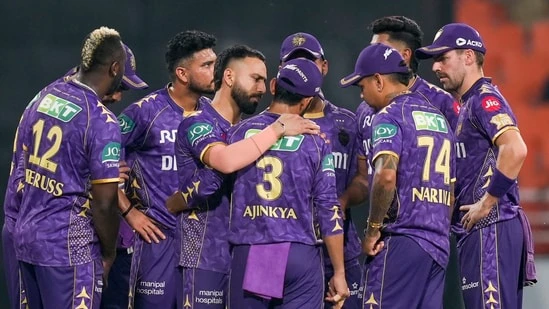
Kolkata Knight Riders enter IPL 2026 looking like a side with a very clear cricketing identity. On paper, this is a strong squad: Narine and Varun remain an elite spin core, Ajinkya Rahane gives them experience, Cameron Green gives them the chance to build a more modern batting-balance XI, and there is enough overseas flexibility to change shape by opponent and venue.
But the timing of their problems matters. KKR go into the season with their Indian pace resources already weakened, Akash Deep ruled out, Harshit Rana unavailable, and Matheesha Pathirana expected only from mid-April. That changes the squad’s texture.
This is why KKR are difficult to place. They are neither a flimsy team nor a cleanly complete one. Compared to the strongest-looking IPL 2026 builds, KKR have one unquestionable edge- middle-overs spin control, but they also carry more volatility in seam bowling and role clarity than a genuine top-two favourite would usually want. They can absolutely make the playoffs. They can also lose two or three games early simply because the attack is incomplete and the batting order is still searching for its best version. That is the range of this squad.
KKR Squad for IPL 2026
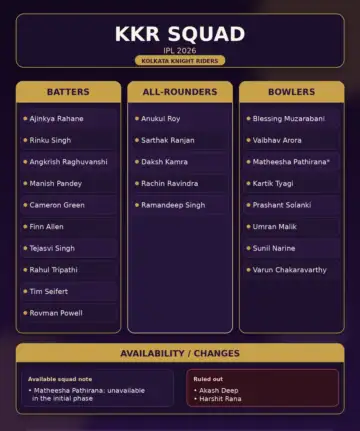 Strengths of KKR in IPL 2026
The spin core still gives KKR a title-level match-up weapon
The cleanest strength in this squad is still the same one that has defined KKR’s best cricket: they can choke the middle overs better than most teams. Varun Chakaravarthy remains one of the best wicket-taking middle-overs spinners in the format; in IPL 2024, he took 21 wickets, and at the 2026 T20 World Cup, he finished with 14 wickets, joint-most in the tournament. Sunil Narine, meanwhile, continues to offer rare dual value. KKR still get batting disruption plus bowling control from one overseas slot. That combination matters because it lets them build XIs that are flexible elsewhere. Few teams can enter a game already knowing that overs 7-15 can be dictated by a genuine advantage.
Rahane gives them more stability and tempo than many realise
Ajinkya Rahane is not on this side as a nostalgia pick. His IPL 2025 output was 390 runs at a strike rate of 147.72, and in the 2025 Syed Mushtaq Ali Trophy, he made 391 runs at a strike rate above 161. That is important because KKR’s batting is not built around one giant Indian top-order superstar in peak T20 mode. It is built around getting shape, tempo and decision-making right. If Rahane gives them a stable powerplay batting without dragging the innings down, Narine can be used more aggressively, Angkrish can be better protected, and Rinku can be saved for the phase that suits him best.
Their overseas options allow multiple XIs
This is one of the squad’s more underrated aspects. KKR can field Narine with Green, Pathirana and Powell if they want finishing and death bowling. They can swap Powell for Rachin Ravindra if they need another batting stabiliser or a left-hander. They can bring in Finn Allen or Tim Seifert if they want a more explosive start. Green’s IPL career numbers: 707 runs at a strike rate of 153.70, show why KKR paid so heavily for him. KKR do not just have names; they have combinations.
Weaknesses of KKR in IPL 2026
The pace attack has already lost structural balance
This is the squad’s biggest problem and the one that should drive any honest verdict. Akash Deep is out. Harshit Rana is out for the season. Pathirana is expected only around mid-April. That means KKR begin the season without two Indian seam options they could have trusted, and without the overseas death specialist they spent heavily on. This is not a minor inconvenience; it disturbs every phase. New-ball planning becomes thinner, middle-overs bridging gets weaker, and death overs depend on patchwork rather than design. Muzarabani is a smart replacement for Mustafizur, but it is not the same as continuity.
The batting has options, but not enough locked roles
A good T20 squad can be flexible. A great T20 squad knows exactly which roles are non-negotiable. KKR are not fully there. Rahane is role-clear. Narine is role-clear. Rinku is obviously central. But after that, the questions stack up. Is Green a top-four banker or a floating accelerator? Is Rachin the first choice or just a match-up cover? Is Powell a regular in Indian conditions? Can Rahul Tripathi be trusted after a 2025 season of only 55 runs at a strike rate of 96.49? There are pathways in this batting unit, yes, but also selection noise. Too many players make sense in theory, but they don’t yet feel inevitable in the XI.
Russell’s old panic-button value is gone
Andre Russell’s exit matters because KKR are no longer carrying that single-player cheat code that could rescue poor balance through brute force. Abhishek Nayar has already framed Rinku Singh and Ramandeep Singh as domestic players who will need to absorb some of that responsibility. That is a reasonably long-term idea, but it also reveals the truth: this squad is less terrifying at the back end than classic KKR sides were. They may be smarter, but they are not automatically more damaging.
 Opportunities for KKR in IPL 2026
Angkrish and Rinku can turn this from functional to dangerous
Angkrish Raghuvanshi’s upward curve and Rinku’s established finishing pedigree are what can make this batting more than merely serviceable. KKR do not necessarily need a 650-run superstar. They need one of their Indian batters apart from Rahane to become a phase-winning presence. If Angkrish becomes a real No. 3 and Rinku returns to high-leverage finishing impact, the batting suddenly looks far deeper than the raw names suggest.
Eden can still be their playoff engine
Even with pace concerns, KKR have a strong home blueprint: squeeze through spin, bat with flexibility, and let Narine-Varun own the middle overs. Teams with a clear home identity survive bad patches better than talented but vague teams. KKR’s path to qualification is obvious enough to be useful.
Threats for KKR in IPL 2026
Early-season points loss could define the campaign
Because Pathirana is not expected until mid-April and Harshit is unavailable, KKR risk entering the competition as a half-built bowling attack. IPL tables harden quickly. A team can recover from one bad week; recovering from a compromised opening block is harder. If KKR lose early games because they cannot close innings with the ball, their stronger version may arrive only after damage is already done.
Overdependence on spin can become predictable
Narine and Varun are elite, but if too much of KKR’s identity depends on them controlling games, opponents with strong spin-hitters or flatter surfaces can pull the contest away from KKR’s preferred script. That risk grows when the pace attack is already depleted.
X-factor player for KKR in IPL 2026
Cameron Green
 Cameron Green is the axis of this squad. Not Narine, who is already a known quantity. Not Pathirana, whose availability is delayed. Green. KKR paid a record ₹25.20 crore for him because he can solve two problems at once: top-order batting power and seam-bowling balance. His IPL career numbers tell you the batting upside, and his overall value lies in the fact that when he works, KKR can field a better XI without feeling one batter or one bowler short. He is not just their most expensive buy; he is their most important structural bet.
Best probable playing XI of KKR for IPL 2026
Sunil Narine✈️
Finn Allen/ Tim Seifert ✈️ (wk)
Ajinkya Rahane
Angkrish Raghuvanshi
Cameron Green ✈️
Rinku Singh
Ramandeep Singh
Varun Chakarvarthy
Vaibhav Arora
Blessing Muzarabani ✈️
Umran Malik/Kartik Tyagi
Impact Substitute: Anukul Roy/Daksh Kamra
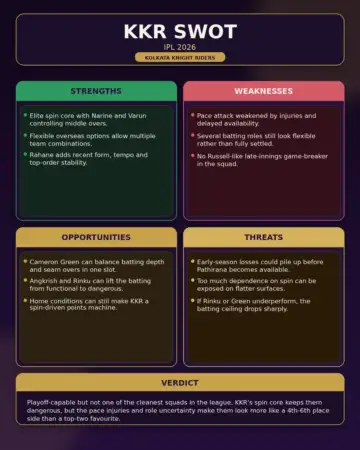
Verdict
KKR do not look like the best squad in IPL 2026. They also do not look weak enough to dismiss. The honest view is this: they are probably a 4th-6th place squad, with 5th feeling the most realistic pre-season call. The reason is simple. The spin quality is elite, the batting has enough modularity to work, and Green gives them one genuine upside lever. But compared to the cleaner, more balanced contenders, KKR are carrying too many bowling-availability problems and too many batting-role questions at the same time. If Pathirana returns sharp and Green becomes the fulcrum KKR paid for, they can still make the playoffs. If the early pace damage costs them points, they could easily spend the season chasing instead of leading. There is enough quality here to compete, but not enough certainty to call them a top-tier favourite.