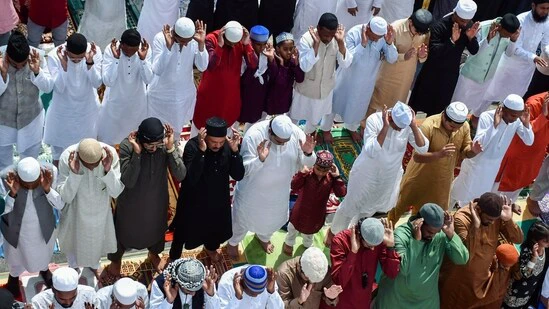
Across India, Eid-ul-Fitr was marked with prayers, gatherings and festive meals on Saturday. But in Kintur village in the Badosarai area of Uttar Pradesh, the day passed without the usual celebrations.
For the Shia community here, this Eid was observed in silence. The reason lies far beyond the village, in Iran, where the death of Ayatollah Ali Khamenei in airstrikes by the United States and Israel on March 1 has left a deep emotional impact on Shia Muslims in particular.
Mourning instead of celebration
Rather than festivities, residents chose restraint. The usual celebrations of Eid-ul-Fitr, sweets, greetings, and family gatherings were missing, news agency PTI reported.
Sarwar Ali, caretaker of the 19th-century Waqf Nawab Amjad Ali Khan Imambara, described how the day unfolded and said, “Shia families observed no festivities this year. They did not prepare ‘sewaiyaan’ (sweet vermicelli) at home or embrace each other; they only offered the congregational prayers. A protest demonstration was carried out peacefully.”
People gathered not just for prayers but also to express their anger over what they called “unjust” military action against Iran. Slogans were raised against Israel, though the demonstration remained peaceful.
Dr Rehan Kazmi, a resident, said the mood in the village was sombre, with a clear sense of grief following Khamenei’s killing.
Residents say the village shares ancestral roots with Ayatollah Ruhollah Musavi Khomeini, the leader of Iran’s 1979 Islamic Revolution and the founding figure of the Islamic Republic. Ayatollah Ruhollah Khomeini was the mentor of the slain Ayatollah Ali Khamenei.
Syed Nihal Ahmad Kazmi, who claims to be a descendant of Khomeini’s family, had earlier said that Musavi participated in India’s freedom movement before travelling to Iran in 1834. Due to restrictions imposed by the British administration at the time, he could not return and eventually settled in the city of Khomein, where Khomeini was later born.
For many in Kintur, the connection extends beyond history. Ayatollah Ali Khamenei had been a disciple of Khomeini and succeeded him after his death in 1989, carrying forward his legacy.