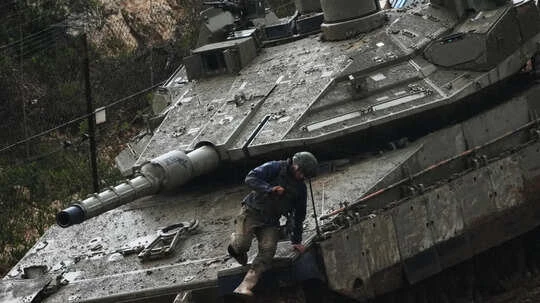
Israeli Defense Minister Israel Katz announced that attacks against Iran will increase significantly in the coming week. Katz made this statement on Saturday, shortly after U.S. President Donald Trump indicated he was considering winding down military operations in the Middle East, despite the U.S. deploying additional warships and Marines to the region amidst Iranian threats to target tourist sites globally.
The conflicting messages emerged as oil prices surged, causing a decline in the U.S. stock market, followed by an announcement from the Trump administration to lift sanctions on Iranian oil aboard ships, a strategy aimed at addressing rising fuel costs.
The ongoing conflict has shown no signs of abating. Iran reported that its Natanz nuclear facility was struck in an airstrike on Saturday, although officials stated there was no radiation leakage. Concurrently, Israel claimed Iran continued missile attacks against it, while Saudi Arabia announced the interception of 20 drones in its eastern region, which houses significant oil installations. The Saudi defense ministry confirmed there were no injuries or damage from these incidents.
The death toll from the conflict has surpassed 1,300 in Iran, over 1,000 in Lebanon, and includes 15 in Israel and 13 U.S. military personnel in the region, with millions displaced in both Lebanon and Iran.
In a notable development, Iran may have utilized a space launch vehicle to target ballistic missiles at Diego Garcia, a British base in the Indian Ocean located nearly 4,000 miles away. Previously, Iran had limited its ballistic missile range to 1,240 miles, but U.S. officials suggested that Iran’s satellite launch capabilities could extend this range.
Justin Bronk, a senior research fellow at the Royal United Services Institute, noted that the Simorgh space launch vehicle could enhance missile range, albeit potentially sacrificing terminal accuracy. Steve Prest, a retired Royal Navy commodore, emphasized the connection between space programs and ballistic missile capabilities, stating, ‘Ballistic missiles are space rockets. They launch, they go really high up and they come down really fast.’ He also suggested that these launches were likely intended as a defiant message in response to Trump’s assertions regarding Iran’s military capabilities.
Egyptian President Abdel-Fattah el-Sissi and Saudi Crown Prince Mohammed bin Salman expressed on Saturday that Iranian attacks on Gulf states jeopardize regional stability. The Saudi Press Agency reported that el-Sissi reiterated Egypt’s condemnation of the Iranian assaults and voiced solidarity with Saudi Arabia against such threats. Additionally, Arab League chief Ahmed Aboul Gheit welcomed the recent visits of el-Sissi and Jordan’s King Abdullah II to various Gulf states, highlighting a show of Arab unity.
House Speaker Mike Johnson stated that the military operation in the Middle East is nearing completion, claiming, ‘I do think the original mission is virtually accomplished now.’ Johnson acknowledged the challenges posed by Iran’s threats in the Strait of Hormuz, particularly as U.S. allies have largely declined to support Trump’s requests for assistance. He expressed optimism that the military engagement would soon conclude once stability is restored.
The ongoing conflict is testing the resolve of Congress, controlled by Trump’s Republican party, as the president initiated military operations without congressional approval. Under the War Powers Act, the president can conduct military actions for 60 days without legislative consent. Thus far, Republican lawmakers have dismissed several Democratic proposals aimed at halting the military campaign. However, legislators have indicated that the administration must present a more comprehensive strategy to avoid potential backlash, particularly as Congress considers new funding requests.
Israel’s military denied responsibility for the attack on Iran’s Natanz nuclear site, which Iranian state media reported had been damaged without causing radiation leakage. Katz stated in a video message that the intensity of attacks by Israel and the U.S. against Iran’s regime would significantly escalate in the coming week.
Reports indicate that a hospital and a tourist site in southwestern Iran sustained damage from U.S. or Israeli strikes, resulting in at least one child’s death. Iranian state media reported that the Ritaj entertainment complex in Ahvaz was hit, and the Imam Ali Hospital in Andimeshk was also damaged, leading to its closure for new patients.
As the conflict enters its fourth week, the death toll continues to rise, with more than 1,300 casualties in Iran, over 1,000 in Lebanon, 15 in Israel, and 13 U.S. military members. Lawmakers in Congress are increasingly questioning the timeline and costs associated with the war in Iran, with at least 13 U.S. personnel reported dead and over 230 wounded. The Pentagon’s pending request for $200 billion in war funding adds to the pressure as oil prices spike and U.S. allies face attacks.
Senator Thom Tillis emphasized the need for clarity regarding U.S. objectives in the conflict, stating, ‘The real question is: What ultimately are we trying to accomplish?’ He expressed general support for actions against the Iranian regime but stressed the importance of a clearly articulated strategy.
Russian Foreign Ministry spokesperson Maria Zakharova condemned the strikes on the Natanz facility as a violation of international law, warning that such actions pose a significant risk of disaster in the Middle East and undermine regional peace and stability.
In Bahrain, authorities reported the sounding of sirens, indicating a potential attack. U.S. Central Command leaders claimed that U.S. forces are focused on degrading Iran’s power projection capabilities. Admiral Brad Cooper detailed military actions aimed at reducing Iran’s control over the vital Strait of Hormuz, crucial for international oil shipping.
Cooper reported that U.S. forces have targeted underground facilities along Iran’s coastline used for missile storage and launchers, stating that these operations aim to protect freedom of navigation in the area. He added that the U.S. has established a comprehensive air defense system over the Middle East.
Twenty-two countries, including the UAE, Bahrain, the U.K., Germany, France, Japan, South Korea, and Australia, condemned Iran’s attacks on commercial vessels and oil facilities, asserting that the repercussions of Iran’s actions will impact vulnerable populations globally.
On Saturday, thousands of worshippers gathered at Tehran’s grand mosque for Eid al-Fitr prayers, marking the end of Ramadan. Many expressed sorrow over the absence of Iranian Supreme Leader Ayatollah Ali Khamenei, who was killed early in the conflict. Masoud Alibenam, a 50-year-old worshipper, reflected on the painful feeling of praying without Khamenei’s presence.
Jordan’s military reported that missile attacks during the week resulted in injuries to a child, bringing the total wounded to 24 since the conflict began on February 28. Over the past three weeks, 240 missiles and drones have been launched at Jordan.
The Diego Garcia air base, crucial for U.S. military operations, has been targeted by Iranian missiles, though details on the strikes remain unclear. The base, approximately 2,500 miles from Iran, has been a focal point in the ongoing conflict.
British officials condemned Iran’s actions, labeling them reckless and emphasizing the threat to British interests and allies. The U.K. has allowed U.S. bombers to utilize British bases for operations against Iran’s missile sites.
In conclusion, Israeli Defense Minister Israel Katz reiterated that attacks on Iran will escalate in the upcoming week. His statements underscore the ongoing volatility in the region and the complex dynamics at play as military operations continue.
The International Atomic Energy Agency has reported no increase in radiation levels at the Natanz facility following the recent attacks, as the agency continues to monitor the situation closely.
Russian President Vladimir Putin expressed solidarity with Iran, calling for resilience in the face of ongoing challenges and reaffirming Moscow’s commitment to its partnership with Tehran.
The United Arab Emirates reported responding to missile and drone attacks, highlighting the ongoing threats posed by Iranian aggression in the region.
In summary, the conflict continues to escalate with significant implications for regional and global stability as both military actions and diplomatic efforts unfold.