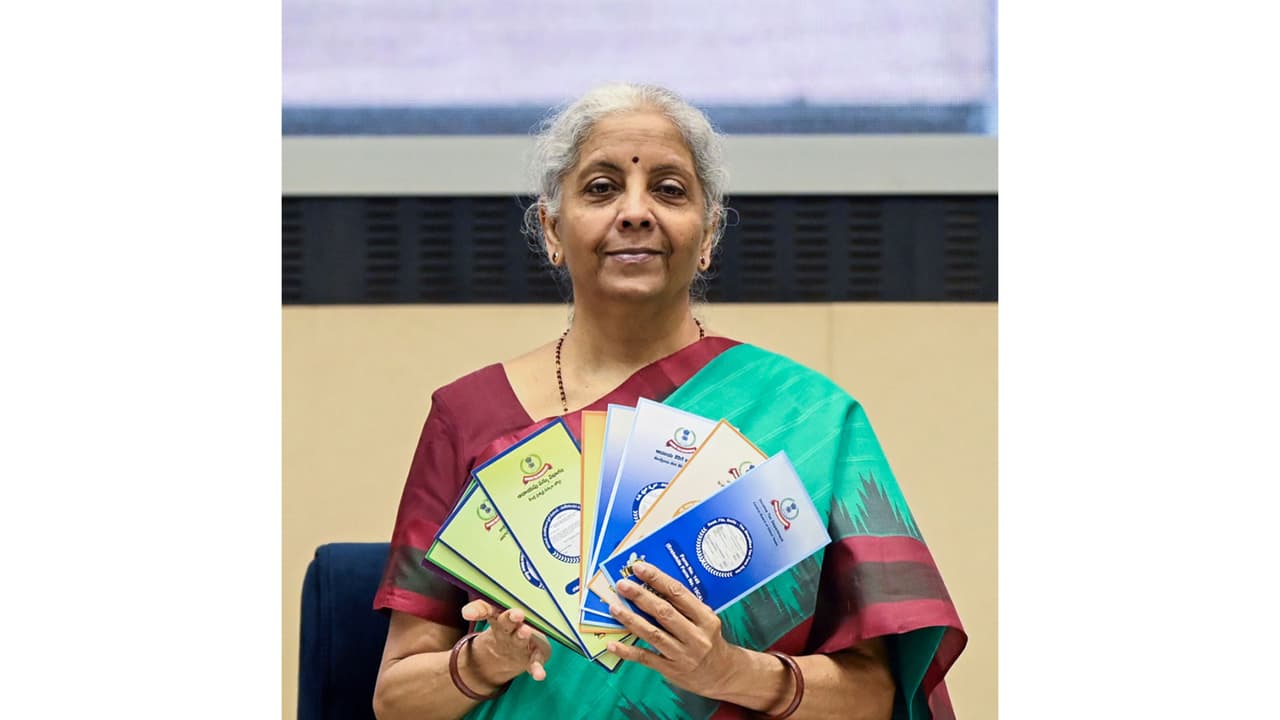
Finance Minister Nirmala Sitharaman launched the simplified Income-tax Act, 2025, calling on tax officers to partner with taxpayers. The new law, part of Mission Viksit Bharat, aims to reduce litigation and enhance clarity and compliance.
In a stirring address that blended patriotic fervour with a call for institutional transformation, Finance Minister Nirmala Sitharaman on Friday urged Income Tax officers to shed the old adversarial mindset and embrace a new spirit of partnership with taxpayers – setting the tone with the immortal lines of a beloved Hindi song: “Chhodo kal ki baatein, kal ki baat puraani, aao milkar likhenge hum Income Tax ki nai kahani, hum Hindustani.” The Finance Minister was speaking at the launch of PRARAMBH 2026 – the nationwide awareness campaign on the Income-tax Act, 2025, anchored around the theme of Policy Reform and Responsible Action for Mission Viksit Bharat.
A Simpler, Fairer Tax Law
Finance Minister Nirmala Sitharaman commended income tax officials for their timely and dedicated efforts, stating that the new Income Tax Act, 2025, is “simpler, fair and clear” and will set a new benchmark in making India a tax-friendly country. The Finance Minister said the new income tax rules will come into effect from April 1 and praised the Income Tax Department for completing the extensive overhaul in record time.
Key Legislative Reforms
Highlighting key reforms, Sitharaman noted that the simplified law removes redundant provisions and archaic language, reducing the number of sections from 819 under the Income Tax Act, 1961, to 536, while chapters have been brought down from 47 to 23. She further said the total word count of the legislation has been nearly halved from 5.12 lakh to 2.6 lakh.
For the first time, the new framework introduces 39 tables and 40 formulas to replace dense textual provisions, improving clarity and ease of interpretation. The exercise was completed in a record six months, with nearly 75,000 person-hours contributed by income tax officials.
New Role and Expectations for Tax Officials
Addressing the assembled tax officials, Sitharaman was unambiguous in redefining the role of the Income Tax department. “You are not a tax collector. You are the face of the government’s relationship with the taxpayer,” she said. “Internalise the spirit of this new law. The spirit is simple – the taxpayer is not your adversary. They are your partner in nation building.”
Laying out a clear roadmap, the Finance Minister enumerated six broad expectations from the Income Tax department as it embarks on implementing the new law:
Samvad – Reach Out, Listen, Engage
Sitharaman called for institutionalised dialogue sessions with taxpayers across the country. “Approach chartered accountants, businessmen – reach everywhere, with everyone, through every medium,” she said, stressing that taxpayer outreach must be proactive and inclusive.
Reduce Litigation
Finance Minister hopes that the New Income Tax will reduce litigation. She called on officers to have less temptation to take matters to court and to make things easy for taxpayers.
Technology – Respond Immediately
The Finance Minister called for the aggressive use of technology to respond to taxpayer queries promptly and efficiently, leaving no room for delay or ambiguity in communication.
Engage Proactively with the Youth
Sitharaman emphasised that the department must reach out to the next generation of Indians. “We must proactively engage with the youth of the country,” she said, adding that a dedicated tax literacy campaign for young Indians would go a long way in building a culture of voluntary compliance.
Institutionalise Young Professionals in CBDT
In a forward-looking proposal, the Finance Minister asked whether young professionals could be formally brought into the Central Board of Direct Taxes (CBDT). She suggested holding hackathons with the Institute of Chartered Accountants of India (ICAI) and other institutions to engage young professionals and drive youth-led innovation in tax administration.
Use Technology to Arrest Evasion
While calling for partnership with honest taxpayers, Sitharaman was equally firm about those who wilfully evade their obligations. “Those who are wilfully getting away – technology will catch them,” she warned, making clear that the new law’s reformist spirit does not mean leniency toward deliberate non-compliance.
A Call for Genuine Cultural Change
In a pointed caution, the Finance Minister urged all stakeholders to ensure the Income-tax Act, 2025, does not suffer the same fate as the legislation it replaces. “Do not let this new Act meet the same fate as the old one. Let this Act not become the 1961 Act,” she said – a clear signal that the government expects genuine cultural and administrative change, not merely a legislative rebrand.
Aligning with PM Modi’s MANAV Vision
Sitharaman also drew a powerful connection between the new tax legislation and Prime Minister Narendra Modi’s vision of MANAV, a human-centric framework for the digital era, articulated by the PM at the recent AI Summit: Moral and Ethical Systems. She explained that M.A.N.A.V. stands for M – Moral and Ethical Systems, A – Accountable Governance, N – National Sovereignty, A – Accessible and Inclusive AI, V – Valid and Legitimate Systems.
She said the Income-tax Act, 2025 must be rooted in moral and ethical systems, strengthen and protect fiscal national sovereignty, and build valid, legitimate systems based on trust with the taxpayer, aligning with the principles of accountable governance, accessibility, and inclusivity. “The Income-tax Act, 2025 must be rooted in moral and ethical systems,” the Finance Minister said. “We need to strengthen and protect fiscal national sovereignty. And the reforms we are building are not just data-driven – they are valid, legitimate systems built in trust with the taxpayer.” (ANI)
(Except for the headline, this story has not been edited by Asianet Newsable English staff and is published from a syndicated feed.)