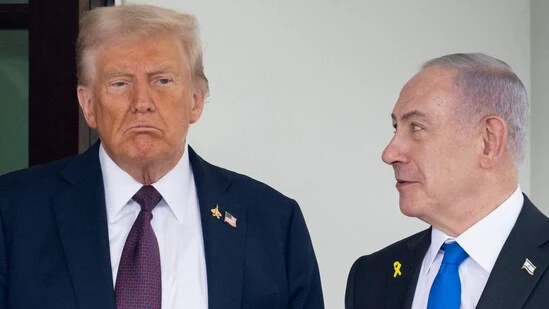
Weeks after a joint US-Israeli offensive against Iran triggered tensions across the Gulf, apparent differences have emerged between US President Donald Trump and Israeli Prime Minister Benjamin Netanyahu over Israel’s decision to strike a key Iranian gas field.
Israel’s attack on the South Pars gas field triggered retaliatory Iranian strikes on energy infrastructure across the Middle East, pushing already high global energy prices even higher and prompting Gulf allies to urge Trump to rein in Netanyahu.
What are the signs of diverging goals in US-Iran war?
The fallout has raised questions about how aligned the two leaders are in conducting a war that initially began as a closely coordinated effort. Any perceived gap between them could influence both the trajectory of the conflict and its eventual outcome.
Speaking during an Oval Office meeting with Japanese Prime Minister Sanae Takaichi, Trump said he did not support Israel’s strike on what is considered Iran’s most critical energy asset.
“I told him, ‘Don’t do that,'” Trump said of Netanyahu’s decision. “We get along great. It’s coordinated, but on occasion he’ll do something. And if I don’t like it — and so we’re not doing that anymore.”
Netanyahu on shared cause with US
Netanyahu, however, said Israel “acted alone” in carrying out the strike and confirmed he has agreed to Trump’s request to avoid further attacks on the gas field. He also downplayed any differences between the two.
“It’s been said that for 40 years I’ve been saying that Iran is a danger to Israel and a danger to the world. That is true,” Netanyahu said in Jerusalem. “You know who else said that? President Trump.”
He added: “Look, I don’t think any two leaders have been as coordinated as President Trump and I. He’s the leader. I’m his ally. America is the leader.”
Trump’s first public reaction to the strike came hours later in a social media post, where he said the US “knew nothing” about the attack beforehand.
However, two sources familiar with the matter said Washington had prior knowledge of Israel’s plans, with one adding that targets are being coordinated between the two countries, according to The Associated Press.
Netanyahu also said Trump had asked Israel to hold off on further such attacks, Reuters reported.
US-Israel alignment on war with Iran
Senior US officials have since tried to emphasise alignment between Trump and Netanyahu, while noting that Washington’s strategy is ultimately driven by US national security interests.
The US campaign has focused on weakening Iran’s missile capabilities, targeting its nuclear programme and striking naval assets. Israel, by contrast, has pursued a more aggressive strategy, including high-profile assassinations, as part of a broader effort to destabilise Iran’s leadership.
Nuclear weapons vs Middle East dominance
Netanyahu has framed the conflict as an opportunity to reshape the Middle East, envisioning a future where Iran is governed by a more moderate leadership. Strong domestic support in Israel has given him the political space to pursue an extended campaign.
Trump, meanwhile, has consistently maintained that his primary objective is to ensure Iran “never has a nuclear weapon,” even as his broader rhetoric around the conflict has shifted.
“The objectives that have been laid out by the president are different from the objectives that have been laid out by the Israeli government,” Director of National Intelligence Tulsi Gabbard told lawmakers during a House intelligence hearing.
In recent days, Trump has also tempered earlier suggestions of regime change in Iran. While he previously indicated that Iranians could soon have a chance to overthrow their leadership, he has since expressed doubts about the feasibility of such an outcome.
“So, I really think that’s a big hurdle to climb for people that don’t have weapons. I think it’s a very big hurdle,” Trump said in a recent Fox News Radio interview.
Asked whether he supported Netanyahu’s calls for Iranians to rise up, Trump suggested such expectations may be unrealistic. “I would think that Bibi would understand that too,” he said.