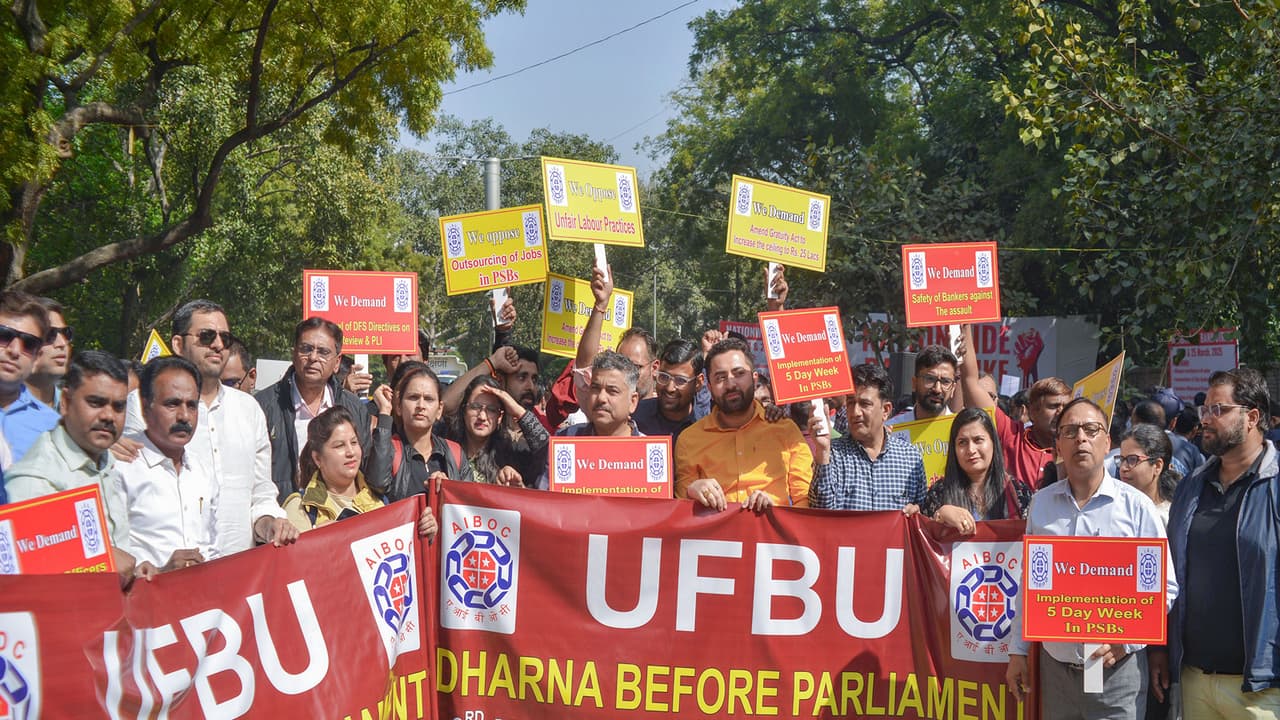
UFBU opposes a new DFS directive on PLI for senior bank officers, calling it ‘premature’ and ‘inappropriate’. It says the unilateral move undermines ongoing conciliation talks and violates established industrial relations principles.
The United Forum of Bank Unions (UFBU) expresses its serious concern and strong objection to the directive issued by the Department of Financial Services (DFS), Ministry of Finance, on Wednesday, advising public sector banks to pay Performance Linked Incentive (PLI) to eligible officers from Scale IV to Scale VIII, and to Deputy Managing Directors in SBI, under the Department’s revised PLI scheme issued vide letter dated 19.11.2024 and the respective bank’s Board-approved policy.
The directive is “premature and inappropriate” since the matter of PLI remains under active discussion in conciliation proceedings before the Office of the Chief Labour Commissioner (Central). The most recent conciliation meeting was held on March 9, wherein the unions and the management side deliberated on the very issue now sought to be unilaterally implemented, the UFBU said in a statement..
The signed minutes of that meeting clearly record that the question of PLI for Scale IV to VII officers for FY 2024-25 was under active consideration, with further steps to be pursued through the conciliation and bilateral process. For DFS to issue bank-specific implementation directives barely nine days later is a step that renders the conciliation process nugatory, the release said.
Violation of Bipartite Principles
UFBU places on record that the unilateral implementation of such a scheme, while formal proceedings are pending, is wholly inconsistent with the spirit and principles of bipartite industrial relations that have sustained the banking sector for the last six decades.
The DFS directive disregards the existing Bipartite Settlement/Joint Notes framework, under which PLI is uniformly linked to the overall performance of each bank and is payable at a uniform rate. “The directive also disregards the deliberations and minutes of several CLC meetings, to which DFS representatives, IBA, Bank Managements and all constituent unions and associations are parties and signatories,” it said.
‘Imposed’ Scheme to Create Division
It is pertinent to note that the revised PLI scheme was never a demand raised by the employees or trade unions in the banking sector. The scheme has been imposed from above and seeks to replace a well-established, collectively negotiated dispensation with an individual-performance-based mechanism for officers in Scale IV and above.
Obviously, the attempt is to shift from the present common performance-based incentive to an individual productivity-based incentive. This will have the effect of placing senior officers into differential risk brackets, creating an artificial and divisive classification within the officer cadre, and undermining the collective character of the workforce.
Serious Financial and Governance Concerns
UFBU further draws attention to the serious financial implications of the revised scheme. Under the existing dispensation, PLI for staff and officers up to middle management is limited to a maximum of 15 days’ Basic Pay plus DA. The DFS-directed scheme, by contrast, envisages PLI of up to 365 days’ Basic Pay for officers in Scale IV and above, potentially resulting in an exponential increase in the financial outgo, reportedly to the extent of nearly fifteen times.
At a time when the banking industry is focused on prudential norms, cost efficiency, capital discipline, and sustainable growth, such a disproportionate increase in a single component of remuneration for a select category of officers raises legitimate questions of propriety, prudence, and governance. “Such a substantial and selective outgo, which was never sought by the employees and has not arisen out of any collectively negotiated settlement, can also have adverse implications for shareholders, including the public shareholder. A disproportionate diversion of resources towards a narrowly targeted incentive structure for a small segment of executives may distort the compensation architecture, invite concerns regarding equitable use of institutional resources, and adversely reflect on governance standards. Any consequential unrest, loss of morale, disruption of teamwork, or industrial disharmony arising out of this divisive measure would also carry operational, reputational, and financial implications for the banks concerned, thereby affecting institutional stability and shareholder interest,” it said.
Fears of Internal Disparity and Resentment
The measure is also bound to create avoidable “internal disparities and weaken the collective unity” that has long been the hallmark of the banking industry’s workforce. More than ninety-five per cent of the employees and officers constituting the backbone of day-to-day banking operations and business generation would remain confined to a “materially inferior dispensation of up to 15 days’ PLI, while a much narrower segment would be placed under an entirely different framework with PLI of up to 365 days. Such differentiation is inherently divisive.”
It will split the workforce into privileged and excluded segments, breed resentment, impair team cohesion, and undermine the spirit of collective endeavour on which banking operations depend, the UFBU said. Any such division across the entire workforce is bound to generate avoidable unrest and jeopardise the industrial harmony that the sector has long valued.
Critique of ‘Discredited’ Performance Models
UFBU further submits that bell-curve and forced-ranking systems of performance assessment have, over time, been widely discredited and increasingly abandoned by major employers across the world because they damage collaboration, depress morale, and create unhealthy internal competition. Global corporations such as Microsoft, Adobe, Accenture, and Deloitte moved away from such models, while in India even private sector banks such as Axis Bank and ICICI Bank publicly shifted away from bell-curve-based appraisal frameworks, the UFBU claimed.
The attempt to introduce, in substance, a similar differentiated and exclusionary model in the banking industry is therefore contrary to contemporary best practice and contrary to the lessons drawn internationally from the failures of such systems, it said.
Warning of Unrest and Call for Dialogue
UFBU reiterates that the conciliation proceedings are a statutorily recognised forum for the resolution of industrial disputes and that any action during their pendency to unilaterally implement a contested scheme is prejudicial to industrial peace. The UFBU warns that such a step may aggravate unrest in the banking sector and could compel the workforce to resort to further democratic and lawful agitational actions in defence of their rights and interests.
UFBU urges upon the Department of Financial Services, the Indian Banks’ Association, and the managements of all public sector banks to refrain from implementing the directive dated March 18 unilaterally, and instead resolve the issue of PLI through established consultative and conciliation mechanisms in a manner that preserves the sanctity of the existing settlements, respects the ongoing process before the CLC, and upholds the principles of fairness, collective dignity, institutional harmony, and constructive industrial relations to which UFBU remains firmly committed. (ANI)
(Except for the headline, this story has not been edited by Asianet Newsable English staff and is published from a syndicated feed.)