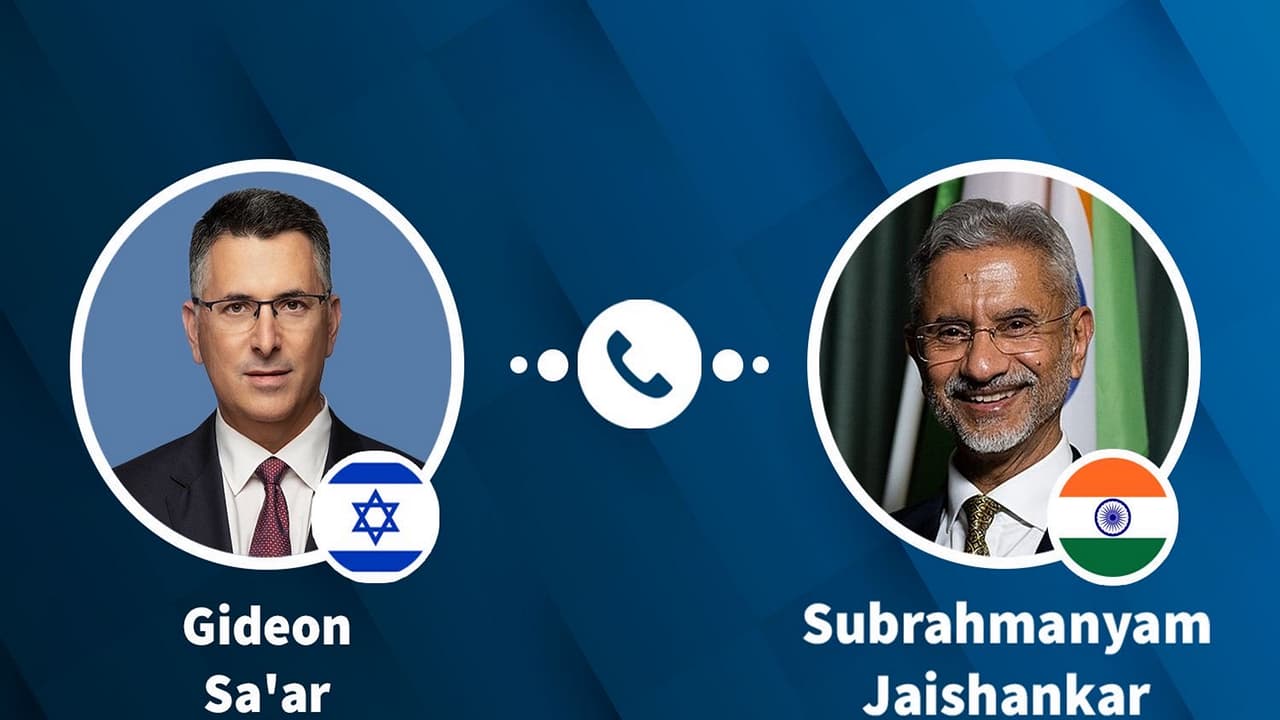
Israeli FM Gidon Saar discussed the West Asia conflict with EAM S Jaishankar, briefing him on operations against the ‘Iranian terror regime.’ Saar highlighted Iran’s ‘naval terrorism’ and valued the ‘special strategic partnership’ with India.
Israeli Foreign Minister Gidon Saar on Thursday emphasised Israel’s appreciation for its “special strategic partnership” with India during a telephonic conversation with External Affairs Minister S Jaishankar. The discussion focused on the ongoing conflict in West Asia and its various implications for the region and beyond. Saar also briefed the EAM on Israel’s operations against what he described as the “Iranian terror regime,” highlighting Tehran’s acts of “naval terrorism” in the Strait of Hormuz. He also spoke on the Iranian regime’s actions towards countries in the Middle East, the Caucasus, and Europe, describing its behaviour as “acting madly.”
Saar Briefs on ‘Iranian Terror Regime’
Saar also posted details of the conversation between the two sides in a post on X, where he stated that he briefed Jaishankar on developments from Israel’s perspective, highlighting the importance of coordination with India as a key partner in ensuring regional stability. “Spoke with my friend India’s Minister of External Affairs S Jaishankar and briefed him on developments in our operation against the Iranian terror regime. I said that the regime is carrying out naval terrorism in the Strait of Hormuz. This is not an American or Israeli issue; it’s a fundamental problem affecting world order and the global economy. If this grave phenomenon is not addressed now, it could spread worldwide. I also addressed the Iranian regime’s aggression toward other countries in the Middle East, the Caucasus, and Europe. I emphasized that the Iranian regime is acting madly. We value our special strategic partnership with India, the world’s largest democracy,” Saar stated in his post on X.
EAM Jaishankar also stated in a post on X, “Had a telecon with FM Gidon Saar of Israel this evening. Exchanged views on the ongoing West Asia conflict and its many repercussions,”
Background of the Escalating Conflict
The development comes amid the escalating conflict that began on February 28 with the killing of 86-year-old Iran’s Supreme Leader, Ayatollah Ali Khamenei, in joint military strikes by the US and Israel, after which Iran, in its retaliation, targeted Israeli and US assets in several Gulf countries and Israel, causing disruption in the waterway and affecting international energy markets and global economic stability.
Due to the conflict in the region, Iran has virtually closed the Strait of Hormuz, a critical transit route for global energy supply. Following the death of Ali Khamenei, Mojtaba Khamenei, son of the former leader, was appointed as the new Supreme Leader of the Islamic Republic. (ANI)
(Except for the headline, this story has not been edited by Asianet Newsable English staff and is published from a syndicated feed.)