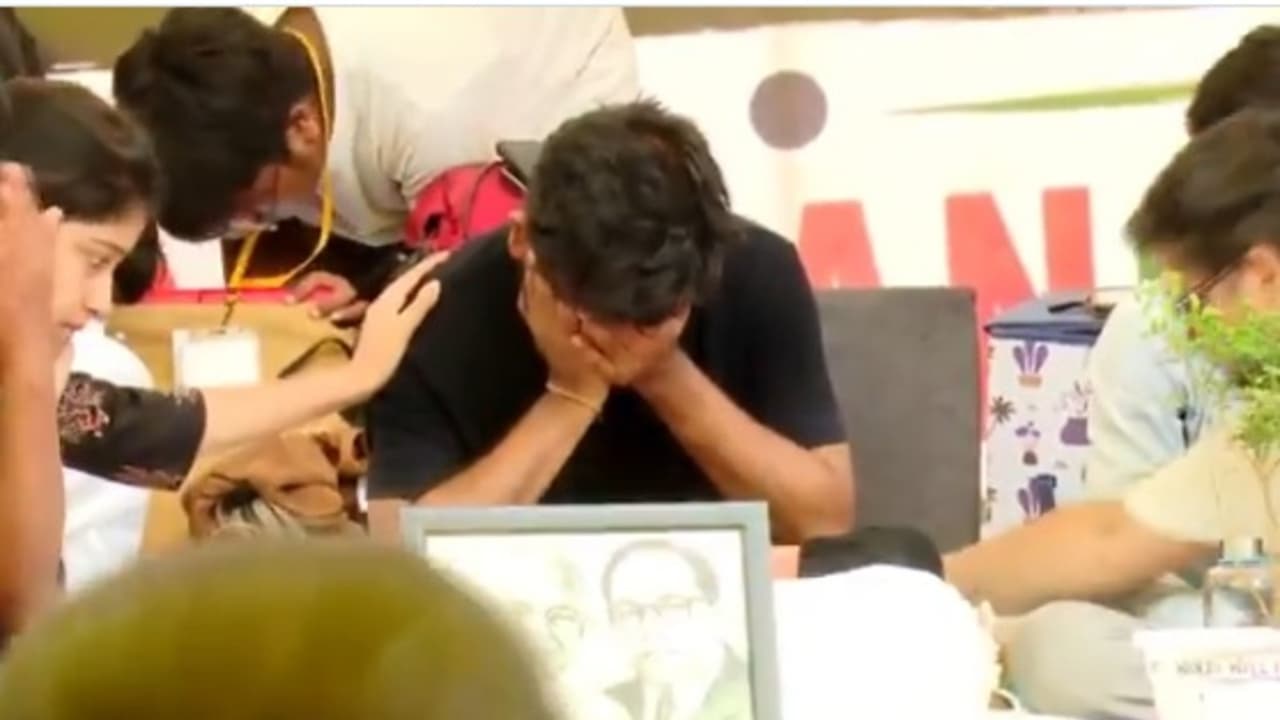
Why did CJP founder Abhijeet Dipke cry bitterly during the fast at Jantar Mantar? After all, why did Sonam Wangchuk give him strict instructions to ‘keep quiet’ in front of everyone? Delhi’s biggest political secret is hidden behind this crying and silence!
New Delhi: Delhi’s historic protest site Jantar Mantar witnessed a very emotional and shocking moment on Saturday. When famous activist Sonam Wangchuk, who was on fast for the last 20 days in the NEET paper leak case, was forcibly picked up by the Delhi Police and taken to Safdarjung Hospital, the founder of ‘Cockroach Janata Party’ (CJP), Abhijeet Dipke, who was commanding the protest, openly wept bitterly. This high-voltage emotional drama has stunned everyone present at Jantar Mantar and has sparked a new and serious debate on the government’s handling of the movement.
Tears shed in front of the camera: The horrifying truth behind the allegations of ‘atrocities’?
As soon as a heavy contingent of Delhi Police put Sonam Wangchuk in the ambulance, there was chaos at Jantar Mantar. Right after the police action, when the media cameras turned towards CJP founder Abhijit Dipke, he could not control his tears. Crying, Dipke alleged that this was a murder of democracy and that selfless activists like Wangchuk were being tortured by the administration. He said with full throat that the police had beaten the protesters. This very emotional moment seen on camera has created a new political storm on social media amid #IndiaWithVikram1 and other trends. The question that arises is whether these tears are just of anger or some unknown fear of disintegration of the movement?
‘You keep quiet!’ – Why did Wangchuk give this strict instruction to Dipke in the middle of his fast?
Amidst this crying, a very mysterious and old bitter story has also come to light. Just before he was taken to the hospital, when the Delhi High Court had ordered daily medical check-ups of Wangchuk in view of his deteriorating health, a strange incident took place at the protest site. Sonam Wangchuk, who was on hunger strike, had interrupted CJP founder Abhijit Dipke in front of everyone and asked him to ‘keep quiet’. Many types of speculations were being made after this incident. Now Deepke himself has exposed this secret. He revealed that Wangchuk did not want his ongoing talks with the government to take any drastic turn. Wangchuk wanted a peaceful Satyagraha, while Dipke’s aggressive stance was taking the movement in the other direction. Is this ideological difference the real reason for Deepke’s tears?
Scroll to load tweet…
Flood of tears or preparation for the ‘Mahasangram’ of 20th July?
Wangchuk may have been removed at Jantar Mantar and Dipke may have been seen breaking down on camera, but CJP workers claim that the movement is not over. Shortly after crying, Abhijeet Dipke changed his attitude and once again gave an open challenge to the administration. He clarified that these tears are not a sign of his weakness but of anger. The protesters have announced that they will not back down despite police orders to vacate Jantar Mantar. Preparations are being made for a huge ‘Parliament March’ on 20th July, the very first day of the monsoon session of Parliament. Now it remains to be seen what color Wangchuk lying on the bed inside Safdarjung Hospital and Janata Party, a cockroach made of tears outside, will show on the streets of Delhi on Monday.
Protestors allege, movement will not stop
After the police action, the protesters called it an attempt to weaken the movement. Abhijit Dipke said that if anyone thinks that the movement will end by taking Wangchuk to the hospital, then it is a misunderstanding. He reiterated that the protest will continue and preparations for the Parliament march will also be made as per the schedule. However, the administration says the priority was only to ensure the safety of Wangchuk’s health and was not intended to abridge anyone’s right to peaceful protest.
Scroll to load tweet…
Now everyone is eyeing what will happen next?
Sonam Wangchuk is under medical observation in the hospital, while the Jantar Mantar movement has reached a new turn. On one hand, the police are describing their action as being in accordance with health safety and court orders, while the protesters are considering it as an attempt to put pressure on the movement. In such a situation, it will be important to see in the coming days whether there is a way for talks or the movement becomes more politically intense.