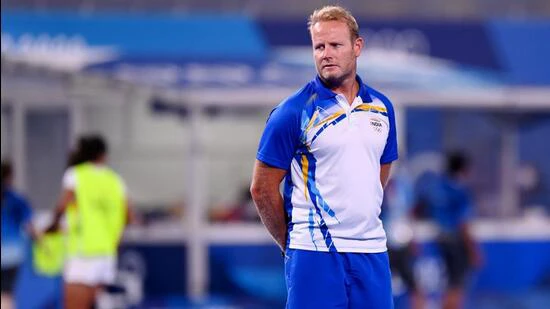
Sjoerd Marijne relaxed into a chair, chuckled occasionally, and discussed how he enjoys playing padel – his “secret” to maintaining fitness and his “young looks”.
The Indian women’s hockey team chief coach also detailed how he enjoys riding his two-wheeler through Bengaluru traffic, enjoying the whiff of the cool breeze along with the smell of coffee while passing many cafes.
The Dutchman can afford to be relaxed, especially after achieving his first target: helping India qualify for the World Cup.
Returning for his second stint with the team after a five-year gap, the 51-year-old had roughly two months to prepare the team for last week’s qualifiers in Hyderabad. It was the final opportunity for the Salima Tete-led outfit to qualify for the quadrennial showpiece in August.
With the immediate obstacle out of the way, Marijne now will have time to prepare the unit for much bigger tests ahead. And the task at hand is not easy.
India’s strikers lacked finishing touch, the midfield lacked fluidity, and the defense was porous, conceding goals against teams like No. 15 Scotland and No. 22 Wales, ranked far below No. 9 India.
“Italy (India won 1-0 in the semi-final) was a really poor game, very low technical skills. A lot of nerves, even though we had already qualified,” Marijne told HT from Bengaluru on Wednesday. “For me, it was good chance to see how the girls were dealing with the pressure, playing in India, for a World Cup spot. It gave me a lot of information and how we’re going to deal with this.”
Perhaps the most striking drawback was the inability of India’s forwardline and penalty corner (PC) specialists to convert their chances. And this was against teams ranked much lower than them who barely play top tier hockey, except eventual winners England.
Out of 120 circle penetrations across five games, India converted only 11 times with four being field goals, six being PC conversions and one stroke – an abysmal conversion percentage of 9.17. In PCs, India had a conversion rate of 16.67% which was less than Uruguay (31.58), Italy (21.43), Scotland (20) and England (19.05).
“We created so many open opportunities and PCs but missed them. If you don’t score, everything looks not that good. One thing we have to improve from this tournament is the conversion from chances to score, in PCs and field goals,” said the 51-year-old.
Gone are the days when former skipper Rani Rampal would create a moment of magic, scoring a goal against the run of the game or experienced forward Vandana Katariya poaching the ball in the striking circle, being in the right spot at the right time to score the goal.
“It’s clear we missed too many opportunities. I don’t believe that the girls on the pitch can’t do it. They also can. But we have to train more. We were short on time. First thing was we had almost 14 girls who were injured when I came. We had to work to get all of them back,” said Marijne.
“The second was discipline, third was team unity, fourth was technical awareness. You cannot train everything in one-month-and-a-half. Now we have seen where we need improvements. We’re going to work on that.
“There will always be a new (Deep) Grace (Ekka), a new Rani, a new Vandana. But they need time. They need international exposure, how to deal with pressure. We have to build on that to become a team.”
While India impressed with some dynamic play, with their zonal game able to thwart counterattacks, winning many balls in the process, and adjusting to the tempo of the game, fitness is another area where Marijne would want to start work immediately. The pace at which India started the contest was clearly missing in the final quarter with their tired legs not able to keep up.
“The first step was to let the injured players get back, in a way that we’re not taking risks with them. But yes, we are not where we want to be with fitness which leads to technical mistakes. They were getting fatigued and then making mistakes,” said Marijne.
“But you’ve to understand, they’re coming from Hockey India League (HIL) where they played many matches. That’s one of the reasons we’ve got (scientific advisor) Wayne Lombard to work on this because he can make big improvements.”
Lombard was part of Marijne’s core team in the Dutchman first stint with the team when he led India to an unprecedented fourth place finish at the 2021 Tokyo Olympics, missing the bronze by a whisker.
Though the first obstacle is out of the way, it was only a minor pebble considering the bigger tests ahead. The first major challenge will be the Nations Cup in Auckland from June 15-21 with the winner getting promoted to the elite Pro League.
That will be followed by the World Cup in Wavre and Amstelveen from August 15-30 where India have been handed a tough group comprising China, England and South Africa with only the top two qualifying for the quarter-finals.
The third successive major event India will take part in will be the Asian Games in Japan from September 19-October 4 which offers a direct berth for the 2028 Los Angeles Olympics.
To prepare for the same, Marijne intends to build a large pool of players, giving them as much international exposure as possible with the team’s trips to Argentina, USA, Netherlands and Germany in April and May.
“It’s important for the development of the team but also to experience pressure. Everybody has to realise they have to show their best every time, every day, in training, during matches to be in the team and not take anything for granted,” said Marijne.
Marijne faced a similar situation in 2018 when the then Rani-led team displayed impressive performances in the World Cup, reaching the quarter-finals, especially considering they hadn’t even qualified for the 2014 edition.
“We had used the World Cup to perform really well at the Asian Games where the girls reached the final for the first time in 20 years. Now, it’s more or less the same planning. The World Cup will help us to be at our best at Asian Games,” added Marijne.
“These matches will help us develop the team under pressure. If we do the things in the process well, the chance of a positive outcome is bigger. That’s how we’re approaching the World Cup and Asian Games.”