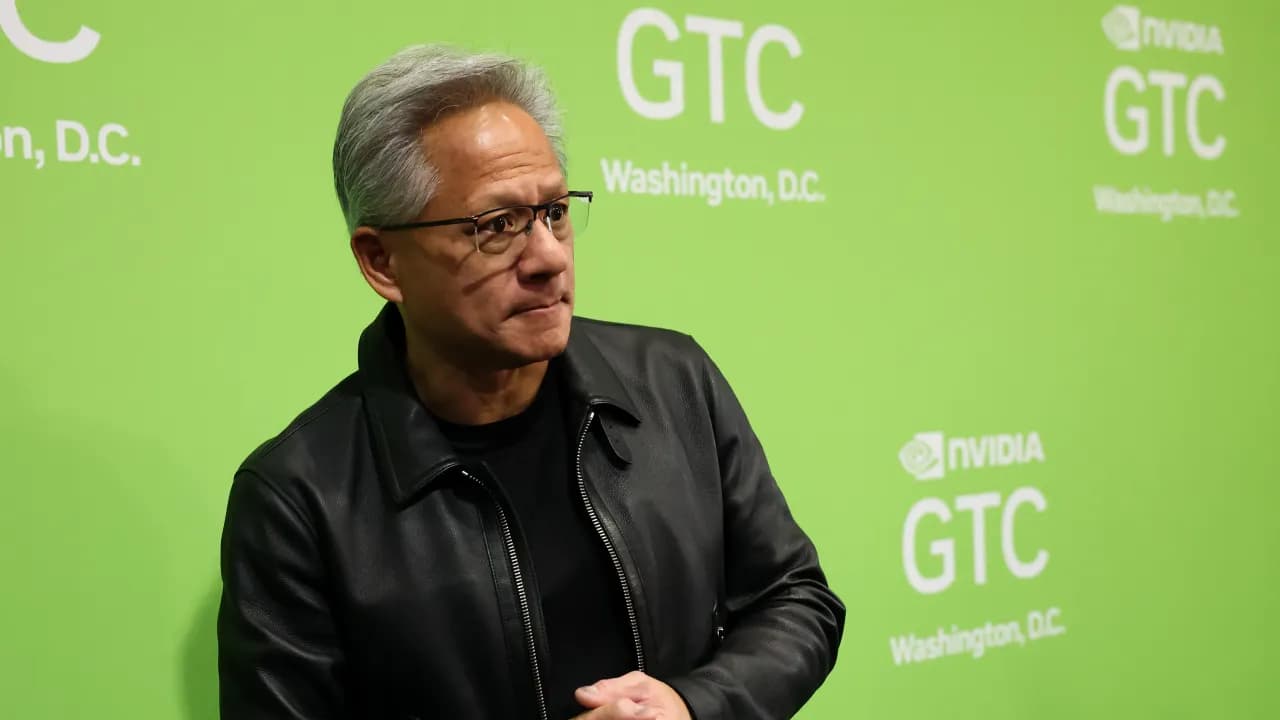
The analyst expects discussion about the company’s next-generation chip, its integration of Groq, and robotics at GTC 2026.
- Explaining that AI is shifting from a model story to an infrastructure story, Moorhead recalled that Huang promised to show off a chip that had not been seen before.
- He highlighted that, while the broader idea two to three years ago was that GPUs would be used for every workload, that idea has since evolved.
- He pointed to Google’s success with Tensor Processing Units with the launch of Gemini 3.1, and Amazon’s deployment of nearly half a million Trainium chips at the company’s Rainier facility.
Nvidia Corp. (NVDA) and CEO Jensen Huang are all set to kick off the GTC 2026 on Monday, with all eyes on the company’s announcements around its next generation of GPUs.
Patrick Moorhead, Chief Analyst at Moor Insights, expects discussions about the company’s next-generation chips, its integration of Groq, and the industrial applications of robotics at the GTC 2026 conference.
The Heterogeneous Compute Moment
Explaining that AI is shifting from a model story to an infrastructure story, Moorhead recalled that Huang promised to show off a chip that had not been seen before. “Jensen has to articulate the idea of heterogeneous computing and then how you can do it so much more easily on Nvidia,” he said.
Moorhead highlighted that, while the broader idea two to three years ago was that GPUs would be used for every workload, that idea has since evolved. He pointed to Google’s success with Tensor Processing Units (TPU) with the launch of Gemini 3.1, and Amazon’s deployment of nearly half a million Trainium chips at the company’s Rainier facility.
“If anybody thinks that heterogeneous computing is on the outs, then you missed the boat,” he added.
Moorhead said Nvidia could also discuss robotics and its industrial applications at this year’s GTC.
Nvidia Needs To Explain How Groq Fits Into Its Roadmap, Says Moorhead
Moorhead also added that Nvidia will have to explain how Groq fits into its roadmap. “A couple of ways to look at that would be a superfast solution that is super, super expensive. I think the other way, they could optimize it for a lower power inference solution,” he said.
Nvidia agreed to buy assets from Groq in a cash deal valued at $20 billion, according to a report by CNBC. Groq stated that its founder and CEO, Jonathan Ross, and other senior leaders will join Nvidia.
What Is Heterogeneous Computing?
Heterogeneous computing refers to a system architecture that combines multiple processor types, such as CPUs, GPUs, and NPUs, to handle AI tasks. Different processor types are well-suited to different tasks. For instance, according to ARM, CPUs handle general-purpose computing, GPUs are good at parallel processing, and NPUs are designed for AI workloads.
A heterogeneous compute platform automatically assigns different tasks to the most suitable processor to optimize both performance and efficiency.
How Did Stocktwits Users React?
Retail sentiment on Stocktwits around Nvidia trended in the ‘bearish’ territory at the time of writing.
One user thinks that Nvidia will pitch heavily on switching inference from High Bandwidth Memory (HBM) to Static Random Access Memory (SRAM).
NVDA stock is down 1% year-to-date, but up 51% over the past 12 months. The SPDR S&P 500 ETF Trust (SPY) is up 19% over the past 12 months, while the Invesco QQQ Trust (QQQ) ETF is up 25%.
For updates and corrections, email newsroom[at]stocktwits[dot]com.<