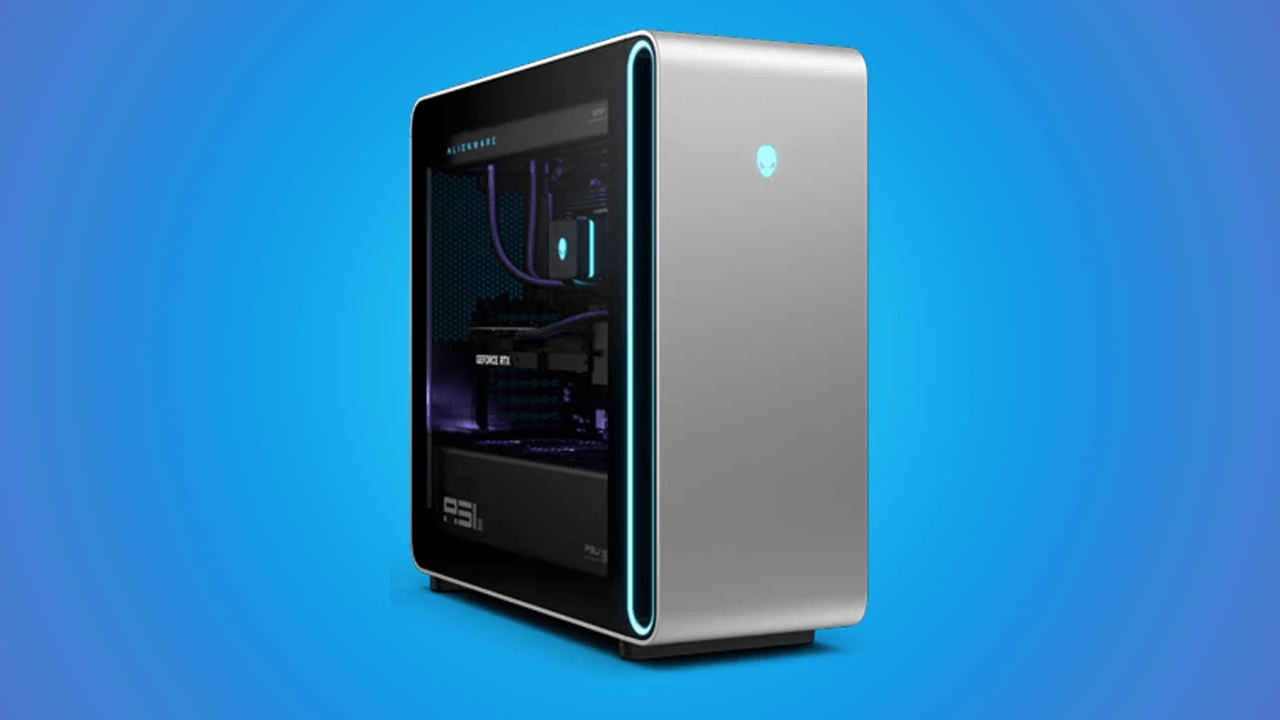
Alienware has spent years building gaming desktops that try to feel less like generic towers and more like statement pieces. With the 2025 Alienware Area-51 Desktop AAT2250, that formula has been refined rather than reinvented, and that too in a rather heavy-handed manner.
This is a machine that exists at the very top end of the market, built around Intel’s Arrow Lake platform and Nvidia’s Blackwell graphics architecture, then wrapped inside a chassis that looks purpose-built for a no-compromise setup. In this custom configuration, Dell aims to deliver flagship desktop performance, keep temperatures under control, and do it without sounding like a vacuum cleaner.
At this level, raw benchmark numbers are only one part of the story. Plenty of high-end desktops can throw serious hardware into a case and post big numbers, but fewer systems manage to combine speed, acoustics, thermal control, sensible internal access, and a feature set that actually feels thought through. The AAT2250 aims to do exactly that. It is a carefully tuned flagship desktop that tries to justify its premium in everyday use as much as it does in peak performance.
This particular configuration pairs Intel’s Core Ultra 9 285K with Nvidia’s GeForce RTX 5090, backed by 64GB of DDR5-6400 memory and a Hynix 2 TB NVMe SSD. On paper alone, that is enough to put it in truly elite company. In practice, the system’s strengths go beyond the headline parts list. The chassis has been redesigned around airflow and acoustic efficiency, internal access is easier than on many boutique systems, and the I/O mix is strong enough to support both gaming and serious creative work. The result is a desktop that feels unapologetically high-end, but also unusually mature in how it approaches the basics.
Alienware Area-51 Desktop AAT2250 Specifications
The Alienware Area-51 Desktop AAT2250 reviewed here is a custom 2025 configuration built around Intel’s Core Ultra 9 285K processor. That is paired with Nvidia’s GeForce RTX 5090 graphics card with 32 GB of VRAM, making this a system designed for 4K gaming, heavy creator workloads, GPU-assisted rendering, and local AI use cases. Memory is configured at 64GB of DDR5-6400 in a 2x32GB arrangement, while primary storage is a Hynix 2 TB NVMe SSD, specifically the SK Hynix PCB01 Gen 5 drive in this unit.
The platform is based on a custom Z890 ATX motherboard, backed by a 1500 W Platinum-rated power supply. Cooling is handled through a 360 mm liquid cooler for the processor, alongside large 180 mm RGB intake fans and 140 mm RGB fans in the chassis. Networking includes 2.5Gb Ethernet and Killer Wi-Fi 7. For expansion, the system supports three M.2 SSD slots in total, one Gen 5 and two Gen 4, plus two SATA bays for 3.5-inch or 2.5-inch drives.
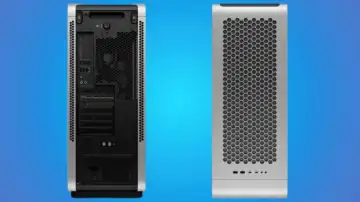
Display output comes from the RTX 5090 and includes one HDMI 2.1b and three DisplayPort 2.1 outputs. Front and top I/O includes two USB 3.2 Gen 1 Type-A ports, two USB 3.2 Gen 2 Type-C ports, and separate 3.5mm headphone and microphone jacks. Around the back, the motherboard adds two Thunderbolt 4 ports, two more USB 3.2 Gen 2 Type-C ports, one USB 3.2 Gen 1 Type-A port, five USB 2.0 Type-A ports, optical S/PDIF, line-in, line-out, and 2.5Gb Ethernet. Overall, the Alienware Area-51 Desktop AAT2250 is a full-fat enthusiast desktop intended to handle almost any modern workload without compromise.
Features
Alienware’s feature set with the Area-51 AAT2250 feels much more deliberate than on many premium desktops that rely too heavily on brand cachet. At a glance, the machine does tick the obvious boxes: high-end CPU, flagship GPU, strong connectivity, RGB lighting, fast networking, and support for modern storage standards. The more important part, however, is how these features come together into a system that feels designed for long-term ownership.
One of the strongest aspects here is the I/O layout. Front-facing USB connectivity remains useful on a desktop, especially for creators and gamers who constantly plug in external SSDs, controllers, capture devices, or headsets. The inclusion of multiple rear USB ports, dual Thunderbolt 4, and 2.5Gb Ethernet gives the system real flexibility in professional environments too. It can sit equally comfortably in a gaming room, an editing bay, or a home office connected to a fast NAS.
 The networking hardware is another plus. Wi-Fi 7 and 2.5GbE may not matter to every buyer today, but together they make the system feel ready for the kind of high-speed home networking setups that are becoming increasingly common. Anyone running a NAS, moving large media files, or working with cloud-heavy production workflows will appreciate not having to think about network bottlenecks.
Storage support is equally sensible. The included SK Hynix PCB01 Gen 5 NVMe SSD is already mmore than fast enough for virtually any real-world gaming scenario, but the fact that the primary M.2 slot supports Gen 5 speeds means the platform is not boxed in. Alienware has also provided room for additional M.2 drives and SATA storage, which matters on a premium desktop where users are likely to expand over time rather than replace the whole machine after a couple of years.
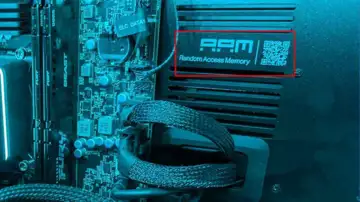 Then there is the serviceability angle. Alienware has printed QR codes directly onto internal components that link to official repair and upgrade videos. It sounds like a small thing, but it is the kind of practical detail that makes a product easier to live with. Many brands talk about user-friendliness. Fewer bother to support it with genuinely useful touches like this.
The caveat is that this is not a completely standard ATX ecosystem experience. The custom Z890 board uses a proprietary 10-pin power connector rather than the conventional 24-pin layout. That means swapping the PSU or motherboard independently is not as straightforward as it would be in a fully standard DIY tower. This is not a deal-breaker, but it is worth knowing. Alienware has made the machine more serviceable and more upgrade-friendly than before, but it has not abandoned proprietary design decisions altogether.
Build Quality
Build quality is one of the clearest areas where the Area-51 AAT2250 feels like more than just a pile of premium parts. The chassis has a sense of identity, which has always been part of Alienware’s appeal, but here it also feels more functional than ornamental. The revised Legend 3 design focuses heavily on airflow and acoustics, and that practical emphasis shows in daily use. And you should ideally get a back brace before lifting the Area-51 AAT2250, it’s about 34.5 kgs. If you’re from across the Pacific, then that’s 76 lbs. A back-breaking 76 lbs. This gives you an idea of how structurally rigid this unit happens to be.
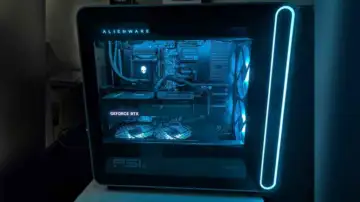 The tool-less access system is especially well executed. A single rear screw unlocks the latch, after which both the transparent side panel and the metal panel can be removed using dedicated buttons. That makes internal access much easier than on a lot of high-performance desktops, particularly for users who may want to add storage or clean out dust without wrestling with awkward panel clips.
Inside, the layout appears designed to support both thermal efficiency and visual neatness. Large fans, liquid cooling, and cable routing all contribute to a chassis that looks purposeful rather than cluttered. The large front intake fans are particularly important because they help move substantial air through the case without needing to spin aggressively. That, in turn, contributes to one of the machine’s most impressive qualities: how restrained it sounds under load.
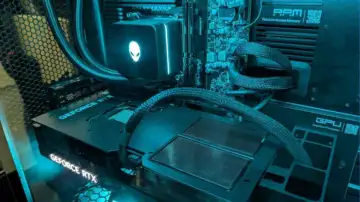 Alienware has also avoided the trap of making the system feel delicate or over-styled. The tower still looks premium and distinctly Alienware, but it does not come across as a purely decorative object. It feels like a serious desktop that just happens to have a striking aesthetic.
There are, however, some design choices that may divide opinion. The proprietary motherboard power arrangement does slightly reduce the sense of full enthusiast freedom. Likewise, the memory support is limited to two DIMM slots and tops out at 64GB DDR5-6400 in this implementation, which Alienware has done in the name of higher clock stability. That makes sense from a tuning perspective, but it does reduce flexibility for buyers who prefer the broader expansion possibilities of standard enthusiast motherboards. We’re pretty certain that Alienware would have had more slots if DDR5, as a memory standard, had been more stable.
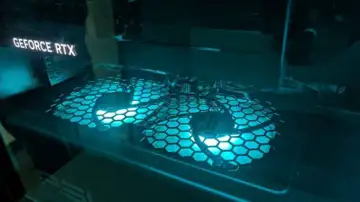 Even with those caveats, the overall construction is impressive. The chassis feels thoughtfully engineered, access is refreshingly straightforward, and the internal design has clearly been built around the realities of cooling a machine at this performance tier.
Performance
Performance is where the Alienware Area-51 AAT2250 fully justifies its flagship ambitions. With an Intel Core Ultra 9 285K and GeForce RTX 5090 at its core, this system is designed to dominate modern gaming and handle demanding creative workloads with ease. The benchmark results reflect exactly that.
At 4K Ultra settings, gaming performance is predictably formidable. Shadow of the Tomb Raider runs at around 157 FPS, which is an absurdly high result for a title still useful as a GPU stress point at this resolution. Guardians of the Galaxy pushes even further to roughly 177 FPS, reinforcing just how much overhead this system has for visually rich games at 4K. Even much heavier modern titles remain highly playable. Monster Hunter Wilds, running at 4K Ultra with ray tracing set to High and DLAA enabled, delivers around 53 FPS. That is a demanding scenario, and the result underlines how this machine handles punishing current-generation workloads without flinching.
| Game and settings | Performance |
|---|---|
| Shadow of the Tomb Raider, 4K Ultra | 157 FPS |
| Guardians of the Galaxy, 4K Ultra | 177 FPS |
| Monster Hunter Wilds, 4K Ultra, Ray Tracing High, DLAA | 53 FPS |
| Cyberpunk 2077, 4K RT Overdrive, native | 34 FPS |
| Cyberpunk 2077, 4K RT Overdrive, DLSS 4 + Frame Generation | 288 FPS |
Cyberpunk 2077 remains the clearest showcase for what the RTX 5090 brings to the table. Running in RT Overdrive mode, native performance sits at around 34 FPS, which is already a reasonable illustration of how extreme the setting is. Switch on DLSS 4 and Frame Generation, though, and the number rockets to around 288 FPS.
Synthetic performance is similarly strong. Geekbench 6 scores of 3,149 in single-core and 21,929 in multi-core place the Core Ultra 9 285K firmly in elite desktop territory. Cinebench 2024’s multi-core score of 2,313 further reinforces the point that there is serious CPU performance here for rendering, encoding, and heavy multitasking. The 3DMark Steel Nomad stress test result, which stayed 99 per cent consistent over 20 runs, is particularly encouraging because it points to stability under sustained load rather than a single flashy benchmark run.
That stability aligns with the desktop’s thermal behaviour. Under heavy load, the RTX 5090 typically settles in the low 70s Celsius, while the processor stays in the low 50s during gaming thanks to the 360mm AIO cooler. Those are excellent results for a system with this class of hardware. More impressive still is how little acoustic noise accompanies them. The AAT2250 has been described as whisper quiet or barely audible even under load, and that is a significant achievement. High-end desktops often make users choose between performance and noise. Alienware seems to have found a far better balance here.
The large 180 mm intake fans clearly play a central role in that equation. By moving a lot of air at lower RPMs, they help the system maintain thermal control without the aggressive fan profiles that often make flagship gaming desktops unpleasant in quieter rooms. There is a reported brief chirp or spin-up noise during boot, which Dell characterises as normal behaviour for high-wattage RTX 50-series cards. In context, that feels more like a quirk than a genuine issue, particularly as it does not appear to define the machine’s behaviour once up and running.
Storage performance is exactly where it should be for a premium Gen 4 NVMe SSD. The included SK Hynix PC811 delivers around 6,994 MB/s sequential reads and around 6,023 MB/s writes. Those are strong figures and more than enough to keep game load times, file transfers, and application launches feeling fast. The presence of Gen 5 support on the primary M.2 slot is useful from a future-proofing standpoint, though the real-world gaming gains from moving beyond a good Gen 4 drive remain modest for now.
Outside pure benchmarks, the Area-51’s broader usefulness is easy to understand. The RTX 5090’s 32GB of VRAM and the CPU’s 24-core design make this an extremely capable workstation for local AI models, high-resolution video editing, and GPU-accelerated production work. It is a desktop that can serve as both a dream gaming machine and a serious creative tool, which is exactly what buyers at this end of the market are likely to want.
Verdict – Alienware Area-51 Desktop AAT2250
The Alienware Area-51 Desktop AAT2250 is an exceptionally capable flagship desktop that gets the big things right. It delivers enormous 4K gaming performance, excellent CPU throughput, strong storage speeds, and unusually polished thermal and acoustic behaviour for a machine packing this much hardware. Just as importantly, it does so in a chassis that is easier to open and maintain than many rival premium systems.
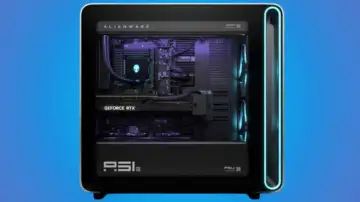 There are limitations. The use of proprietary power connections on the motherboard means this is not as open-ended as a fully standard DIY build, and the two-DIMM memory layout reduces long-term flexibility somewhat. However, it will be a while before you’d consider more memory given that you’re getting 64 GB to boot. Buyers looking for absolute component freedom may still be better served by a custom-built tower. But that criticism needs context. Alienware is trying to make the most modular enthusiast chassis on the market while delivering a refined, high-performance desktop that feels premium, looks distinctive, runs cool, stays quiet, and remains reasonably approachable to upgrade.
On those terms, the AAT2250 succeeds very well. This is a desktop that feels engineered rather than merely assembled. The combination of the Core Ultra 9 285K, RTX 5090, quiet cooling system, strong I/O selection, and sensible internal access makes it one of the more convincing ultra-premium gaming desktops in its class. For buyers who want a top-tier desktop without the uncertainty of sourcing and tuning every part themselves, the Alienware Area-51 AAT2250 makes a very strong case for itself.