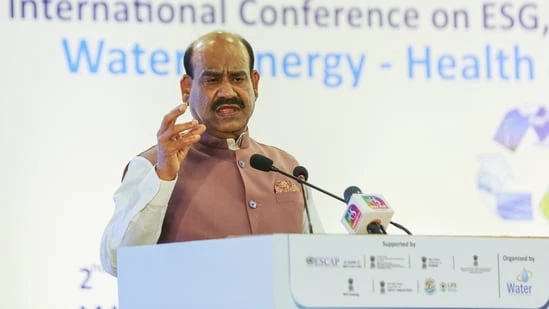
The Opposition’s bid to remove Lok Sabha Speaker Om Birla failed on Wednesday as the no-confidence motion against him was defeated by a voice vote amid loud protests by Congress members against Union home minister Amit Shah’s sharp attack on Leader of the Opposition Rahul Gandhi.
In his speech, Amit Shah slammed the Opposition for moving the resolution and said the “regretful” move came for the first time in nearly four decades. He also alleged that Gandhi was frequently absent from the House, didn’t participate in key proceedings including discussions on the President’s address and the Union Budget, and chose to travel abroad during sessions.
“The LoP has been complaining that he is not allowed to speak. It’s not the ruling party or the Speaker who decided the duration to be allotted to each Speaker, but the concerned party. But instead of this…he leaves the country and goes abroad,” he said.
“In terms of seats, Om Birla gave the Congress six times more speaking time than the BJP. A no-confidence motion was brought against the Speaker of the Lok Sabha, yet their Leader of Opposition, Rahul Gandhi, himself did not speak on it,” he added.
Shah’s tirade against Gandhi and use of an unparliamentary word led to Congress MPs rising in protest and demanding an apology even as Jagdambika Pal, who was presiding over the proceedings, assured that the word would be examined and expunged.
Shah said the BJP was in the Opposition longer than it had been in power but never moved or supported a motion against the Speaker. “We have been in the Opposition, and three times a no-confidence motion against the Lok Sabha Speaker has been brought, but the Bharatiya Janata Party and the NDA, while in the opposition, never brought a no-confidence motion against the Lok Sabha Speaker…We have worked to protect the dignity of the Speaker’s position and have also demanded protection from the Speaker for our legal rights and constitutional rights,” he said.
Shah was referring to the no confidence motions against GV Mavalankar in 1954, Hukam Singh in 1966, and Balram Jakhar in 1987. Shah took a swipe at the opposition parties and said while the motions against Mavalankar and Singh were moved by the socialists and the Samajwadi Party, the Communist Party of India moved the motion against Jakhar. “…Today all these parties are part of the ghamandi gathbandhan …” he said, referring to the INDIA bloc of opposition parties.
Questioning the intent behind the Speaker’s ruling, which is binding on the members, casts a shadow on democracy, Shah said.
“For 75 years, these two Houses have deepened the foundation of our democracy, but today the Opposition has, in a way, cast a question mark on this credibility…The House proceedings are conducted on the basis of mutual trust and as per rules. The Speaker serves as a neutral custodian, representing both the ruling party and the Opposition,” he said.
The no-confidence motion was moved by Congress MP Mohammad Jawed against Birla for his alleged partisanship, not allowing the LoP to raise important issues pertaining to the country’s security, and the suspension of over 100 Opposition MPs during previous sessions.
Shah, however, denied all these allegations, and said that issues have to be raised within the ambit of the laid-down rules and that no member has the right to speak in a manner the House rules do not permit.
“Specific rules have been created by Lok Sabha to guide how the Speaker should conduct the sessions. This House is not a marketplace; members are expected to speak and participate according to its rules and procedures…The House runs on mutual trust. For both the ruling side and the Opposition-the Speakers of the House serve as custodians,” he said.
“He [Gandhi] suddenly had an idea — to have a debate on his own press conference. This is not a market. This is the Lok Sabha. Topics for debate are formally decided here. From your great-grandfather to your grandmother to your father, there were tall leaders in India, but the Lok Sabha never had a debate on anyone’s press conference,” Shah added.
The home minister said that while disagreement with the Speaker’s decision may be expressed, under the rules of the Lok Sabha, the Speaker’s decisions are considered final.
“This Lok Sabha is the greatest panchayat of India’s democracy, and not only in India but across the world, the reputation and dignity of our democracy have been established…But when questions are raised against the head of this panchayat, against his loyalty, it raises doubts not only in the country but across the world about our democratic process,” he said.
Junking the Congress’s claims that the LoP was silenced and not allowed to raise issues, Shah read out a list of foreign visits allegedly undertaken by Gandhi during sessions, and claimed that Gandhi’s participation in the proceedings was below the average for all MPs.
“Why does he (Gandhi) not speak…no Speaker can stop him, he is giving the Lok Sabha a bad name. The party moved the resolution (against the Speaker)…but he has not even spoken on it,” Shah said. He added, “When the opportunity to speak comes, he goes on trips to Germany and England.”
Shah said the LoP had never spoken during the motion of thanks to the President’s Address, the Budget discussions, and on several key legislations including outlawing instant triple talaq, reading down of Article 370 in Jammu and Kashmir, Citizenship Amendment Act, and the 150th anniversary of Vande Mataram.
“In the 17th Lok Sabha, his attendance was 51% while the average was 66%. In the 16th Lok Sabha, his attendance was 52% while the national average was 80%, and in the 15th Lok Sabha, his attendance was 43% while the national average was 76%…” Shah said.
Shah also took potshots at the Congress and the Opposition, pointing out how Birla had to twice ask them to correct the anomalies in the resolution seeking his removal.
Earlier in the day, Gandhi said he was stopped from speaking in the Lok Sabha on multiple occasions, adding that the House does not represent one party but the whole country. “…This house is the expression of the people of India, this House does not represent one party… Every time we get up to speak, we are stopped,” he said. Congress MP Gaurav Gogoi, who initiated the debate, said the resolution against Birla was meant to safeguard parliamentary dignity and was not driven by personal animosity.