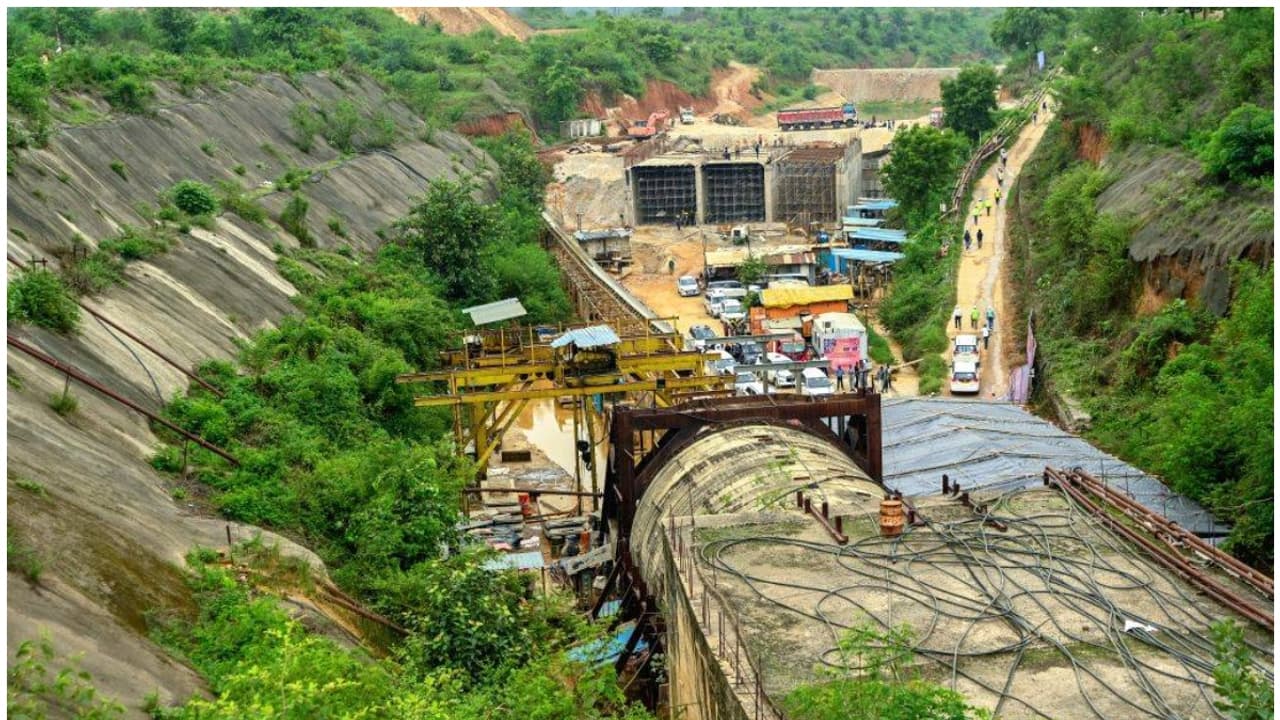
The country’s longest irrigation tunnel (12 km) in Madhya Pradesh was completed after 17 years. It will cut through the Vindhya Mountains and deliver Narmada water to the Son Basin, which will provide irrigation and drinking water to 1,450 villages.
Bhopal: Indian engineers and laborers have achieved a historic feat by overcoming the challenges of nature and geographical barriers. The work of the country’s longest irrigation tunnel (Sleemanabad Tunnel), which is being built by cutting the Vindhya mountain range in Sleemanabad, Madhya Pradesh, has finally been completed. At exactly 3:30 pm on Tuesday, the machines successfully broke the last rock wall of the tunnel and the tunnels coming from both sides merged.
Mythological story of Narmada-Sonbhadra rivers
According to local folklore, the marriage of ‘Narmada’, the daughter of Maikal hills, and ‘Sonbhadra’ river was to take place. But due to a misunderstanding, Narmada got angry and flowed towards the west and joined the Arabian Sea, while Sonbhadra flowed towards the east and joined the Ganga River. Vindhya Mountain stood between these two like a huge wall. Now modern engineering has created a new path through this tunnel to join the basins of these rivers which naturally flow in opposite directions.
It was impossible to build a canal by cutting mountains.
The Vindhya Mountains that separate the Narmada and Son valleys are about 40 meters higher than the surrounding land. It was almost impossible to build an open-cut canal on top of this mountain. For this, more than 40 million cubic meters would have had to be excavated. Not only this, cutting an area hundreds of meters wide and dealing with the heavy groundwater level present there was a huge challenge. Therefore the engineers took the difficult decision of digging a tunnel from inside the mountain itself.
Engineering challenges and rising expenses
This huge tunnel is a total of 11.95 kilometers (about 12 km) long and 10.14 meters wide. The rocks inside the mountain were changing their form every 10 to 15 meters. At some places there were hard marble and limestone, while at other places suddenly layers of soft soil and slate appeared. Due to the dissolution of limestone, large sinkholes were formed under the ground. Every minute 18,000 to 25,000 liters of groundwater was entering the tunnel, which workers had to continuously pump out. Due to these serious technical challenges, America’s famous ‘Robbins’ tunnel boring machines also got stuck here and got damaged. Initially the budget of this project was only ₹799 crore, which increased to ₹1,600 crore after a delay of 17 years.
Two-way technology and breakthrough moment
In view of the delay in the project, the engineers decided to dig tunnels from both ends of the mountain. On one side was the American Robbins machine and on the other side was the German HK. (German HK) The mountain was cut using machines. Finally, after 17 years of continuous hard work, on Tuesday afternoon, the 6.5 km long upper tunnel and the 5.4 km long lower tunnel met each other precisely at Sleemanabad Junction. As soon as the last rock fell, a wave of happiness ran on the faces of the workers who had been working in the dark for 17 years.
Sanjeevani for farmers of 1,450 villages
The biggest feature of this tunnel is that the water of Narmada River flowing through it will reach the Son Basin only by natural gravity without the help of any pump. This ‘Bargi Diversion Project’ will provide drinking water and irrigation facilities to more than 1,450 drought-hit villages in Jabalpur, Katni, Maihar, Satna, Rewa and Panna districts of Madhya Pradesh. Through this, the target is to irrigate a total of 2,45,000 hectares of land, out of which the land related to Sleemanabad tunnel alone is 185,000 hectares.
Although the tunnel is now completely ready, a few more canals and eight aqueducts still need to be built for the water to reach the last farmer’s field. A target has been set to irrigate 44,160 hectares of land by March 2026, 87,433 hectares by September 2026 and 154,693 hectares by December 2027. Upon completion of this project, there will be a major change in the rural economy, farming and living standards of the people of this area.