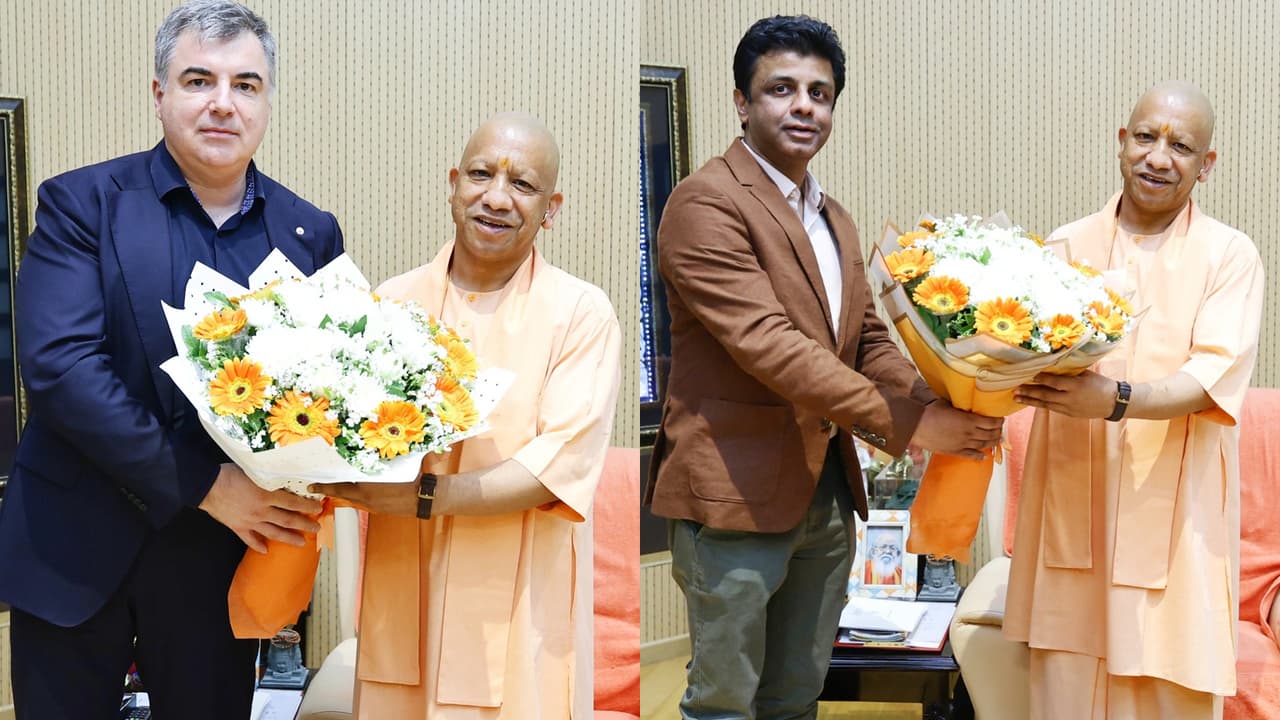
Yogi Adityanath Konstantin Novoselov Meeting: Nobel Prize winning scientist Konstantin Novoselov met Chief Minister Yogi Adityanath in Lucknow. In the meeting, Loham Company’s plan to set up India’s first “Rare Earth to Magnet” integrated facility in UP and promoting advanced material research was discussed.
Yogi Adityanath and Konstantin Novoselov Meeting: Nobel laureate scientist Konstantin Novoselov met Uttar Pradesh Chief Minister Yogi Adityanath in Lucknow on Wednesday morning. Loham Company CEO Rajat Verma and company Chief of Staff Ayush Sabat were also present in this meeting. During the meeting, the guests appreciated the positive environment being created for investment in Uttar Pradesh. Chief Minister Yogi Adityanath, while welcoming all the guests to the state, said that better opportunities are being continuously created for investment and modern technology in the state.
Discussion on making Uttar Pradesh an advanced material research hub
In the meeting, it was discussed in detail how Uttar Pradesh can be made a major center of the country in the field of advanced materials research and engineering. During this, discussions were also held on the plan of Loham Company, in which it is proposed to set up India’s first “Rare Earth to Magnet” integrated facility in the state. If this project starts, it will give a big boost to the high-tech manufacturing sector in the country. Also, Uttar Pradesh can become an important center for modern technology based industries.
Konstantin Novoselov is famous for the discovery of graphene.
Nobel Prize winning scientist Konstantin Novoselov is known worldwide for his discovery of graphene. Currently he is working as Strategic Advisor and Partner with Loham Company. Their goal is to apply new research in materials science at an industrial level, especially in battery technology and the energy sector.
Focus on battery technology and recycling
The main focus of Lohm and Novoselov’s collaboration is on two important areas. First, by using 2D materials such as graphene to make next-generation lithium-ion batteries safer, more capacious and longer-lasting. Second, to develop advanced recycling systems for batteries and permanent magnets, allowing better recovery of critical minerals. This will increase re-use of resources and strengthen the circular economy.
Important initiative for Make in India and green energy
Experts believe that this cooperation can play an important role in strengthening India’s Make in India initiative and green energy vision. If these projects are successful, it will create new opportunities in the field of energy, battery technology and advanced materials research in the country.