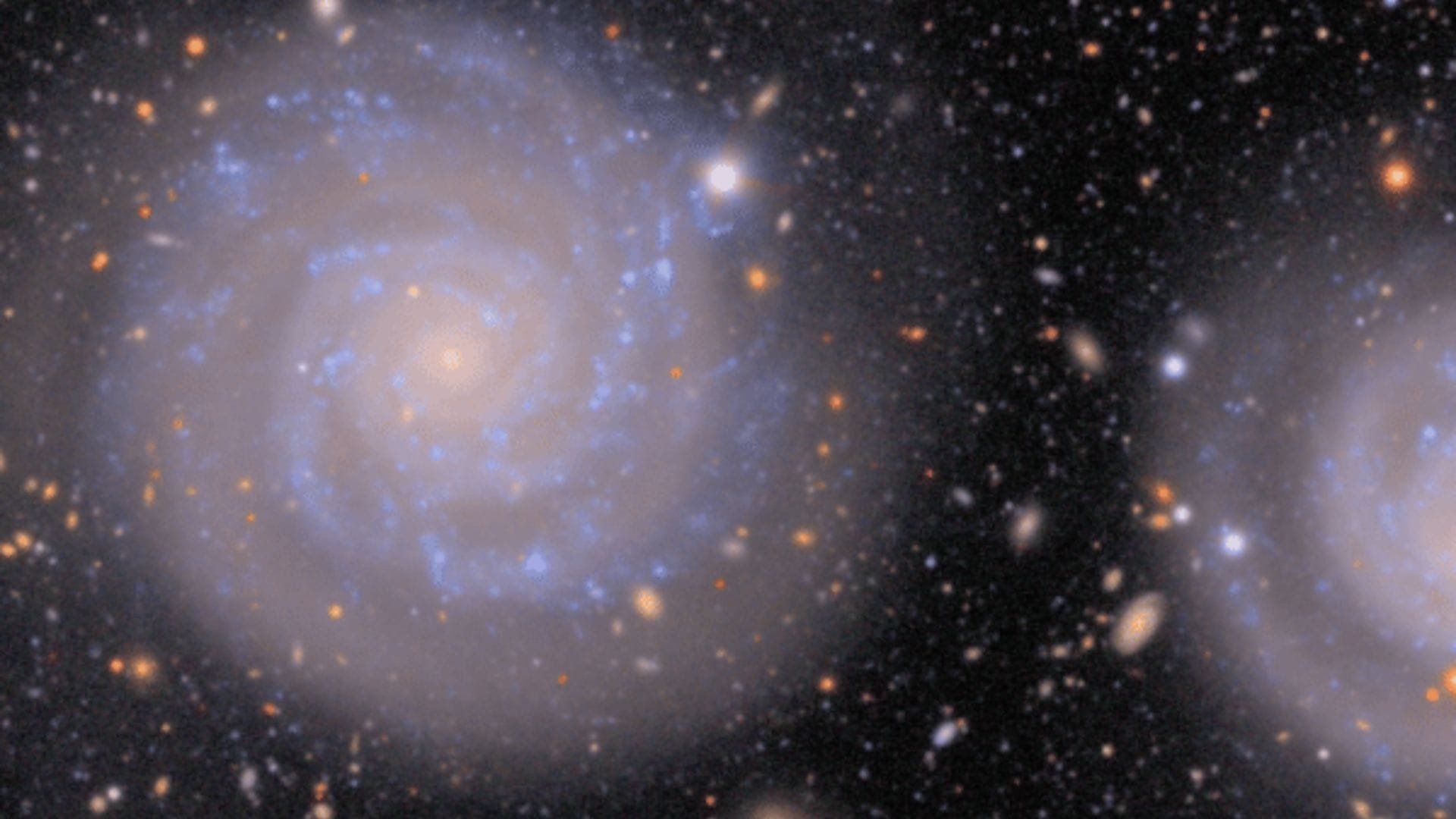
New Delhi: An international team of scientists have introduced the Regalade all-sky catalogue of nearly 80 million galaxies, which has now been published in Astronomy and Astrophysics. When astronomers detect a merger between two black holes or neutron stars, or a sudden phenomenon such as a tidal disruption event or a star exploding in a supernova, they need to know where to look and the distance to the event. Existing galaxy catalogues are incomplete beyond 300 million lightyears, with large gaps in the map of the nearby universe.
Regalade fills this gap by combining data from major surveys and cleaning it using the data from the Gaia mission, by removing stars that have been misidentified as galaxies. This is a high-purity, high-completeness catalogue that includes accurate distances and size measurements for all galaxies, and stellar masses for most of the galaxies. The requirement for the catalogue came out of astronomers struggling to look up galaxies in multiple catalogues, with the new consolidated catalogue simplifying the work. Every time a transient is detected, astronomers have to retrieve the distance, with the new catalogue simplifying the process. The general public can also explore the Regalade catalogue and navigate through millions of galaxies.
Incredible scale and depth
The Regalade catalogue covers the entire sky, and reaches out to more than four billion lightyears, mapping out about 10 per cent the volume of the visible universe. The Vera C Rubin observatory has turned on its discovery machine, and is expected to flag about seven million transients every night. The Regalade catalogue ensures that astronomers can rapidly locate these transients and plan follow-up observations. The catalogue will allow astronomers to rapidly identify host galaxies, and quickly classify rare transients including luminous red novae, stellar mergers, and tidal disruption events. The catalogue combines expertise in time-domain astronomy, galaxy surveys and multi-messenger astrophysics.