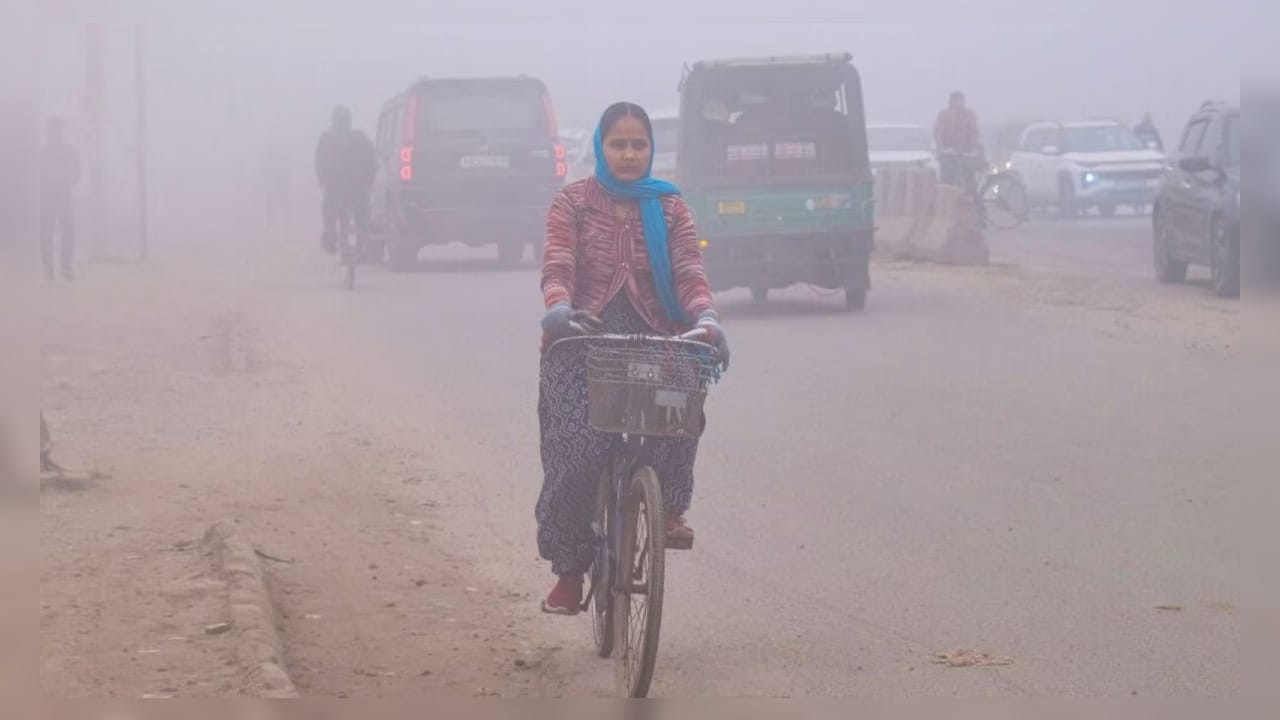
New Delhi: The surprise fog shrouding parts of Delhi-NCR on Monday evening and Tuesday morning caught commuters off guard just as temperatures starts rising across northern India. It was not just Delhi-NCR, but the entire northern region — from Punjab to Uttar Pradesh — that reported the surprise fog.
Ambala, Punjab: Dense fog was reported on the Delhi–Amritsar National Highway in March, forcing drivers to use headlights and move slowly due to low visibility. pic.twitter.com/GXYAKYE6Gp
— IANS (@ians_india) March 8, 2026
Fog shrouds Delhi-NCR in surprise
In the national capital region (NCR) patches of dense haze were reported in Ghaziabad and Meerut, sharply reducing visibility and slowing traffic on major routes like the Delhi-Meerut Expressway. Motorists described trees and buildings disappearing behind a “grey veil” as vehicles crawled through the morning traffic. Netizens in the national capital shared images of the fog on social media, wondering whether it was unseasonal smog or a rare weather phenomenon appearing unusually late in the season.
The India Meteorological Department (IMD) had not yet issued an official explanation for the event at the time of writing. However, similar fog episodes have been observed during transitional weather periods when moisture, temperature shifts and pollution combine in the lower atmosphere.
Why the fog while mercury soars?
Fog in northern India is usually associated with winter. Yet under certain conditions, it can also appear in early spring.
Atmospheric inversions, calm winds and lingering moisture can trap water vapour close to the ground. When temperatures fluctuate rapidly between cool nights and warmer days, this moisture can condense into fog even as the broader climate moves towards summer.
Pollution plays an important role in intensifying such events. Aerosol particles from vehicles, industries and other sources provide surfaces on which moisture can condense, making fog thicker and more persistent.
In some cases, meteorologists describe the phenomenon as “flash fog”, a rapid-onset fog that forms quickly and can disappear just as suddenly once temperatures rise.
‘Sunburn on the lungs’
The fog episode arrives at a time when attention in Delhi often shifts away from air pollution after the winter smog season ends. Yet pollution does not vanish with the change of season. It merely takes a different form.
During the summer, surface ozone becomes a major concern. Unlike pollution caused by particulate matter that dominates winter headlines, ozone forms through chemical reactions between nitrogen oxides and volatile organic compounds under sunlight.
These pollutants come from vehicles, industries and power plants. Some are also emitted naturally by certain trees under strong sunlight and high temperatures.
Studies have shown that areas such as Lutyens’ Delhi, despite their greenery, can become hotspots of ozone formation because some tree species emit compounds that contribute to this chemical process.
Scientists say the risk of summer ozone episodes is likely to increase as temperatures climb. Higher heat, stronger sunlight and limited air circulation create conditions that accelerate ozone formation.
Fogged capital’s summer pollution woes: A warning bell?
Research suggests that ozone pollution in Delhi tends to peak between March and May. In particularly hot years, the pollutant can exceed safe limits on the majority of summer days.
For residents, the implications are subtle but significant. While the skies may appear clear compared with winter’s smog, the pollutants are still accumulating in the air. Don’t blame just the winter smog. Summer comes with its own kind of smog, a.k.a. ground-level ozone. Often co-occurring with the fine particulate matter (the PM 2.5s and PM 1s), ground-level ozone works in tandem with the air pollutants that severely impact respiratory and cardiovascular health. Don’t let the clear summer skies fool you. The fine particulate matter will still find its way into your lungs and bloodstreams, even in the hot months. Needless to say, this “sunburn on the lungs” triggers asthma, chronic obstructive pulmonary disease (COPD) and pulmonary issues, eventually leading to premature death.
Tuesday’s fog may have been short-lived, but it also serves as a reminder that Delhi’s air quality challenges do not end with winter. They simply change shape with the seasons.